
Food-Grade White Mineral Oil
White Mineral Oil is a highly refined, clear, colorless liquid hydrocarbon mixture used in carefully defined food and food-contact applications. Depending on the destination market and grade, it may function as a bakery or confectionery release agent, polishing and sealing agent, protective surface coating, dust-control oil, fermentation-fluid float, lubricant or component of a permitted processing system. Industrial approval must address hydrocarbon purity, aromatic-content control, viscosity, flow behavior, flash point, oxidation stability, application rate, food-contact status and the exact legal conditions of use.
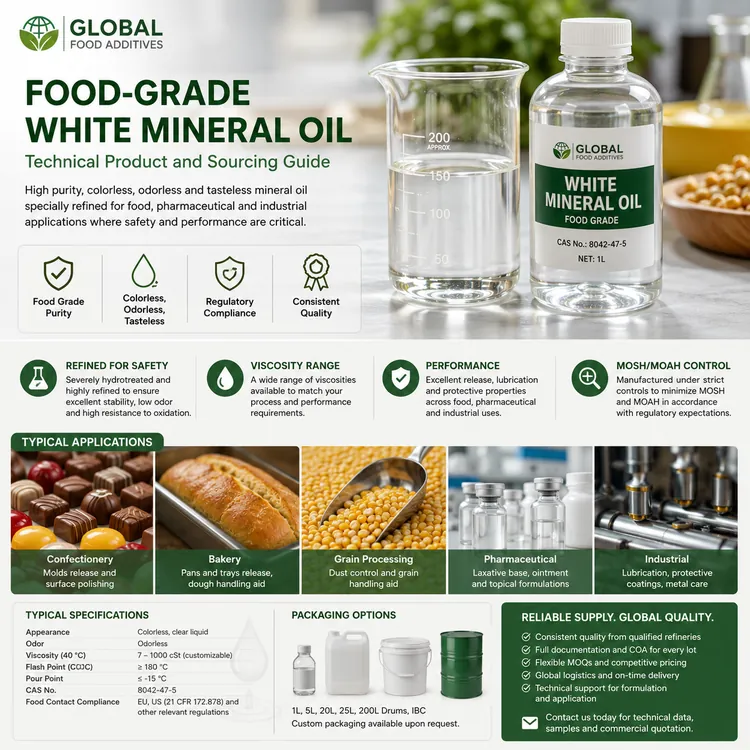
Product identity
| Product name | White Mineral Oil |
|---|---|
| Common synonyms | White oil, liquid paraffin, highly refined mineral oil and paraffinum liquidum |
| Chemical class | Highly refined mixture of liquid saturated petroleum hydrocarbons |
| Hydrocarbon character | Predominantly paraffinic and naphthenic saturated hydrocarbons |
| Common CAS number | 8042-47-5; confirm the exact identifier on the supplier SDS and specification |
| Typical appearance | Clear, colorless and transparent oily liquid |
| Odor and taste | Essentially odorless and tasteless for suitable food or pharmacopeial grades |
| Water solubility | Practically insoluble in water |
| Primary selection property | Kinematic viscosity at a defined test temperature |
| Primary food functions | Release, lubrication, polishing, sealing, protective coating, dust control and permitted process assistance |
| Commercial supply form | Liquid in pails, drums, intermediate bulk containers or bulk tankers |
| E / INS number | Do not assign E905, INS 905 or another number without confirming the exact material, application and destination-market rule |
Potential industrial applications
Application-specific and legally permitted grades may be evaluated for:
- Bakery-pan, belt, cutter and mold release
- Confectionery release, sealing and polishing
- Starch-mold conditioning in confectionery manufacture
- Protective coating of selected raw fruits and vegetables
- Dust control on approved cereal grains
- Protective floats on selected fermentation or brine systems
- Tablet or capsule processing in permitted food applications
- Anti-dusting of approved powdered food ingredients
- Permitted antifoam or defoamer systems
- Food-contact plastics, elastomers, paper or equipment components
- Incidental-contact machinery lubricant formulations
- Wooden food-contact utensil and surface conditioning where allowed
White Mineral Oil compared with related materials
| Material | Physical identity | Key distinction |
|---|---|---|
| White Mineral Oil | Clear liquid mixture of highly refined hydrocarbons | Selected primarily by viscosity, purity and legal use condition |
| Paraffin wax | Solid crystalline petroleum wax | Higher molecular weight and a defined melting or congealing range |
| Microcrystalline wax | Solid, fine-crystal, branched and cyclic hydrocarbon wax | More flexible, adhesive and higher melting than many paraffin waxes |
| Petrolatum | Semi-solid mixture of hydrocarbons | Gel-like consistency and different penetration or congealing specifications |
| Technical mineral oil | Industrial petroleum-derived liquid | May not satisfy food-grade direct-use purity or authorization |
| Vegetable oil release agent | Triglyceride oil from plant sources | Different oxidation, flavor, biodegradability and allergen profile |
| H1 machinery lubricant | Complete lubricant formulated for incidental food contact | May contain base oil, thickeners, antioxidants and other additives; not automatically approved for direct food addition |
| Pharmaceutical liquid paraffin | Mineral oil meeting a pharmacopeial monograph | Pharmacopeial conformity does not by itself authorize every food application or market |
Refining and purification
White Mineral Oil is produced from selected petroleum fractions through severe refining and purification. Modern production may include distillation, solvent treatment, catalytic hydrogenation, hydrocracking, adsorption and polishing steps designed to remove color, odor, sulfur compounds, reactive components and aromatic hydrocarbons.
| Manufacturing stage | Process objective | Buyer relevance |
|---|---|---|
| Feedstock selection | Select a suitable petroleum or synthetic hydrocarbon fraction | Influences viscosity distribution, purity and traceability |
| Distillation | Separate hydrocarbons by volatility and molecular range | Influences flash point, volatility and viscosity |
| Severe hydrogenation | Saturate aromatic structures and remove sulfur- or nitrogen-bearing compounds | Central to color, odor, stability and aromatic-purity control |
| Hydrocracking or catalytic conversion | Convert and refine less desirable molecular structures | Supports high saturation and controlled molecular distribution |
| Adsorptive polishing | Remove residual color bodies and polar impurities | Supports water-white appearance and neutral sensory character |
| Fractionation | Create viscosity-specific commercial grades | Determines spraying, pumping, film formation and migration |
| Final filtration | Control particles and visible contamination | Important for spray nozzles, polished surfaces and clear products |
| Dedicated packing | Protect the refined oil from contamination | Tank history, hoses, seals and filling hygiene require control |
Grade selection by viscosity
White Mineral Oil is commonly traded in low-, medium- and high-viscosity grades. The commercial grade must be identified by a measured kinematic viscosity at a specified temperature rather than by an informal label such as light or heavy.
| Grade direction | Typical operating behavior | Potential application fit |
|---|---|---|
| Low viscosity | Easier pumping, finer atomization and thinner film formation | Fine spray, light coatings, low-temperature dosing and rapid surface spreading |
| Medium viscosity | Balance of pumpability, film retention and controlled migration | General release, confectionery polishing and selected protective coatings |
| High viscosity | Thicker film, reduced drain-off and higher pumping resistance | Persistent release films, heavy-duty coating or specified grain treatment |
| ISO-defined viscosity grade | Viscosity controlled under an agreed industrial classification | Equipment lubrication, grain treatment or customer-specific process controls |
| Pharmacopeial grade | Conforms to a specified USP–NF, Ph. Eur., BP or other monograph | Applications requiring both pharmacopeial and food-use review |
Viscosity-temperature behavior
Mineral-oil viscosity decreases as temperature increases. This affects pump output, spray droplet size, nozzle pressure, film thickness, leakage, drain-off and the amount retained on the food or processing surface.
Cold-operation risks
- Higher pumping pressure
- Reduced atomization
- Larger droplets and uneven coverage
- Slow transfer from drums or tanks
- Feeder or flow-meter inaccuracy
- Excessive coating thickness
High-temperature risks
- Reduced film thickness
- Increased drainage or migration
- Greater leakage through seals
- Changes in spray pattern
- Higher vapor or mist formation
- Reduced retention on hot surfaces
The supplier should provide viscosity data at the operating temperature or a viscosity-temperature curve. Heating should be limited to the minimum required for flow and must remain safely below the relevant flash point and equipment-design limits.
Direct food use versus food-contact use
| Use category | Example | Approval requirement |
|---|---|---|
| Direct food additive | Mineral oil intentionally present in or on the food | Exact food category, function and maximum level must be authorized |
| Processing aid | Release or process function with limited residual presence | Processing-aid definition and residual technical effect must be reviewed locally |
| Food-contact-material component | Component of rubber, paper, polymer, coating or adhesive | Relevant indirect-additive or food-contact-material regulation |
| Incidental-contact lubricant | Lubricant in machinery where incidental contact can occur | Complete lubricant formulation must meet the applicable incidental-contact criteria |
| Non-contact industrial lubricant | Closed gearbox outside the food-contact zone | Industrial specification; contamination-prevention controls still required |
| Pharmaceutical or cosmetic use | Excipient, topical base or personal-care ingredient | Separate monographs and regulations; not evidence of food-use authorization |
United States direct-use conditions
Current 21 CFR 172.878 permits qualifying White Mineral Oil in specific food applications and establishes use limitations. The table below is a technical summary; the current regulation and all cross-referenced provisions must be reviewed before use.
| Permitted U.S. application | Regulatory limitation |
|---|---|
| Release, binding and lubrication in capsules or tablets containing flavor, spice, condiment or nutrient concentrates for addition to food, excluding confectionery | Not more than 0.6% of the capsule or tablet |
| Release, binding and lubrication in capsules or tablets containing food for special dietary use | Not more than 0.6% of the capsule or tablet |
| Protective float on fermentation fluids during vinegar and wine manufacture | Good manufacturing practice |
| Food defoamer | Subject to the applicable U.S. defoamer regulation |
| Bakery-product release agent and lubricant | Not more than 0.15% of the bakery product |
| Release agent in dehydrated fruits and vegetables | Not more than 0.02% of the dehydrated product |
| Release agent in egg-white solids | Not more than 0.1% of the egg-white solids |
| Protective coating on raw fruits and vegetables | Good manufacturing practice |
| Component of a hot-melt coating on frozen meat | Not more than 0.095% of the meat |
| Protective float on pickle-curing brine | Good manufacturing practice |
| Confectionery molding starch | Not more than 0.3% of the molding starch |
| Release, binding and lubrication in yeast manufacture | Not more than 0.15% of the yeast |
| Anti-dusting agent in sorbic acid for food use | Not more than 0.25% of the sorbic acid |
| Release, sealing and polishing in confectionery manufacture | Not more than 0.2% of the confectionery |
| Dust-control treatment of wheat, corn, soybean, barley, rice, rye, oats or sorghum | Not more than 0.02% by weight of grain |
| Dust-control treatment of rice using ISO 100-viscosity oil | Not more than 0.08% by weight of rice grain |
Indirect food-contact applications
In the United States, 21 CFR 178.3620 addresses mineral oil used as a component of nonfood articles intended for food contact. White Mineral Oil meeting the direct-food purity specification may be used in qualifying nonfood articles subject to the applicable limitations.
The indirect-food-contact regulation also describes technical white mineral oil for certain nonfood articles. Technical white mineral oil should not be confused with the more highly controlled material used directly in or on food under 21 CFR 172.878.
Review current 21 CFR 178.3620
Bakery release engineering
White Mineral Oil can reduce adhesion between dough or baked product and pans, molds, knives, dividers or other approved surfaces. Performance depends on viscosity, surface temperature, spray pattern, film thickness, food composition and equipment condition.
Potential benefits
- Reduced pan and mold sticking
- Improved product release consistency
- Reduced damaged-product rate
- Cleaner cutting or dividing
- Lower mechanical release force
- More stable line throughput
- Reduced buildup on selected surfaces
- Controlled surface gloss where appropriate
Potential process failures
- Uneven spray coverage
- Excessive oil pickup
- Surface spotting
- Reduced crust adhesion
- Oil migration into packaging
- Slippery conveyors or floors
- Nozzle blockage from contaminated oil
- Regulatory over-application
Bakery release-system controls
- Confirm that the exact direct-use application and maximum level are permitted.
- Select viscosity according to surface temperature, pump and nozzle.
- Filter the oil through a supplier- or equipment-approved filtration system.
- Calibrate the spray system by mass applied per unit time or product area.
- Verify transverse and longitudinal spray uniformity.
- Measure actual oil pickup on the product rather than relying only on pump settings.
- Monitor release performance, residue buildup and rejected-product rate.
- Revalidate after changing viscosity grade, nozzle, line speed or product formulation.
Confectionery release and polishing
In authorized confectionery processes, White Mineral Oil can reduce sticking, condition molding starch, support sealing and provide surface gloss. The target should be a uniform microscopic film rather than visible oil.
| Process | Technical objective | Control priority |
|---|---|---|
| Starch molding | Improve mold release and starch flow | Oil level in starch, mold definition and starch recycling |
| Pan polishing | Develop gloss and reduce pieces sticking together | Fine dosing, product temperature and polishing time |
| Sealing | Reduce moisture exchange and surface tack | Film continuity, package compatibility and flavor neutrality |
| Equipment release | Reduce adhesion on selected molds or process surfaces | Food pickup, sanitation and legal use level |
| Tablet manufacture | Support release, binding or lubrication in permitted products | Dose uniformity, tablet hardness, disintegration and legal scope |
Excessive application can produce oily mouthfeel, visible spotting, flavor suppression, package staining, poor coating adhesion or failure to meet the legal maximum. Apply the minimum quantity necessary to achieve the intended effect.
Fruit and vegetable protective coatings
Where specifically permitted, White Mineral Oil may be applied as a thin protective coating to selected raw fruits and vegetables. The coating can reduce surface moisture loss and improve appearance, but it must not conceal deterioration or replace hygienic handling and cold-chain control.
- Verify that the commodity and destination market permit the coating.
- Apply only to clean, sound and appropriately prepared produce.
- Control oil temperature and viscosity during spraying or brushing.
- Measure application uniformity and surface retention.
- Confirm that coating does not restrict gas exchange excessively.
- Evaluate gloss, tack, flavor, package interaction and consumer handling.
- Conduct storage and transport trials under commercial humidity and temperature conditions.
- Verify any required labeling or post-harvest-treatment declaration.
Grain dust-control engineering
Approved mineral-oil treatment can reduce airborne dust during grain transfer, handling and storage. Uniform low-level application is essential because over-treatment can affect appearance, processing and legal compliance.
System design factors
- Grain type and moisture
- Legal maximum application level
- Required viscosity grade
- Ambient and grain temperature
- Spray-nozzle droplet distribution
- Conveyor and transfer-point layout
- Mass-flow measurement
- Mixing and coating uniformity
Verification endpoints
- Dust reduction at transfer points
- Oil addition per metric ton
- Uniformity across the grain stream
- Visible surface condition
- Storage behavior
- Milling and downstream-processing performance
- Residue and compliance records
- Worker exposure and housekeeping improvement
For very low treatment rates, use a calibrated mass-flow-controlled dosing system rather than manual volume estimation.
Fermentation and brine floats
A continuous oil layer can reduce access of air, evaporation and external contamination in selected traditional fermentation or brine applications. The system must be designed so that the oil remains a controlled surface layer and does not interfere with fermentation, withdrawal, cleaning or finished-product quality.
- Confirm that the use is permitted for the exact product.
- Use only the minimum quantity needed to maintain coverage.
- Control vessel geometry and exposed liquid-surface area.
- Prevent mixing of the float into the fermentation fluid.
- Inspect for gaps, contamination and emulsification.
- Define removal or separation before downstream processing.
- Validate cleaning procedures for the vessel and transfer lines.
- Monitor any effect on aroma, yeast ecology and fermentation performance.
Antifoam and defoamer systems
White Mineral Oil can form part of a legally permitted defoamer system. Performance depends on droplet dispersion, spreading, hydrophobic particles, emulsifiers, dosage point and process shear. Straight mineral oil and formulated antifoam products should not be treated as equivalent.
| Antifoam factor | Technical effect | Control requirement |
|---|---|---|
| Oil viscosity | Influences spreading, dispersion and persistence | Select against foam type and process temperature |
| Droplet size | Controls transport to the foam lamella | Validate premixing, emulsification or direct dosing |
| Hydrophobic particles | Can improve film rupture in formulated antifoams | Each component must be permitted and correctly declared |
| Emulsifier | Controls dispersibility and storage stability | Balance rapid dispersion against excessive stabilization |
| Addition point | Determines distribution and response time | Add before or at the foam-generating stage as validated |
| Overdose | May create oiling, haze or downstream separation | Use the minimum effective concentration |
MOSH, MOAH and aromatic-purity management
Mineral-oil-hydrocarbon control is an important purchasing issue. Mineral-oil saturated hydrocarbons are commonly described as MOSH, while mineral-oil aromatic hydrocarbons are described as MOAH. Highly refined White Mineral Oil is designed to be predominantly saturated and to meet stringent aromatic-purity tests.
Because White Mineral Oil itself contributes to the MOSH analytical fraction, a total-MOSH result does not distinguish intentional, authorized oil from contamination arising from packaging, printing inks, machinery lubricants or environmental sources. Buyers should define the purpose of testing, carbon-number range, sample preparation, method, detection limit and interpretation before setting a contract requirement.
| Control area | Technical consideration |
|---|---|
| MOAH | Establish an agreed limit or non-detection criterion using a defined method and reporting threshold |
| UV absorbance | Supports control of ultraviolet-absorbing aromatic impurities |
| Polycyclic aromatic compounds | Review applicable pharmacopeial, food or customer purity tests |
| MOSH carbon range | Characterize the intended oil and distinguish it from other hydrocarbon sources where possible |
| Laboratory method | Confirm chromatography, cleanup, integration, interferences and limits of quantification |
| Packaging contribution | Review recycled fiber, printing inks, adhesives and transport packaging |
| Plant lubricant contribution | Map food-contact risk points and distinguish process lubricant sources |
| Cross-contamination | Use dedicated or validated tanks, hoses and filling systems |
Industrial specification review matrix
A purchase specification should identify the exact grade and intended regulatory use. Typical physical-property values should be separated from mandatory purity and release criteria.
| Specification area | What to define or verify | Industrial importance |
|---|---|---|
| Product identity | White Mineral Oil, commercial grade and applicable CAS identifier | Prevents substitution with wax, petrolatum or technical oil |
| Regulatory grade | Direct-food, pharmacopeial, food-contact or incidental-contact status | Determines the permitted application |
| Appearance | Clear, colorless liquid free from visible matter | Supports identity and contamination detection |
| Color | Saybolt, APHA or another defined color method | Important for clarity, refining quality and product appearance |
| Odor and taste | Essentially neutral under a defined sensory procedure | Prevents off-flavor in coated or polished food |
| Kinematic viscosity | Controlled range at 40°C, 100°F or another specified temperature | Primary grade, pumping and film-formation parameter |
| Viscosity index | Grade-specific value where operationally important | Describes viscosity change across temperature |
| Density or specific gravity | Value at a defined temperature | Required for inventory, metering and mass-volume conversion |
| Refractive index | Controlled range at a defined temperature | Supports identity and lot consistency |
| Flash point | Minimum using a specified closed- or open-cup method | Important for heating, storage and fire-risk assessment |
| Pour point | Maximum or typical low-temperature flow limit | Supports cold-storage and winter-pumping design |
| Volatility | Distillation range or evaporative-loss control where relevant | Influences misting, odor, process loss and film persistence |
| Readily carbonizable substances | Passes applicable pharmacopeial or regulatory test | Indicates absence of reactive impurities |
| Sulfur compounds | Passes applicable compendial test | Supports refining purity and sensory neutrality |
| Ultraviolet absorbance | Conformance to applicable food or pharmacopeial limits | Controls aromatic and polycyclic impurities |
| MOAH | Method-defined limit, carbon range and reporting threshold | Supports contemporary aromatic-hydrocarbon risk management |
| Acid value | Maximum under a defined method | Supports stability and contamination control |
| Saponification value | Low or non-detectable under the applicable test | Detects contamination by fatty oils or ester materials |
| Water content | Maximum water by Karl Fischer or an agreed method | Protects clarity, storage and equipment performance |
| Particulate cleanliness | Visual, filtration or particle-count requirement where needed | Prevents nozzle blockage and visible defects |
| Elemental impurities | Applicable lead, arsenic, nickel or other metal limits | Supports food-safety and customer compliance |
Certificate-of-analysis review
Identity and physical properties
- Exact product name and viscosity grade
- Lot or batch number
- Appearance and color
- Kinematic viscosity and test temperature
- Density or specific gravity
- Refractive index where specified
- Flash point or pour point where contractual
- Manufacture and expiry or retest dates
Purity and regulatory properties
- UV-absorbance or pharmacopeial conformity
- Readily carbonizable substances
- Sulfur-compound test
- MOAH or aromatic-purity data where required
- Acid and saponification values where specified
- Water and particulate cleanliness
- Authorized quality release
- Confirmation that results represent the shipped lot
Supplier qualification
White Mineral Oil supplier approval should cover crude or synthetic feedstock control, severe refining, contamination prevention, dedicated storage, tanker history, analytical capability and change management.
Manufacturing and quality information
- Legal manufacturer and refinery location
- Petroleum or synthetic feedstock description
- Hydrogenation or hydrocracking process
- Fractionation and viscosity-grade controls
- UV-absorbance and aromatic-purity controls
- Tank, line, hose and filling-system segregation
- Food-safety or GMP program
- Applicable ISO, GMP or pharmacopeial certification
- Traceability from refinery batch to delivered package
- Laboratory method validation
- Deviation, complaint and CAPA system
- Change-notification policy
Supply-chain controls
- Dedicated or prior-cargo-controlled tanker transport
- Food-compatible hoses, seals and pumps
- Tank cleaning and inspection records
- Seal-number control for bulk shipments
- Container and drum food-contact compliance
- Tamper-evident closure where required
- Emergency contamination and recall plan
- Safety stock and alternate production-site availability
- Seasonal viscosity and cold-flow planning
- Pre-shipment sample availability
Documents to request before approval
- Current product specification or technical data sheet
- Representative certificate of analysis
- Batch-specific certificate of analysis for every shipment
- Current safety data sheet
- Direct-food, food-contact or incidental-contact regulatory statement
- Applicable USP–NF, Ph. Eur., BP or other monograph declaration
- Refining-process or highly refined oil statement
- UV-absorbance and aromatic-purity compliance statement
- MOSH/MOAH data and analytical method where required
- Polycyclic-aromatic-compound statement
- Antioxidant declaration, including identity and level if used
- Allergen and cross-contact declaration
- GMO statement
- Animal-origin and BSE/TSE statement where requested
- Halal and Kosher certificates where required
- Country-of-origin and legal-manufacturer declaration
- Shelf-life, retest and storage statement
- Packaging, drum, IBC or tanker specification
- Food-contact declaration for package and liner
- Change-control and advance-notification commitment
Antioxidants and formulation ingredients
Some White Mineral Oil grades may contain an authorized antioxidant at the minimum level required to produce the intended stability effect. Others are supplied without intentionally added antioxidant.
- Request a declaration of every intentionally added antioxidant.
- Confirm that the antioxidant is permitted for the intended market and use.
- Verify whether the antioxidant affects UV-absorbance testing.
- Review potential labeling or customer clean-label implications.
- Do not assume that two oils with the same viscosity have the same additive package.
- Confirm that no color, fragrance or technical additive is present unless specifically approved.
Pumping, metering and spray-system engineering
| Equipment area | Engineering consideration | Recommended control |
|---|---|---|
| Storage tank | Cleanliness, water exclusion and previous product | Dedicated or validated food-compatible tank with sealed vents |
| Transfer pump | Viscosity range and flow stability | Use a pump designed for the grade and temperature |
| Flow meter | Density and viscosity affect accuracy | Calibrate against mass delivered under operating conditions |
| Spray nozzle | Droplet size, cone angle and blockage risk | Match nozzle, pressure and oil temperature |
| Heated line | Lower viscosity but increased thermal and fire risk | Use controlled trace heating with high-temperature protection |
| Filter | Protects valves and nozzles from particles | Define filter material, rating and change interval |
| Flexible hose | Potential swelling, extraction or flavor contamination | Validate elastomer compatibility and food-contact status |
| Return loop | Can heat, aerate or contaminate the oil | Minimize unnecessary recirculation and dead legs |
Mass and volume conversion
Mineral-oil dosing should preferably be controlled by mass. Where the system meters by volume, use the lot-specific or specification density at the actual operating temperature.
Application rate: percentage on product = oil mass ÷ treated product mass × 100.
Density and viscosity change with temperature, so calibrate the system under normal production conditions.
Compatibility with equipment and packaging
White Mineral Oil is compatible with many metals and polymers, but it can soften, swell or extract components from certain elastomers, adhesives and plastics. Compatibility depends on oil grade, temperature and contact time.
- Validate pump seals, gaskets and valve seats.
- Review hose-liner composition and extraction resistance.
- Confirm drum, IBC and cap-liner food-contact compliance.
- Evaluate migration into labels, adhesives and printed packaging.
- Check package staining and oil transmission during shelf life.
- Avoid unapproved recycled or previously used containers.
- Confirm that sampling equipment does not introduce plasticizer or oil.
- Use clean, dry and dedicated transfer fittings where practical.
Storage and warehouse handling
- Store in sealed, correctly labeled food-compatible containers.
- Protect the product from water, dust, cleaning chemicals and foreign oils.
- Keep drums and IBCs closed except during controlled dispensing.
- Store away from strong oxidizing agents and incompatible chemicals.
- Avoid unnecessary heating and prolonged high-temperature storage.
- Apply FEFO inventory control using the supplier's expiry or retest date.
- Inspect seals, closures, drum condition and product clarity before use.
- Segregate food-grade material from technical lubricants and maintenance oils.
- Use dedicated pumps or a validated line-clearance procedure.
- Record every internal transfer to preserve lot traceability.
Occupational and environmental handling
White Mineral Oil generally has low volatility at ambient temperature, but mist can form during high-pressure spraying, heated operation or mechanical agitation. Spills create a serious slip hazard.
Worker controls
- Follow the current supplier safety data sheet.
- Control mist at heated or high-pressure application points.
- Use suitable eye and skin protection during transfer.
- Avoid prolonged contact with contaminated clothing.
- Keep walking surfaces clean and dry.
- Use safe procedures for heated oil and equipment.
- Control ignition sources according to flash-point assessment.
Spill and waste controls
- Stop the source without creating additional risk.
- Contain spills before they reach drains or soil.
- Use compatible absorbent material.
- Prevent oily absorbent from entering food or feed streams.
- Dispose of waste under local environmental requirements.
- Clean residual film to remove slip risk.
- Investigate and document contamination of food-contact areas.
Cleaning and sanitation
Mineral-oil films are water insoluble and can persist on tanks, hoses, conveyors and floors. Cleaning programs should use suitable temperature, alkaline detergent, surfactant action and mechanical energy.
- Drain or physically recover as much free oil as possible.
- Pre-rinse only where the cleaning design prevents uncontrolled oil spreading.
- Apply a validated oil-removing detergent at the approved concentration and temperature.
- Provide sufficient turbulence, brushing or mechanical action.
- Rinse until detergent and visible oil are removed.
- Inspect difficult areas, including seals, spray manifolds and dead legs.
- Verify cleaning using an appropriate visual, swab, rinse or surface test.
- Prevent recovered oil or cleaning water from contaminating food, packaging or the environment.
Shelf life and stability
Highly refined White Mineral Oil is generally chemically stable when protected from contamination, excessive heat, strong oxidants and prolonged exposure to unsuitable storage conditions. Shelf life remains supplier and package specific.
Incoming stability checks
- Clarity and absence of haze
- Color
- Odor
- Kinematic viscosity
- Water or sediment
- Acid value where specified
- Package integrity
- Lot and date verification
Application stability checks
- Spray and pumping performance
- Film retention
- Surface gloss
- Release performance
- Odor or flavor neutrality
- Package staining or migration
- Oxidative or thermal change
- Finished-product compliance through shelf life
Regulatory positioning outside the United States
International treatment of White Mineral Oil is not uniform. A petroleum- derived glazing agent, mineral oil, paraffin, microcrystalline wax and petrolatum may have separate identities, additive numbers and use conditions.
- Do not assume that U.S. direct-food authorization applies in another country.
- Do not automatically declare White Mineral Oil as E905 without verifying the exact EU or national identity and authorization.
- Confirm whether the product is treated as an additive, processing aid, glazing agent or food-contact material.
- Verify the permitted food category, maximum level and purity criteria.
- Review additive carry-over and processing-aid exemptions separately.
- Confirm ingredient-list wording and any surface-treatment declaration.
- Check whether pharmacopeial or food-chemical specifications are mandatory.
- Obtain written supplier compliance for the destination market and intended use.
Commercial comparison method
Quotations should be compared using the exact viscosity and regulatory grade required by the process. A lower-cost technical oil is not an acceptable substitute for an authorized direct-food grade.
| Comparison factor | Commercial question |
|---|---|
| Regulatory status | Is the exact product approved for the intended direct or indirect use? |
| Viscosity | Are values reported at the same temperature and by an equivalent method? |
| Aromatic purity | Are UV, MOAH or pharmacopeial controls suitable for the customer? |
| Application rate | What mass of oil is required per metric ton or product unit? |
| Process yield | Does the grade reduce rejects, sticking, downtime or product loss? |
| Low-temperature flow | Will heating or winterization equipment be required? |
| Package format | Does the drum, IBC or bulk delivery match consumption and storage? |
| Bulk logistics | Are tanker cleaning, previous cargo and dedicated-hose controls documented? |
| Incoming testing | Will viscosity, MOAH, UV or sensory testing be required per lot? |
| Documentation | Are all regulatory, pharmacopeial and origin documents included? |
| Supply continuity | Are backup refinery, safety stock and emergency delivery available? |
Include dosing equipment, heating, filtration, quality testing, cleaning, waste handling and any rejected-product reduction in the total-cost model.
Recommended sample and approval workflow
- Define whether the use is direct food, processing aid, coating, food-contact material or incidental-contact lubrication.
- Confirm the destination-market legal status and maximum level.
- Define viscosity, color, flash point, aromatic purity and other critical specifications.
- Review the refinery, grade, antioxidants, transport and packaging documentation.
- Obtain a representative sample from the intended production site.
- Verify identity, viscosity, clarity, odor and critical purity properties.
- Test pumping, metering, spraying and filtration under representative temperatures.
- Conduct an application-rate trial around the minimum effective dose.
- Measure product pickup, release, gloss, migration and sensory neutrality.
- Complete an industrial trial at normal line speed and batch size.
- Evaluate finished-product packaging and shelf-life performance.
- Approve the exact manufacturer, refinery, grade, specification, package and transport route before routine purchasing.
RFQ information required for an accurate quotation
| RFQ category | Recommended information |
|---|---|
| Intended use | Direct food, release, coating, polishing, dust control, food-contact component or lubricant base |
| Food or process | Bakery, confectionery, grain, produce, fermentation, tablet or other application |
| Destination market | Country and any customer-specific standard |
| Required regulatory grade | FDA direct-food, food-contact, USP–NF, Ph. Eur., BP, FCC or other requirement |
| Viscosity | Required kinematic-viscosity range and measurement temperature |
| Physical properties | Density, color, flash point, pour point or refractive-index requirements |
| Purity requirements | UV absorbance, sulfur, carbonizable substances, MOAH, PAH or other controls |
| Antioxidant policy | Antioxidant-free or identity and maximum level of permitted antioxidant |
| Operating temperature | Storage, pumping, spray, coating and product-surface temperatures |
| Application rate | Target grams per product unit or kilograms per metric ton |
| Quantity | Sample, trial order, commercial order and estimated annual demand |
| Packaging | Pail, drum, IBC or bulk-tanker requirement |
| Destination | Country, port, terminal or full delivery location |
| Delivery term | Requested Incoterm and precisely named place |
| Shipment schedule | Sample deadline, first commercial delivery and recurring demand |
| Documents | CoA, specification, SDS, refinery, regulatory, MOSH/MOAH, pharmacopeial, Halal and Kosher documents |
| Approval requirements | Sample testing, audit, pre-shipment sample, tanker inspection or third-party analysis |
How to request White Mineral Oil
Send the intended food or food-contact use, destination country, regulatory grade, viscosity range and test temperature, required purity standard, MOAH or ultraviolet-absorbance requirements, operating temperature, target application rate, quantity, packaging, Incoterm, shipment schedule and document list. Where available, include your existing specification, product label or redacted certificate of analysis so supplier options can be compared on an equivalent basis.
Frequently asked questions
What is White Mineral Oil?
White Mineral Oil is a highly refined mixture of liquid, predominantly saturated paraffinic and naphthenic hydrocarbons. Suitable grades are clear, colorless, essentially odorless and manufactured to strict purity requirements.
Is White Mineral Oil solid or liquid?
It is liquid at ordinary handling temperatures. Solid paraffin wax, microcrystalline wax and semi-solid petrolatum are different product families.
Is White Mineral Oil edible?
Only a qualifying food-grade product may be used in specifically authorized food applications and at the permitted level. A technical or machinery-grade mineral oil must not be treated as a food ingredient.
What is the difference between light and heavy White Mineral Oil?
The main difference is viscosity. Lower-viscosity grades flow and atomize more easily, while higher-viscosity grades form a thicker, more persistent film. Exact values must be stated at a defined test temperature.
Why is viscosity temperature important?
Mineral oil becomes thinner as temperature rises. A value at 40°C, 100°F or 100°C represents a different condition and cannot be compared directly without supporting data.
Can White Mineral Oil be used as a bakery release agent?
It can be used in authorized markets and applications. In the United States, current 21 CFR 172.878 permits qualifying White Mineral Oil as a bakery release agent and lubricant up to the stated regulatory limit.
Can it be used to polish confectionery?
Qualifying White Mineral Oil may be used for release, sealing and polishing in authorized confectionery applications. Dosage, product category and destination-market requirements must be verified.
Can it be used for grain dust control?
Certain U.S. grain treatments are listed in 21 CFR 172.878 with defined maximum application levels. Equipment must provide accurate, uniform, mass-controlled dosing.
Is food-grade White Mineral Oil the same as H1 lubricant?
No. H1 refers to a complete lubricant intended for incidental food contact. Its ingredients and use conditions may differ from a direct- food White Mineral Oil.
What are MOSH and MOAH?
MOSH are mineral-oil saturated hydrocarbons, and MOAH are mineral-oil aromatic hydrocarbons. Highly refined White Mineral Oil is primarily saturated, while aromatic purity should be controlled through suitable specifications and analytical methods.
Why is UV absorbance tested?
Ultraviolet-absorbance testing helps control UV-absorbing aromatic and polycyclic impurities. The applicable method and limits depend on the regulatory or pharmacopeial grade.
Does White Mineral Oil oxidize?
Highly refined mineral oil is comparatively stable, but excessive heat, contamination and strong oxidants can degrade quality. Antioxidants may be present in some grades and should be declared.
Does White Mineral Oil have an E number?
A universal E-number declaration should not be assumed. Petroleum- derived oils, waxes and glazing agents have different legal identities and authorizations. Verify the exact destination-market rule.
Can USP mineral oil automatically be used in food?
No. Pharmacopeial compliance is a purity designation. The specific food category, function and use level must also be authorized under the relevant food law.
Which specification values are most important?
Important parameters include regulatory grade, kinematic viscosity, density, color, odor, flash point, pour point, UV absorbance, sulfur compounds, readily carbonizable substances, MOAH, water and particulate cleanliness.
How should two offers be compared?
Compare regulatory status, viscosity at an equivalent temperature, aromatic purity, application dose, package, transport controls, testing requirements and delivered cost—not price per kilogram alone.
Can Global Food Additives source different grades?
Global Food Additives can review low-, medium- and high-viscosity food-grade, pharmacopeial and food-contact White Mineral Oil options against the application, specification, quantity and destination.
Send your White Mineral Oil specification and application requirements.
For an accurate comparison, include the intended direct-food or food-contact use, destination market, viscosity range and test temperature, regulatory or pharmacopeial grade, aromatic-purity requirements, operating temperature, application rate, quantity, packaging, Incoterm and document list. Our team will review your inquiry and respond from orders@foodgradeadditives.com .
Your message has been received. You will be redirected to the home page.