
Food-Grade Whey Protein Isolate
Whey Protein Isolate, commonly abbreviated as WPI, is a highly purified milk-protein ingredient used for protein enrichment and functional performance in beverages, nutrition products, bakery, dairy foods, confectionery, meat systems and specialized formulations. Commercial grades can differ substantially in native-protein content, lactose, minerals, phospholipids, heat stability, solubility, gel strength, foaming, emulsification, flavor and instant-dispersion behavior. Industrial selection should therefore be based on the complete specification and application trial rather than protein percentage alone.
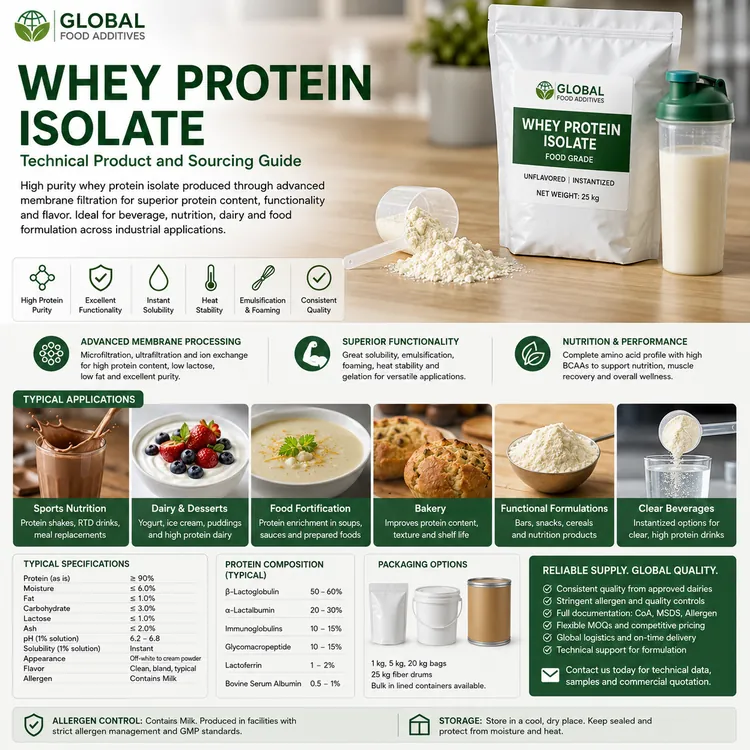
Product identity
| Product name | Whey Protein Isolate |
|---|---|
| Common abbreviation | WPI |
| Ingredient family | Milk-derived whey protein |
| Typical protein benchmark | Common commercial isolates contain at least approximately 90% protein on a dry-matter basis; supplier limits and test methods vary |
| Principal proteins | Beta-lactoglobulin, alpha-lactalbumin, bovine serum albumin, immunoglobulins and other whey-derived protein fractions |
| Additional protein fraction | Glycomacropeptide may be present in cheese-whey-derived grades and differs according to the source stream and process |
| Primary functions | Protein enrichment, emulsification, foaming, heat-set gelation, water binding and texture development |
| Typical appearance | White to light cream free-flowing powder |
| Typical commercial forms | Standard spray-dried powder, agglomerated powder, instantized powder or lecithinated powder |
| Major allergen | Milk |
| E / INS number | Not normally identified by a conventional E or INS additive number; verify destination-market ingredient terminology |
Industrial application fit
Application-specific WPI grades may be selected for:
- Ready-to-mix nutrition powders
- Ready-to-drink high-protein beverages
- Clear acidic protein drinks
- Sports and active-nutrition products
- Clinical and specialized nutrition products
- Protein bars and high-protein snacks
- Dairy drinks, yogurt and desserts
- Ice cream and frozen desserts
- Bakery, cake, biscuit and bread products
- Whipped toppings and aerated foods
- Processed meat, poultry and seafood products
- Emulsified sauces and dressings
- Confectionery and protein inclusions
- Plant-and-dairy hybrid formulations
Whey-protein composition
Whey Protein Isolate is not one purified molecule. It is a mixture of milk-serum proteins whose relative proportions depend on whether the starting material is cheese whey, casein whey or a directly filtered milk stream. Processing can also change protein structure without changing the declared total protein.
| Protein fraction | General functional relevance | Industrial consideration |
|---|---|---|
| Beta-lactoglobulin | Major bovine whey protein with strong heat-induced aggregation and gelation potential | Influences heat stability, gel strength, fouling and sulfur-note development |
| Alpha-lactalbumin | Compact calcium-binding whey protein with nutritional and functional relevance | Relative level may be important in fractionated or specialized products |
| Bovine serum albumin | Minor protein with heat-sensitive functional behavior | Normally evaluated as part of the total whey-protein system |
| Immunoglobulins | Minor protein fraction whose retention depends on source and heat treatment | Bioactive positioning requires grade-specific evidence and compliant claims |
| Glycomacropeptide | Rennet-derived casein fragment present in many cheese-whey streams | May differ between cheese-whey and native milk-serum-protein products |
| Residual phospholipids | Can influence emulsification, flavor, oxidation and membrane performance | Level is affected by whey clarification and microfiltration |
| Residual lactose | Contributes carbohydrate, sweetness and Maillard-browning risk | WPI is generally low in lactose but is not automatically lactose-free |
| Minerals | Influence ionic strength, heat stability, flavor and gelation | Calcium, sodium, potassium, phosphorus and ash should be reviewed for sensitive applications |
Industrial production process
Commercial WPI is commonly manufactured from clarified sweet whey or from milk-derived serum protein. The process is designed to retain protein while removing most lactose, water, fat and soluble minerals.
| Production stage | Process objective | Potential effect on final WPI |
|---|---|---|
| Whey or milk-stream sourcing | Obtain a controlled dairy-protein feed stream | Influences protein profile, flavor, minerals, glycomacropeptide content and traceability |
| Clarification | Remove curd fines, suspended matter and process contaminants | Supports membrane operation, color and microbiological control |
| Fat separation | Reduce residual whey fat and phospholipid-rich material | Influences flavor stability, protein purity and emulsification |
| Microfiltration | Remove bacteria, residual fat, casein particles or selected suspended components | Can improve microbial quality, clarity and functional consistency |
| Ultrafiltration | Retain proteins while allowing water, lactose and smaller dissolved components to permeate | Increases protein concentration and reduces non-protein solids |
| Diafiltration | Wash retained protein with water to remove additional lactose and minerals | Supports higher protein purity and lower lactose or ash |
| Ion exchange where used | Separate protein from other charged components | Can produce high protein purity with a mineral and protein-fraction profile different from membrane-only WPI |
| Concentration | Increase solids before drying | Thermal history and residence time influence denaturation and flavor |
| Pasteurization | Control vegetative microorganisms | Time-temperature exposure may change native-protein functionality |
| Spray drying | Convert concentrated liquid protein into stable powder | Influences moisture, particle structure, solubility and scorched particles |
| Agglomeration | Create larger porous particles with improved wetting | Improves dispersibility but changes bulk density and package volume |
| Lecithination | Modify particle surfaces for improved water wetting | Lecithin source affects labeling, allergen review and instant performance |
| Sieving and packing | Control particle distribution, foreign material and lot identity | Supports flowability, food safety, traceability and logistics |
Membrane-filtered versus ion-exchange WPI
| Process route | Potential advantages | Points to evaluate |
|---|---|---|
| Ultrafiltration and diafiltration | Physical separation with broad retention of whey-protein fractions | Residual minerals, phospholipids, lactose and membrane-process consistency |
| Microfiltration-supported process | Improved removal of fat, bacteria and suspended particles | Membrane pore size, processing temperature and protein yield |
| Ion-exchange process | High protein purity and controlled mineral removal | Protein-fraction distribution, pH exposure, salts and sensory profile |
| Combined process | Customized purity and functionality | Complete manufacturing description and lot-to-lot consistency |
WPI compared with related protein ingredients
| Ingredient | General composition | Key distinction |
|---|---|---|
| Whey Protein Isolate | High-purity whey protein with low residual lactose, fat and non-protein solids | Selected for high protein density and specialized functionality |
| Whey Protein Concentrate | Whey protein with more residual lactose, minerals and fat, depending on grade | Often lower cost but lower protein concentration than WPI |
| Hydrolyzed Whey Protein | Whey protein enzymatically broken into smaller peptides | Different flavor, bitterness, osmolarity and functional behavior |
| Native Whey Protein | Milk-serum proteins separated directly from milk rather than collected from cheese whey | Different source profile and typically lower glycomacropeptide content |
| Milk Protein Isolate | Contains both casein and whey proteins in a milk-like ratio | Different hydration, heat stability, gelation and nutritional composition |
| Caseinate | Soluble salt of acid-precipitated casein | Strong emulsification and water binding with different heat and acid behavior |
| Micellar Casein Concentrate | Casein-rich milk protein retaining micellar structure | Slower hydration and different thickening and coagulation properties |
| Microparticulated Whey Protein | Heat-aggregated whey-protein particles engineered for creaminess | Used primarily for fat-like mouthfeel rather than maximum solubility |
Functional-property overview
| Function | Protein mechanism | Industrial application |
|---|---|---|
| Protein enrichment | High concentration of milk-derived protein solids | Nutrition powders, beverages, bars and fortified foods |
| Solubility | Hydrated proteins disperse at the molecular or colloidal level under suitable conditions | Ready-to-drink and ready-to-mix products |
| Emulsification | Protein adsorbs at oil-water interfaces and forms a protective interfacial film | Sauces, beverages, emulsified meat and nutrition products |
| Foaming | Protein unfolds at the air-water interface and stabilizes bubbles | Whipped products, aerated desserts and bakery |
| Heat-set gelation | Unfolded proteins associate into a three-dimensional network | Meat products, desserts, gels and structured foods |
| Water binding | Hydrated protein network immobilizes part of the aqueous phase | Yield, juiciness, viscosity and texture control |
| Film formation | Protein creates a continuous dried or heat-set layer | Coatings, encapsulation and specialized barriers |
| Color development | Protein amino groups can participate in Maillard reactions with reducing sugars | Bakery color and flavor development |
Protein solubility
Solubility depends on protein structure, pH, temperature, ionic strength, calcium, protein concentration, hydration time and previous heat exposure. High total protein does not guarantee high soluble protein.
Factors supporting solubility
- Limited protein denaturation during manufacture
- Appropriate pH away from the aggregation region
- Controlled mineral and calcium levels
- Adequate hydration time
- Correct powder-addition rate
- Suitable water temperature
- Controlled protein concentration
- Appropriate homogenization and shear
Common causes of poor solubility
- Excessive thermal denaturation
- High localized protein concentration
- Acidification before complete hydration
- Excess calcium or multivalent minerals
- Protein-protein aggregation during storage
- Insufficient agitation
- Powder lumps or fish-eyes
- Heat treatment near the protein's least-stable pH region
Hydration and dispersion
WPI powder must be dispersed before it can hydrate. Fine particles can wet rapidly at the surface and form cohesive lumps containing dry powder. Agglomerated and lecithinated grades are designed to improve wetting and dispersion in low-shear consumer or industrial systems.
- Charge clean process water and begin controlled agitation.
- Use a water temperature compatible with the supplier's recommendation and final process.
- Add WPI gradually into a stable vortex or through a validated powder induction system.
- Avoid dumping large quantities onto a stationary liquid surface.
- Continue mixing until visible powder and lumps are absent.
- Allow sufficient hydration before acid, high salt, calcium, alcohol or hydrocolloid addition.
- Minimize unnecessary air incorporation where foaming is undesirable.
- Verify hydration by solubility, sediment, turbidity or process-specific testing rather than appearance alone.
Standard powder versus instantized WPI
| Physical grade | Typical behavior | Best-fit use |
|---|---|---|
| Standard spray-dried powder | Fine particles, relatively high bulk density and greater risk of floating or lumping | Industrial high-shear processing and dry premixes |
| Agglomerated powder | Larger porous particles with improved water penetration | Ready-to-mix powders and lower-shear systems |
| Lecithinated instant powder | Modified particle surface with improved wetting | Consumer shakes, vending and rapid-dispersion applications |
| Fine beverage grade | Fast dispersion under controlled industrial mixing | Liquid beverage manufacture |
| Low-dust grade | Reduced fines and improved occupational handling | High-volume dry blending and automated dosing |
Heat stability and denaturation
Heat unfolds whey-protein molecules and exposes reactive sites. Depending on pH, mineral balance, protein concentration and heat load, the proteins may remain dispersed, form controlled gels or aggregate into visible sediment.
| Process condition | Potential result | Development action |
|---|---|---|
| Mild pasteurization | Limited denaturation in a well-designed system | Confirm solubility and flavor after heating |
| High-temperature short-time processing | Partial unfolding, aggregation or deposit formation | Optimize protein concentration, pH, minerals and thermal profile |
| Ultra-high-temperature processing | Severe aggregation risk in high-protein formulations | Use a validated heat-stable grade and commercial pilot trials |
| Retorting | Strong denaturation, sediment, gelation or sulfur-note development | Evaluate alternate protein systems, stabilizers and process design |
| Baking | Protein setting, moisture binding and browning | Adjust water, reducing sugars, leavening and bake profile |
| Extrusion | Denaturation, aggregation and texturization under heat and shear | Control moisture, temperature, screw profile and residence time |
| Spray drying after formulation | Additional heat exposure and possible loss of redispersibility | Validate inlet, outlet and concentrate conditions |
Heat-induced fouling
High-protein liquids can deposit protein and mineral material on heat exchangers. Fouling reduces heat transfer, increases pressure drop, shortens production runs and complicates cleaning.
- Control inlet-protein hydration and visible insolubles.
- Optimize calcium, phosphate, citrate and total ionic strength.
- Avoid unnecessary preheating and long hot holding times.
- Maintain turbulent flow where equipment design permits.
- Monitor differential pressure and heat-transfer efficiency.
- Define maximum production-run length before cleaning.
- Validate alkaline and acid cleaning sequences.
- Inspect regenerated heat-exchanger sections and low-flow zones.
pH-dependent behavior
Whey proteins normally carry different electrical charges depending on pH. Near the region of minimum net charge, protein-protein attraction and aggregation risk increase. At sufficiently low acidic pH, selected WPI systems can regain useful solubility because the proteins carry a net positive charge.
| pH region | General behavior | Application consideration |
|---|---|---|
| Neutral to mildly acidic | Broad use in dairy, nutrition and emulsified products | Heat stability depends strongly on minerals and protein concentration |
| Near minimum-charge region | Higher aggregation and precipitation risk | Avoid slow acidification and heating without validated stabilization |
| Strongly acidic beverage range | Selected grades can provide relatively clear, stable protein solutions | Hydrate first, acidify under control and validate pasteurization |
| Very low pH | Greater sourness, hydrolytic stress and package compatibility concerns | Evaluate flavor, stability and legal product category |
Clear acidic protein beverages
Clear or translucent protein beverages require a WPI selected for acidification, optical clarity and heat processing. A standard neutral shake grade may produce haze, sediment or protein rings.
- Use low-mineral water with controlled hardness.
- Hydrate the WPI completely before strong acid addition.
- Add acid gradually under adequate mixing.
- Avoid local low-pH zones that can irreversibly aggregate protein.
- Control calcium and other multivalent ions.
- Filter or clarify only through validated systems that do not remove excessive protein.
- Use a heat process demonstrated for the target protein concentration.
- Evaluate haze, sediment, flavor and color throughout shelf life.
Emulsification performance
Whey proteins can adsorb rapidly at oil-water interfaces and form a stabilizing protein film. Emulsion performance depends on protein concentration, prior denaturation, homogenization pressure, oil phase, pH, minerals and competing surface-active materials.
Potential applications
- Nutrition beverages
- Flavor emulsions
- Meal-replacement products
- Emulsified meat products
- Sauces and dressings
- Encapsulated oils
- Whipped emulsions
- Spray-dried lipid systems
Performance measurements
- Oil-droplet size distribution
- Creaming rate
- Free oil or oiling-off
- Protein surface coverage
- Heat stability
- Salt and acid stability
- Oxidative stability
- Emulsion performance after storage
Foaming performance
Whey proteins can unfold at air-water interfaces and create films around air bubbles. Foam creation and foam stability are separate properties: rapid whipping does not guarantee long-term stability.
| Foam variable | Potential effect | Control action |
|---|---|---|
| Residual fat | Can destabilize protein foam | Select a low-fat grade and control equipment contamination |
| Protein denaturation | Can improve or reduce interfacial film formation | Evaluate the exact heat history |
| pH | Changes charge, unfolding and bubble-film behavior | Optimize at the finished-product pH |
| Salt | Can weaken electrostatic repulsion and promote aggregation | Test the actual ionic composition |
| Sugar | Increases continuous-phase viscosity and can slow drainage | Balance foam stability against whipping time |
| Hydrocolloids | Can slow drainage but may inhibit aeration if excessive | Optimize type, level and addition sequence |
| Whipping shear | Controls air incorporation and bubble size | Validate mixer speed, time and batch fill |
Heat-set gelation
Concentrated whey-protein solutions can form gels when heat unfolds the proteins and permits intermolecular association. Gel texture ranges from soft and elastic to firm and brittle depending on pH, mineral balance, protein concentration and heating.
Gel-strength drivers
- Protein concentration
- Native-protein content
- Heating temperature and time
- pH
- Calcium and ionic strength
- Reducing environment
- Other proteins
- Hydrocolloids and starches
Gel evaluation
- Gelation temperature
- Storage modulus
- Breaking force
- Elasticity
- Water-holding capacity
- Syneresis
- Cut surface
- Freeze-thaw stability
Ready-to-drink beverage engineering
High-protein ready-to-drink beverages are sensitive to hydration, minerals, pH, homogenization, thermal load and storage temperature. A WPI that works in dry powder may not remain stable after commercial UHT or retort processing.
- Specify the target protein concentration in the finished beverage.
- Control process-water hardness and mineral addition.
- Hydrate protein before adding strong buffers or stabilizers.
- Evaluate preheat and homogenization order.
- Control inlet temperature and hold time before sterilization.
- Measure sediment, viscosity and particle size after processing.
- Evaluate sulfur, cooked-milk and cardboard flavor notes.
- Conduct real-time and accelerated shelf-life testing.
- Assess age gelation and package-wall deposition.
Ready-to-mix powder engineering
Ready-to-mix products require both chemical quality and consumer-relevant powder performance. Wetting, sinking, dispersion and dissolution should be evaluated separately.
| Powder property | Meaning | Industrial relevance |
|---|---|---|
| Wettability | Ability of water to penetrate the powder surface | Lecithination and agglomeration can improve performance |
| Sinkability | Ability of wetted particles to move below the water surface | Low-density powder may float unless properly instantized |
| Dispersibility | Ability to break into small particles without lumps | Important for shaker bottles and low-shear preparation |
| Solubility | Ability of protein material to dissolve or remain colloidally stable | Determines sediment, mouthfeel and visual appearance |
| Bulk density | Mass per unit untapped powder volume | Affects package fill, scoop volume and freight |
| Flowability | Ability to discharge consistently from bins and feeders | Affects blending, filling and consumer use |
| Dustiness | Generation of airborne fine particles | Affects loss, cleaning and allergen exposure |
Protein-bar applications
WPI provides concentrated protein and structure in bars but can contribute to hardening during storage. Protein-protein interactions, moisture migration, sugar type, polyols, humectants and storage temperature all influence texture.
- Evaluate initial dough or mass processability.
- Control total protein and protein-source blend.
- Optimize water activity rather than moisture alone.
- Balance glycerol, syrups, fibers and polyols.
- Assess Maillard browning with reducing sugars.
- Measure hardness throughout shelf life.
- Evaluate flavor masking and protein aftertaste.
- Use packaging with appropriate moisture and oxygen barriers.
Bakery applications
WPI can increase protein content, support browning, bind water and modify crumb or batter structure. It does not behave like wheat gluten and can reduce expansion if used without compensating formulation changes.
| Bakery effect | Potential benefit | Potential risk |
|---|---|---|
| Water binding | Improved moisture retention | Dry or dense texture if formula water is not adjusted |
| Protein setting | Additional structure during heating | Reduced expansion or excessive firmness |
| Maillard browning | Enhanced crust color and baked flavor | Excessive darkening or bitter flavor |
| Foaming | Potential aeration in cake and whipped systems | Fat contamination or overmixing can destabilize foam |
| Gluten interaction | Can modify dough hydration and protein balance | Does not replace gluten elasticity |
| Shelf life | Potential moisture management | Protein aggregation can increase firmness over time |
Meat, poultry and seafood systems
WPI can support emulsification, water binding, protein enrichment and heat-set structure in processed meat systems. Performance depends on salt, phosphate, pH, endogenous meat protein and heating.
- Confirm legal use and labeling in the destination market.
- Hydrate WPI before addition where the process requires it.
- Evaluate interaction with salt-soluble meat proteins.
- Measure cook yield and purge.
- Assess sliceability and bite.
- Check emulsion stability and fat separation.
- Evaluate color and flavor effects.
- Validate allergen segregation and finished-label declaration.
Dairy and frozen-dessert applications
| Application | Potential contribution | Development priority |
|---|---|---|
| Yogurt | Protein enrichment, body and water binding | Fermentation rate, heat treatment, graininess and syneresis |
| Dairy beverage | Protein density and mouthfeel | Heat stability, sediment and flavor |
| Pudding or dessert | Heat-set structure and protein enrichment | Gel texture, starch interaction and whey-off |
| Ice cream | Protein enrichment, emulsification and overrun support | Mix viscosity, whipping, meltdown and chalkiness |
| Frozen high-protein dessert | Solids and protein contribution | Hardness, iciness, freezing point and protein aggregation |
| Whipped topping | Foam creation and interfacial stabilization | Fat system, whipping time and foam drainage |
Sensory profile
A high-quality unflavored WPI should have a mild dairy profile, but flavor varies with source whey, fat removal, oxidation, heat history, storage and packaging.
Potential desirable attributes
- Mild dairy aroma
- Clean protein taste
- Low bitterness
- Low astringency
- Minimal sulfur character
- Low residual sweetness
- Neutral aftertaste
- Low chalkiness
Potential defects
- Oxidized or cardboard notes
- Cooked or sulfurous notes
- Cheesy or fermented notes
- Bitter peptides
- Metallic or mineral taste
- Chalkiness
- Astringency
- Stale storage flavor
Industrial specification review matrix
Results should identify whether they are reported as-is or on a dry-matter basis. Protein results also depend on the nitrogen-conversion factor and analytical method.
| Control area | What to specify or verify | Industrial importance |
|---|---|---|
| Product identity | WPI grade, source stream, manufacturer and manufacturing route | Prevents substitution between functionally different proteins |
| Protein | Minimum protein as-is and/or dry basis with test method and nitrogen factor | Controls nutrition, formulation and commercial value |
| Moisture | Maximum water or loss on drying | Affects protein basis, flow, shelf life and cost |
| Lactose | Maximum lactose using an agreed analytical method | Important for claims, tolerance, browning and nutrition labeling |
| Fat | Maximum residual fat | Influences oxidation, flavor, foaming and protein purity |
| Ash | Total mineral content | Supports purity, heat stability and supplier comparison |
| Sodium | Controlled value or maximum | Required for nutrition calculation and low-sodium products |
| Calcium | Typical or controlled range | Influences heat stability, gelation and nutrition |
| pH | pH of a defined solution at a defined temperature | Supports lot consistency and process compatibility |
| Solubility | Soluble-protein index, nitrogen-solubility index or application method | Critical for beverages and high-protein systems |
| Denaturation | Native-protein index or another supplier-defined functional marker | Influences heat stability, gelation and foaming |
| Particle size | Sieve distribution or laser-diffraction profile | Controls dust, wetting, flow and blend segregation |
| Bulk density | Loose and tapped bulk density | Affects package fill, freight and feeder calibration |
| Wettability | Time under a defined instant-powder method | Important for consumer and low-shear preparation |
| Dispersibility | Undissolved material after a defined mixing procedure | Supports ready-to-mix performance |
| Scorched particles | Maximum under an agreed visual or filtration method | Indicates drying control and affects light-colored beverages |
| Sensory quality | Appearance, odor, flavor and absence of abnormal notes | Chemistry alone cannot establish application suitability |
| Microbiological quality | Total count, coliforms, Enterobacteriaceae, yeast, mold and pathogen criteria | Supports food safety and customer approval |
| Elemental impurities | Lead, cadmium, arsenic, mercury or market-specific limits | Supports regulatory and customer compliance |
| Foreign-material control | Sieve, magnet, metal-detection and packaging-inspection systems | Reduces physical-contamination risk |
Protein analytical methods
Protein is often calculated from total nitrogen. Different methods and nitrogen-conversion factors can generate different reported values. Commercial comparisons should therefore use equivalent methods.
Method questions
- Is nitrogen measured by Kjeldahl or combustion?
- Which nitrogen-to-protein conversion factor is used?
- Is protein reported as-is or on dry matter?
- Is non-protein nitrogen included?
- What is the measurement uncertainty?
- Is the CoA value guaranteed or typical?
Commercial interpretation
- Compare suppliers using an equivalent protein basis.
- Convert price to cost per kilogram of actual protein.
- Do not assume higher calculated protein gives better functionality.
- Review moisture because it changes as-is protein concentration.
- Confirm the finished-food nutrition calculation independently.
Example: divide the delivered ingredient price by 0.90 when the guaranteed as-is protein content is 90%. Add formulation, process-yield and quality costs before making a final supplier comparison.
Amino-acid and nutritional documentation
WPI is generally selected as a complete dairy-protein source, but nutrition claims must be based on product-specific composition, digestibility rules, serving size and destination-market legislation.
- Request a representative amino-acid profile.
- Confirm whether values are stated per 100 g powder or per 100 g protein.
- Request essential-amino-acid and branched-chain-amino-acid data where needed.
- Confirm the calculation basis for leucine and other label claims.
- Review protein-quality calculations required in the destination market.
- Do not transfer clinical or sports-performance claims from one grade to another.
- Confirm finished-product claim thresholds after processing and shelf life.
Microbiological and food-safety controls
WPI is a low-moisture dairy powder but is not automatically sterile. Supplier approval should include controls from raw whey through drying and post-dryer handling.
Potential release criteria
- Total aerobic plate count
- Coliforms or Enterobacteriaceae
- Escherichia coli where required
- Yeast and mold
- Salmonella absence
- Listeria monocytogenes risk controls as applicable
- Staphylococcus aureus where required
- Additional criteria for vulnerable-population applications
Manufacturing controls
- Approved milk and whey supply
- Pasteurization validation
- Membrane-system sanitation
- Dryer hygiene and environmental monitoring
- Post-dryer zoning
- Dry-cleaning controls
- Air and compressed-air quality
- Sieve, magnet and metal-detection systems
Milk-allergen control
Facilities handling WPI should include it in the milk-allergen control program. Fine dairy-protein dust can spread through weighing, blending, conveying and cleaning operations.
- Identify all WPI storage, transfer and weighing locations.
- Use controlled scheduling and physical segregation.
- Validate cleaning of shared mixers, conveyors and filling lines.
- Control airborne dust and shared dust-collection systems.
- Use dedicated or controlled utensils and containers.
- Verify label issuance and packaging-line clearance.
- Apply a documented rework policy.
- Use appropriate allergen swabs or protein tests in cleaning validation.
- Train warehouse, sanitation, maintenance and production personnel.
Lactose and milk-allergy positioning
| Issue | Technical interpretation |
|---|---|
| Milk allergy | Immune reaction to milk proteins; WPI remains a milk-protein allergen |
| Lactose intolerance | Reduced ability to digest lactose; tolerance depends on residual lactose and total intake |
| Low-lactose WPI | Contains a supplier-controlled low level of lactose but requires product-specific data |
| Lactose-free claim | Must meet the applicable destination-market definition and be supported by validated testing |
| Dairy-free claim | Not appropriate for a conventional milk-derived WPI ingredient |
| Vegan claim | Not appropriate because WPI is derived from milk |
Regulatory and labeling positioning
WPI is generally handled as a dairy-food ingredient rather than a conventional numbered food additive. The common or usual ingredient name, milk-allergen declaration, nutrition labeling and claims must be verified in each destination market.
United States
Milk is a major food allergen in the United States. FDA guidance gives “whey (milk)” as an example of declaring the food source of the allergen. A finished product may identify milk in the ingredient list or in a compliant “Contains” statement, subject to the complete labeling rules.
Manufacturing facilities must also control allergen cross-contact and prevent undeclared milk through appropriate current good manufacturing practices and preventive controls.
European Union and other markets
Milk and products derived from milk are subject to allergen emphasis under applicable EU food-information requirements. The declared ingredient name and allergen presentation should reflect the exact WPI composition and finished-food use.
Nutrition and health claims, high-protein claims, lactose-free claims, sports-nutrition statements and suitability claims require separate review under destination-market rules.
Lecithin and instantization declarations
Instant WPI may be lecithinated using sunflower, soy or another permitted lecithin source. The lecithin source and concentration can affect ingredient labeling, allergen review, flavor and customer acceptance.
- Request the lecithin source and approximate use level.
- Confirm whether soy-derived lecithin requires allergen declaration.
- Verify GMO status of the lecithin source where required.
- Confirm whether the product contains flow agents or processing aids.
- Compare instantized and non-instantized material on an equal protein basis.
- Evaluate lecithin oxidation and flavor through shelf life.
Supplier qualification
Supplier qualification should cover milk sourcing, cheese or milk-stream origin, membrane operation, heat treatment, dryer hygiene, allergen control and functional consistency.
Manufacturing and quality information
- Legal manufacturer and production site
- Country of milk and whey origin
- Cheese-whey, casein-whey or native milk stream
- Membrane and/or ion-exchange process description
- Heat-treatment conditions
- Agglomeration and lecithination process
- Food-safety plan and HACCP controls
- Applicable ISO or GFSI-recognized certification
- Environmental-monitoring program
- Allergen-management program
- Traceability and recall capability
- Change-notification policy
Supply-continuity information
- Normal production and shipment lead time
- Minimum order quantity
- Seasonal milk-supply effects
- Safety-stock policy
- Approved alternate manufacturing site
- Lot-blending and standardization policy
- Functional-release testing
- Emergency air-freight or expedited-shipment capability
- Discontinuation-notice period
- Technical support for reformulation
Documents to request before commercial approval
- Current product specification or technical data sheet
- Representative certificate of analysis
- Batch-specific certificate of analysis for every shipment
- Safety data sheet where applicable
- Manufacturing-process description
- Source-whey or source-milk declaration
- Country-of-origin and legal-manufacturer statement
- Protein method and nitrogen-conversion factor
- Amino-acid profile
- Lactose, fat, ash and mineral data
- Solubility and instant-performance data
- Heat-stability or functional-test data where relevant
- Microbiological specification
- Elemental-impurity statement
- Milk-allergen and cross-contact declaration
- Gluten statement
- GMO and irradiation statements
- Lecithin source and carrier declaration
- Halal and Kosher certificates where required
- Shelf-life, storage and post-opening instructions
- Packaging and pallet specification
- Change-control and advance-notification commitment
Packaging and industrial logistics
WPI is commonly supplied in moisture- and oxygen-protective lined bags, cartons or bulk bags. Exact net weight, liner, pallet pattern and container loading are supplier specific.
| Logistics parameter | Information to confirm |
|---|---|
| Primary package | Multiwall paper bag, polyethylene-lined bag, carton or bulk bag |
| Inner liner | Material, food-contact compliance, seal and moisture barrier |
| Net weight | Nominal package weight and permitted filling tolerance |
| Pallet configuration | Bags per pallet, pallet dimensions, gross weight and pallet type |
| Container loading | Palletized or floor-loaded quantity and moisture protection |
| Temperature requirement | Ambient or supplier-specified controlled conditions |
| Label information | Product, grade, allergen, lot, origin, net weight, dates and storage conditions |
| Export documentation | Invoice, packing list, certificate of origin, health certificate, CoA and market-specific documents |
| Delivery term | Agreed Incoterm and precisely named port, terminal or destination |
Storage and warehouse handling
- Store sealed packages in a clean, cool and dry warehouse.
- Protect powder from moisture, condensation, odors and direct sunlight.
- Keep packages off floors and away from wet walls.
- Apply FEFO inventory rotation using the supplier-declared expiry date.
- Reseal opened packages immediately or transfer the powder to a clean, labeled, moisture-protective container.
- Segregate WPI from non-milk products under the allergen-management plan.
- Avoid package compression that can damage agglomerated particles.
- Record internal lot movement to preserve full traceability.
Occupational powder handling
Fine WPI powder can become airborne during bag opening, tipping, blending and cleaning. Airborne milk protein presents both dust and allergen cross-contact concerns.
- Use enclosed transfer or local exhaust ventilation where practical.
- Use low-dust or agglomerated grades for high-volume manual handling.
- Avoid uncontrolled dry sweeping and compressed-air cleaning.
- Use suitable respiratory, eye and skin protection where required.
- Assess combustible-dust hazards for the exact powder and process.
- Ground equipment and control ignition sources where required.
- Prevent dairy-protein dust from entering non-allergen production zones.
- Follow the current safety data sheet and site risk assessment.
Shelf-life and stability program
WPI powder is sensitive to moisture uptake, oxidation, flavor change, protein aggregation and loss of instant performance. Stability depends on heat history, residual fat, oxygen exposure, package barrier and warehouse conditions.
Incoming-ingredient stability
- Moisture
- Water activity
- Solubility
- Wettability and dispersibility
- Color and odor
- Oxidized flavor
- Caking and flow
- Package integrity
Finished-product stability
- Protein sediment
- Viscosity increase or age gelation
- Flavor oxidation
- Sulfur or cooked notes
- Bar hardening
- Emulsion or foam breakdown
- Color and Maillard browning
- Package interaction
Commercial comparison method
WPI offers should be compared by delivered protein cost and functional performance rather than powder price alone. A lower-cost product may require more powder, produce more sediment, reduce line run time or need additional stabilizers.
| Comparison factor | Commercial question |
|---|---|
| Protein basis | Are suppliers reporting protein using equivalent methods and moisture bases? |
| Lactose and fat | Do residual non-protein solids meet the nutrition and sensory target? |
| Solubility | Will the product remain stable in the actual application? |
| Heat stability | Does the grade survive the required pasteurization, UHT or retort process? |
| Instant performance | Does the powder wet and disperse under the consumer preparation method? |
| Sensory quality | Does the grade require additional flavor masking or sweetener? |
| Process yield | Does it improve water binding, reduce purge or support line efficiency? |
| Packaging | Does package size and density fit the plant and warehouse? |
| Incoming testing | Will additional solubility, lactose, microbiology or functional testing be required? |
| Documentation | Are allergen, origin, regulatory and certification documents complete? |
| Supply continuity | Are backup production, safety stock and technical support available? |
Add costs associated with stabilizers, flavor masking, fouling, cleaning, sediment loss, process downtime and rejected production.
Recommended sample and approval workflow
- Define the application, protein target, pH, heat process and shelf life.
- Review supplier documents for source, process, protein method, lactose, minerals and microbiology.
- Obtain a representative sample from the intended commercial site and grade.
- Test protein, moisture, lactose, solubility and critical microbiological parameters.
- Compare powder hydration using the actual plant-water quality and mixing equipment.
- Conduct a controlled dose-response trial in the complete formulation.
- Apply the full homogenization, pasteurization, UHT, baking, freezing or extrusion process.
- Evaluate sediment, gelation, emulsion, foam, yield and sensory quality.
- Complete an industrial trial at representative batch size and line speed.
- Conduct shelf-life testing in the final commercial package.
- Confirm finished-product allergen labeling and nutrition calculations.
- Approve the exact manufacturer, site, grade, specification, package and process conditions before routine purchasing.
RFQ information required for an accurate quotation
| RFQ category | Recommended information |
|---|---|
| Product type | Standard WPI, instant WPI, native WPI, clear-beverage WPI or application-specific grade |
| Application | Powder, beverage, bar, dairy, bakery, meat, confectionery or another product |
| Protein requirement | Minimum as-is and/or dry-basis protein with test method |
| Lactose and fat | Maximum permitted values |
| Functional target | Solubility, heat stability, gelation, emulsification, foam, water binding or instant dispersion |
| Process pH | Starting, processing and finished-product pH |
| Heat process | Pasteurization, UHT, retort, baking, extrusion or spray drying |
| Protein concentration | Target percentage in the finished product |
| Water and mineral system | Water hardness, calcium, phosphate, citrate and electrolyte profile |
| Physical grade | Standard, fine, agglomerated, low-dust or lecithinated instant powder |
| Lecithin source | Sunflower, soy, non-lecithinated or customer-specific requirement |
| Dietary and certification requirements | Gluten statement, GMO status, Halal, Kosher or other market needs |
| Quantity | Sample, pilot order, commercial order and estimated annual demand |
| Packaging | Required bag, carton or bulk-bag size and pallet format |
| Destination | Country, port, terminal or full delivery location |
| Delivery term | Requested Incoterm and named place or port |
| Schedule | Required sample date, first shipment and recurring demand plan |
| Documents | CoA, specification, process, origin, allergen, lactose, microbiology, regulatory and certification documents |
| Approval requirements | Pilot trial, third-party testing, plant audit or pre-shipment sample |
How to request Whey Protein Isolate
Send the intended application, required protein and lactose specification, finished-product protein level, pH, heat process, functional objective, preferred instantization, lecithin source, quantity, packaging, destination, Incoterm, shipment timing and document requirements. Where available, include your current WPI specification, certificate of analysis, process flow or finished-product benchmark so suppliers can be compared on an equivalent technical basis.
Frequently asked questions
What is Whey Protein Isolate?
Whey Protein Isolate is a highly purified milk-protein powder produced by removing most lactose, fat, minerals and water from a whey or milk-serum-protein stream.
How much protein does WPI contain?
Many commercial isolates are specified at approximately 90% or more protein on a dry-matter basis. The exact guaranteed result, moisture basis, test method and nitrogen-conversion factor must be confirmed.
Is WPI the same as Whey Protein Concentrate?
No. WPI generally contains more protein and less lactose, fat and minerals than WPC. Functional performance can also differ because of source, processing and heat history.
Is Whey Protein Isolate lactose free?
It is usually low in lactose but should not automatically be called lactose free. Request the supplier's lactose specification and verify the legal claim threshold in the target market.
Is WPI safe for people with milk allergy?
No. WPI contains milk protein and is a milk allergen. Lactose intolerance and milk-protein allergy are different conditions.
What is native Whey Protein Isolate?
Native WPI is generally produced from a milk-derived serum-protein stream rather than from cheese whey. The exact source and process should be confirmed because the term is not applied identically by every supplier.
What is instant Whey Protein Isolate?
Instant WPI is physically engineered for improved wetting and dispersion, commonly through agglomeration and optional lecithination.
Why does WPI form lumps in water?
The outside of a powder cluster can hydrate and trap dry powder inside. Gradual addition, adequate agitation, powder induction, agglomeration or lecithination can reduce lumping.
Can WPI be used in clear beverages?
Selected acid-stable grades can be used in low-pH clear or translucent beverages. Standard neutral-beverage grades may produce haze or sediment.
Does heat denature whey protein?
Yes. Heat can unfold and aggregate whey proteins. Controlled denaturation can create useful gels, while excessive heating can cause sediment, fouling or loss of solubility.
Can WPI form a gel?
Yes. Concentrated, hydrated WPI can form a heat-set protein network. Gel strength depends on protein concentration, pH, minerals, heat treatment and other ingredients.
Can WPI stabilize oil emulsions?
Yes. Whey proteins can adsorb at oil-water interfaces and stabilize small droplets. Homogenization, pH, minerals and thermal processing must be optimized.
Can WPI create foam?
Whey proteins can create and stabilize air bubbles in suitable formulations. Residual fat, pH, salt, heat damage and mixing conditions influence foam performance.
Does WPI have an E number?
WPI is generally handled as a dairy ingredient rather than a conventional E-numbered additive. Verify the common ingredient name and labeling rules in the destination market.
Which specification values are most important?
Important parameters include protein and method, moisture, lactose, fat, ash, minerals, pH, solubility, particle size, bulk density, instant performance, sensory quality and microbiological limits.
How should two WPI offers be compared?
Compare protein on an equivalent basis, lactose, fat, solubility, heat stability, sensory quality, application dosage, process yield, documentation and delivered cost per kilogram of usable protein.
Can Global Food Additives source a specific WPI grade?
Global Food Additives can review standard, instant, lecithinated, native, clear-beverage, low-mineral, high-gel and high-foam WPI grades against the requested application and specification.
Send your Whey Protein Isolate specification and process requirements.
For an accurate comparison, include the application, required protein and lactose limits, functional target, finished-product protein level, pH, heat process, instantization preference, lecithin source, quantity, destination, packaging, Incoterm and document list. Our team will review your inquiry and respond from orders@foodgradeadditives.com .
Your message has been received. You will be redirected to the home page.