
Tempeh Starter Culture
Tempeh Starter Culture is a food-grade microbial inoculum containing selected viable Rhizopus spores for controlled aerobic fermentation of soybeans, pulses, grains, seeds and other technically suitable plant substrates.
During fermentation, Rhizopus mycelium grows around and between the prepared substrate particles, forming a cohesive white matrix. Enzymatic activity contributes to substrate transformation, characteristic aroma development, texture modification and formation of the compact structure associated with properly fermented tempeh.
Industrial performance depends on strain identity, inoculum viability, substrate preparation, acidification, moisture, inoculation uniformity, oxygen transfer, bed depth, incubation temperature, metabolic heat removal and hygiene control.
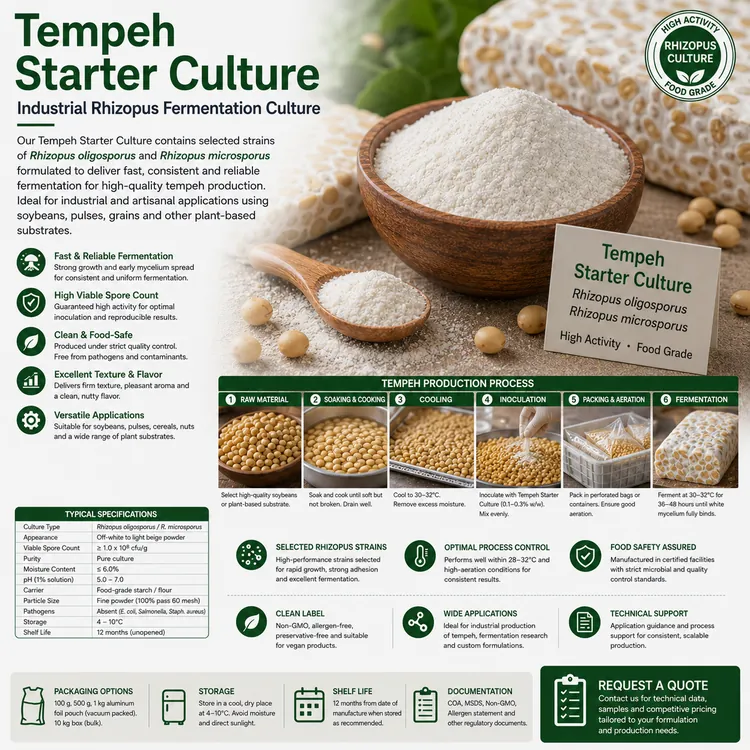
Product identity
| Product name | Tempeh Starter Culture |
|---|---|
| Common names | Tempeh inoculum, tempe starter, Rhizopus starter and tempeh mold culture |
| Product category | Food fermentation culture and microbial processing ingredient |
| Typical organism | Selected food-grade Rhizopus strain; exact species, variety and strain code are supplier specific |
| Frequently cited taxonomy | Rhizopus microsporus var. oligosporus or Rhizopus oligosporus, depending on the supplier's validated nomenclature |
| Primary function | Controlled mycelial fermentation, particle binding, texture formation and characteristic tempeh development |
| Fermentation mode | Aerobic solid-state fermentation |
| Typical form | Dry viable-spore preparation blended with a food-grade carrier |
| Typical carrier | Rice flour, cereal flour, starch or another declared food-grade carrier |
| Activity expression | Viable spores per gram, CFU/g or a supplier-defined activity and dosing system |
| E / INS number | No single universal E or INS number normally applies |
| CAS / identity | A living microbial preparation is not represented by one universal CAS number |
| Storage form | Refrigerated, frozen or validated ambient-stable format, depending on supplier technology |
| Allergen position | Determined by the culture carrier, production medium, cross-contact controls and supplier declaration |
Primary industrial functions
- Initiates controlled Rhizopus fermentation
- Promotes rapid, uniform mycelial colonization
- Binds substrate particles into a cohesive cake
- Supports characteristic tempeh texture development
- Contributes to aroma and flavor formation
- Supports enzymatic modification of the substrate
- Improves fermentation reproducibility
- Reduces reliance on uncontrolled environmental inoculation
- Supports standardized industrial batch timing
- Can be selected for specific substrates and process conditions
How the culture produces tempeh
When viable spores are distributed through a properly prepared substrate, they germinate under favorable moisture, oxygen and temperature conditions. Hyphae extend across the particle surfaces, penetrate accessible structures and form an interconnected mycelial network.
The white mycelium physically binds the substrate into a compact cake. At the same time, fungal enzymes can modify proteins, carbohydrates, lipids and cell-wall components. The degree of transformation depends on the strain, substrate, fermentation time and process conditions.
Mycelial binding
Dense, uniform mycelial growth provides the structural cohesion expected in finished tempeh. Poor inoculum distribution, excessive surface moisture, inadequate aeration or contamination can lead to weak binding and irregular growth.
Enzymatic transformation
Rhizopus may produce proteolytic, lipolytic, amylolytic and cell-wall-modifying enzymes. Their practical effect varies with the strain and raw material and should not be assumed without application testing.
Flavor development
Controlled fermentation can reduce raw or beany notes and create mild mushroom-like, nutty or fermented aromas. Overfermentation, overheating or contamination can generate ammonia-like, alcoholic, sour or otherwise atypical odors.
Competitive colonization
A strong inoculum can occupy the substrate rapidly, but it is not a substitute for hygienic production. Raw-material control, thermal preparation, acidification, sanitation and controlled incubation remain essential.
Technical parameters to evaluate
Tempeh starter cultures should be purchased against a signed specification that clearly identifies the microorganism, carrier, activity, storage conditions and purity criteria. Product performance cannot be assessed from product name alone.
| Parameter | Industrial significance | Purchasing guidance |
|---|---|---|
| Organism identity | Confirms that the preparation contains a validated tempeh-producing Rhizopus culture. | Request species or variety, strain code, identification method and strain-traceability information. |
| Strain status | Individual strains can differ in growth rate, enzyme activity, temperature tolerance, aroma and substrate compatibility. | Confirm that the strain is approved by the supplier for the intended food use and destination market. |
| Viable spore count | Influences inoculation rate, fermentation speed and batch consistency. | Specify minimum viable spores or CFU per gram at release and, where possible, at the end of shelf life. |
| Inoculation activity | Some suppliers express performance using a proprietary activity unit rather than CFU/g alone. | Require a clear conversion to the recommended dose per kilogram of prepared substrate. |
| Carrier composition | Affects flow, dispersibility, allergen status, labeling and dose calculation. | Request the complete ingredient statement and carrier percentage where relevant. |
| Moisture | Affects spore stability, flowability and shelf life. | Include a maximum value and analytical method in the specification. |
| Water activity | Provides an application-relevant indication of dry-culture stability. | Request a maximum value where long shelf life or ambient distribution is required. |
| Particle size | Influences dry blending, dust generation and inoculation uniformity. | Specify a free-flowing grade suitable for the intended manual or automated dosing method. |
| Dispersibility | Uneven distribution can produce uncolonized areas and localized overgrowth. | Evaluate distribution in the actual substrate and mixing equipment. |
| Growth rate | Determines fermentation time and production capacity. | Request supplier performance data under defined substrate, temperature and dose conditions. |
| Temperature range | Defines suitable incubation and process-control limits. | Obtain the recommended range, optimum target and maximum culture-tolerance information. |
| Substrate compatibility | Performance can differ between soybeans, peas, chickpeas, lupins, cereals and mixed substrates. | Request application evidence for the intended raw material. |
| Microbiological purity | Controls unwanted bacteria, yeasts and molds in the starter. | Specify total contaminants and organism-specific limits where appropriate. |
| Pathogen criteria | Supports food-safety qualification of the culture. | Include Salmonella absence and other criteria required by customer policy, risk assessment and destination market. |
| Mycotoxin risk assessment | Confirms that the selected strain and production process are appropriate for food use. | Request strain safety documentation and relevant contaminant declarations from the manufacturer. |
| Storage temperature | Directly affects viability retention. | State the permitted storage range and excursion policy. |
| Shelf life | Determines inventory planning and minimum remaining activity. | Confirm shelf life in unopened packaging and after opening. |
Commercial culture presentations
Dry carrier-based culture
A dry spore preparation blended with rice flour, starch or another declared carrier is a common commercial format. It is convenient for weighing and distribution but requires protection from moisture and heat.
Concentrated culture
A high-potency culture may reduce dosing volume but requires more precise weighing and mixing. Small weighing errors can have a larger effect on fermentation consistency.
Single-strain culture
A clearly identified single-strain product can support reproducibility and traceability. Performance remains dependent on substrate and process conditions.
Multi-component preparation
Some commercial products may include more than one microorganism, processing aid, carrier or protective ingredient. The full composition and intended function of every component should be documented.
Raw materials suitable for development trials
Soybeans are the conventional substrate for tempeh, but industrial manufacturers also evaluate other pulses, grains, seeds and blended plant materials. A successful trial requires adjustment of hydration, cooking, dehulling, particle size, acidification and aeration.
Soybeans
- Whole or split dehulled soybeans
- Traditional tempeh production
- Established protein and carbohydrate profile
- Requires control of soaking, cooking and surface moisture
Other pulses
- Chickpeas
- Peas
- Faba beans
- Lupins
- Lentils
- Other technically suitable legumes
Grains and pseudocereals
- Barley
- Oats
- Rice
- Millet
- Quinoa
- Blended pulse-and-grain systems
Seeds and specialty substrates
- Sunflower seed
- Sesame-containing blends
- Peanut or nut-based systems where legally suitable
- Okara and selected food-production side streams
- Mixed plant-protein substrates
Typical tempeh production sequence
- Raw-material approval. Inspect identity, infestation, foreign material, moisture, microbiological condition and storage history.
- Cleaning and sorting. Remove stones, damaged seeds, dust and other foreign material.
- Soaking or hydration. Hydrate the substrate using a validated time, temperature and water-to-product ratio.
- Dehulling and particle preparation. Remove hulls where required and establish a particle structure that supports colonization and package aeration.
- Thermal treatment. Cook, steam or blanch sufficiently to soften the substrate and reduce competing microorganisms without producing excessive breakdown.
- Draining and surface drying. Remove free water. The substrate should be hydrated internally but not wet or glossy on the surface.
- Acidification. Adjust the substrate using a validated food-grade acidification process where required by the production system.
- Cooling. Cool the substrate to the validated inoculation temperature before adding the culture.
- Inoculation. Add the specified starter quantity and distribute it uniformly throughout the batch.
- Filling and forming. Pack into perforated film, trays or another oxygen-permeable production format at a controlled bed depth.
- Incubation. Maintain controlled temperature, humidity and airflow while monitoring metabolic heat generation.
- Endpoint determination. Assess mycelial coverage, cake integrity, aroma, temperature, absence of abnormal growth and process time.
- Cooling or further processing. Rapidly cool, cook, pasteurize, freeze or otherwise stabilize the product according to the validated commercial process.
Variables that determine fermentation performance
Numerical targets are strain, substrate and equipment specific. Development trials often begin within conventional tempeh-processing ranges, but the final operating limits must be established by the manufacturer and starter supplier.
| Variable | Typical development consideration | Control objective |
|---|---|---|
| Inoculation rate | Often expressed as culture grams per kilogram of prepared substrate or as viable spores per kilogram. | Achieve rapid, uniform colonization without unnecessary culture cost. |
| Substrate pH | A mildly acidic starting condition is commonly used, but the target depends on the validated process. | Reduce growth opportunity for undesirable competitors while supporting Rhizopus development. |
| Substrate moisture | The substrate must be sufficiently hydrated but free from excess surface water. | Support fungal growth without creating anaerobic wet zones or bacterial spoilage. |
| Inoculation temperature | The cooked substrate must be cooled before the starter is added. | Avoid thermal damage to spores and prevent premature condensation. |
| Incubation temperature | Commercial processes often operate around the upper twenties to low thirties degrees Celsius, depending on strain. | Maintain rapid growth without overheating or damaging the culture. |
| Fermentation time | Many processes develop a bound cake within approximately one to two days, but the endpoint is application specific. | Stop fermentation when mycelial coverage, texture and aroma meet the validated standard. |
| Bed depth | Thick beds retain more metabolic heat and may receive less oxygen in the center. | Maintain uniform oxygen transfer and temperature. |
| Package perforation | Hole size, spacing and film permeability affect gas exchange. | Supply oxygen while controlling drying and contamination risk. |
| Airflow | Incubator loading and rack geometry affect air distribution. | Remove metabolic heat and prevent stagnant zones. |
| Relative humidity | Low humidity can dry the product; excessive condensation can create wet contamination zones. | Maintain surface condition compatible with uniform growth. |
| Product-core temperature | May rise above chamber temperature as fungal metabolism intensifies. | Detect self-heating early and adjust cooling or airflow. |
Temperature control during scale-up
Rhizopus growth generates metabolic heat. In a small laboratory pack, heat may dissipate easily, while commercial racks, trays or stacked packages can retain heat and develop significant temperature gradients.
Excessive internal temperature can accelerate respiration, weaken the mycelium, increase sporulation, create off-odors, damage product texture or favor undesirable microorganisms.
- Measure product-core temperature, not chamber air alone.
- Map warm and cool positions within the incubator.
- Define maximum rack and chamber loading.
- Control spacing between trays or packages.
- Increase airflow as metabolic activity rises.
- Consider staged temperature settings during fermentation.
- Avoid thick product beds without validated heat removal.
- Establish alarms and corrective actions for overheating.
Oxygen transfer and package design
Tempeh fermentation is aerobic. The package or fermentation vessel must therefore allow controlled oxygen transfer while protecting the substrate from excessive drying and environmental contamination.
Perforated flexible film
Perforated bags or sheets are commonly used. Hole diameter, spacing, film thickness, filling weight and bed thickness should be standardized.
Trays and reusable forms
Trays can support controlled geometry and automated handling. Their hygienic design, drainage, airflow and cleanability must be validated.
Solid-state fermentation vessels
Larger vessels may require forced aeration, temperature sensing and controlled humidity. Scale-up changes oxygen and heat-transfer behavior substantially.
Package atmosphere
Low oxygen can slow mycelial growth and create wet, poorly bound regions. Excessive aeration can dry the substrate and promote premature sporulation.
Potential industrial applications
Traditional soybean tempeh
- Retail tempeh blocks
- Foodservice tempeh
- Fresh refrigerated products
- Frozen tempeh
- Pasteurized or cooked tempeh formats
Alternative-pulse tempeh
- Chickpea tempeh
- Pea tempeh
- Lupin tempeh
- Faba bean tempeh
- Lentil-based products
Mixed plant substrates
- Pulse-and-grain combinations
- Seed-containing tempeh
- High-protein blended substrates
- Texture-optimized multi-component products
Ingredient-grade fermented materials
- Fermented plant-protein inclusions
- Ground or crumbled tempeh ingredients
- Cooked and dried fermented components
- Inputs for burgers, fillings and ready meals
Side-stream valorization
- Okara-based development projects
- Selected cereal or pulse side streams
- Food-grade upcycled substrates
- Fermented ingredients for further processing
Research and product development
- Strain-screening programs
- Alternative-protein fermentation
- Texture and flavor development
- Fermentation-process optimization
Hygiene and HACCP considerations
Tempeh production involves a warm, moist substrate that can support microorganisms other than the intended Rhizopus culture. A strong starter is important, but it does not replace prerequisite programs, validated thermal preparation, sanitation or environmental control.
Raw-material controls
- Approved suppliers
- Foreign-material removal
- Pest and infestation control
- Mycotoxin and contaminant risk assessment
- Storage moisture and temperature control
- Allergen segregation
Thermal-process controls
- Validated cooking or steaming step
- Uniform treatment of the substrate
- Controlled cooling before inoculation
- Prevention of post-process contamination
- Documented time and temperature records
Inoculation-area controls
- Hygienic zoning
- Controlled personnel and utensil movement
- Clean, sanitized mixers and contact surfaces
- Protected starter handling
- Environmental monitoring where appropriate
Incubation controls
- Chamber temperature monitoring
- Product-core temperature monitoring
- Airflow and humidity control
- Batch segregation and traceability
- Defined rejection criteria
Microbiological qualification requirements
| Control | Purpose |
|---|---|
| Rhizopus identity | Confirms that the production organism matches the approved strain or culture description. |
| Viable activity | Confirms sufficient spores remain viable for predictable fermentation. |
| Salmonella | Common pathogen criterion for dry food ingredients and microbial preparations. |
| Enterobacteriaceae or coliforms | Provides an indicator of hygienic manufacture and contamination control. |
| Escherichia coli | Supports hygiene verification where required. |
| Staphylococcus aureus | May be included according to customer policy and risk assessment. |
| Bacillus cereus | May be relevant for cereal- or flour-based carriers and application risk assessment. |
| Non-target yeasts and molds | Controls unwanted culture contaminants. |
| Strain safety assessment | Supports confirmation of food-use suitability and absence of unacceptable toxigenic characteristics. |
Recommended industrial trial measurements
| Trial stage | Measurements to consider |
|---|---|
| Starter inspection | Package integrity, lot, expiry date, storage history, odor, color, flowability and certificate-of-analysis review. |
| Prepared substrate | Moisture, pH, temperature, particle size, dehulling, surface dryness and microbial condition. |
| Inoculation | Dose accuracy, mixing time, culture distribution and substrate temperature. |
| Early fermentation | Spore germination, initial mycelial growth, chamber conditions and product temperature. |
| Peak growth | Core temperature, oxygen availability, condensation, odor and uniformity across racks. |
| Fermentation endpoint | White coverage, cake cohesion, internal binding, aroma, absence of abnormal color and total process time. |
| Finished texture | Firmness, sliceability, crumbliness, chewiness and cooking performance. |
| Sensory quality | Fermented aroma, bitterness, acidity, ammonia notes, raw-bean notes and overall acceptability. |
| Microbiological verification | Pathogen criteria, hygiene indicators and product-specific shelf-life organisms. |
| Post-process stability | Refrigerated shelf life, freezing stability, purge, color, aroma and package condition. |
Indicators of normal and abnormal fermentation
Expected characteristics
- Uniform white or off-white mycelial coverage
- Particles bound into a cohesive cake
- Clean, mild fermented or mushroom-like aroma
- No excessive free moisture
- No slimy or sticky bacterial layer
- Consistent internal and external colonization
Possible rejection indicators
- Pink, orange, green or unusual colored growth
- Strong putrid, solvent, alcoholic or ammonia odor
- Wet, slimy or collapsing structure
- Large uncolonized zones
- Severe overheating
- Unexpected gas formation or package swelling
Black or gray sporulation may occur when Rhizopus is allowed to mature beyond the preferred harvest point. Sporulation can indicate advanced fermentation or excessive oxygen exposure, but any unusual appearance must be evaluated against the approved product standard and food-safety plan rather than accepted automatically.
Common fermentation observations
| Observation | Possible contributing factors | Areas to investigate |
|---|---|---|
| Slow or absent mycelial growth | Low culture viability, underdosing, high inoculation temperature, unsuitable pH or cold incubation. | Check storage history, starter activity, dose, substrate temperature, pH and incubator calibration. |
| Patchy colonization | Uneven starter distribution, inconsistent moisture, dense packing or poor aeration. | Review mixing, particle size, bed depth and package perforation. |
| Weak cake structure | Short fermentation, large gaps between particles, excess surface moisture or low inoculum activity. | Adjust particle preparation, draining, dose and endpoint time. |
| Wet or slimy product | Excess moisture, condensation, inadequate acidification, bacterial contamination or insufficient airflow. | Review draining, cooling, pH, hygiene, package design and incubator humidity. |
| Product overheats | High chamber loading, thick beds, low airflow or excessive incubation temperature. | Increase spacing and cooling, reduce bed depth and monitor core temperature. |
| Premature black sporulation | Extended fermentation, high oxygen exposure, surface drying or delayed cooling. | Shorten fermentation, adjust perforation and cool promptly at endpoint. |
| Strong ammonia odor | Overfermentation, excessive proteolysis or high product temperature. | Review endpoint timing, temperature profile and cooling delay. |
| Sour or alcoholic odor | Unwanted bacterial or yeast growth, poor thermal treatment or delayed inoculation. | Review sanitation, cooling time, acidification and culture dominance. |
| Dry surface and poor binding | Low substrate moisture, excessive airflow, low humidity or excessive perforation. | Rebalance hydration, humidity, airflow and package permeability. |
| Batch-to-batch inconsistency | Variable raw material, inaccurate dosing, changing starter age or incubator non-uniformity. | Standardize incoming material, scales, culture storage and chamber mapping. |
Cooling, stabilization and shelf life
Fermentation continues until temperature, oxygen availability or microbial activity is reduced. Finished tempeh should therefore be cooled or stabilized promptly after the approved endpoint.
Refrigerated product
Rapid chilling slows further growth and biochemical change. Shelf life depends on hygiene, packaging, residual activity and storage temperature.
Frozen product
Freezing can extend distribution life but may influence texture, purge and package condition after thawing. Freeze-thaw trials should reflect the commercial cold chain.
Cooked or pasteurized product
Thermal stabilization can reduce viable mold and extend shelf life. The process must be validated for the selected package, product thickness and target microorganisms.
Dried ingredient
Fermented material may be dried and milled for use as an ingredient. Drying conditions affect flavor, color, protein functionality and microbial stability.
Culture carrier and final-product declarations
The active Rhizopus culture may be supplied on a cereal, rice, starch or other carrier. The carrier and production medium can affect ingredient labeling, gluten declarations, allergen controls and dietary-positioning claims.
- Request the complete starter ingredient statement.
- Confirm carrier identity and percentage where relevant.
- Review wheat, soy, milk and other cross-contact risks.
- Confirm gluten-related declarations with supporting evidence.
- Verify vegan or vegetarian suitability.
- Review GMO status where required.
- Confirm whether processing aids remain in the commercial culture.
- Determine the correct finished-product ingredient declaration.
Strain and market documentation
Microbial cultures should be qualified at strain level wherever possible. A species name alone may not provide enough information to establish safety, identity or regulatory suitability.
Identity documentation
- Species, variety and strain code
- Culture-deposit reference where available
- Identification method
- Genetic or phenotypic stability information
- Manufacturing-strain traceability
Safety documentation
- History of food use
- Strain safety assessment
- Toxigenicity risk evaluation
- Antimicrobial-resistance review where applicable
- Contaminant-control program
Market compliance
- Destination-country culture status
- Permitted food category
- Processing-aid or ingredient classification
- Labeling requirements
- Novel-food or premarket-review considerations
Claim support
- Non-GMO declaration
- Halal and kosher status
- Vegan suitability
- Gluten statement
- Organic compatibility where certified
Documents to request before approval
- Current signed product specification
- Technical data sheet
- Lot-specific certificate of analysis
- Microorganism identity and strain declaration
- Viable spore or CFU specification
- Recommended inoculation rate
- Carrier and complete ingredient statement
- Microbiological purity criteria
- Pathogen testing statement
- Strain safety or food-use suitability assessment
- Mycotoxin and toxigenicity risk statement where applicable
- Allergen and cross-contact declaration
- Gluten declaration
- GMO statement
- Country-of-origin statement
- Manufacturing-site statement
- Food-safety certification and audit scope
- Halal and kosher certificates where required
- Vegan or vegetarian suitability statement
- Organic certificate where applicable
- Storage and transport specification
- Shelf-life and activity-retention information
- Packaging and food-contact compliance declaration
- Temperature-excursion policy
- Change-notification procedure
- Traceability and recall procedure
- Safety Data Sheet or workplace-handling information where applicable
Storage, handling and shipment
| Primary packaging | Sealed moisture-barrier sachets, pouches, bags or containers suitable for maintaining culture viability. |
|---|---|
| Package atmosphere | Supplier dependent; packaging may use controlled moisture, vacuum or protective gas technology. |
| Pack size | Laboratory, pilot and industrial pack sizes may be available. Select a size that minimizes repeated opening and moisture exposure. |
| Storage temperature | Follow the supplier's validated refrigerated, frozen or controlled-ambient storage instruction. |
| Moisture protection | Keep the culture sealed and dry. Moisture exposure can reduce flowability and viability. |
| Heat protection | Avoid hot warehouses, direct sunlight and uncontrolled vehicle temperatures. |
| Shipment | Use insulated or temperature-controlled transport when required by the supplier's stability data. |
| Temperature monitoring | Data loggers or indicators may be appropriate for sensitive or long-distance shipments. |
| Opened package | Reseal immediately, minimize humidity exposure, identify the opening date and follow the supplier's in-use shelf life. |
| Stock rotation | Apply first-expired, first-out control and maintain lot-level traceability. |
| Activity verification | Consider periodic application or viability testing for long-held inventory and critical production. |
Starter preparation and dosing controls
The culture should be handled as a sensitive biological material. Moisture, heat, prolonged exposure to air and contact with sanitizer residues can reduce viable activity.
- Bring only the required culture quantity into production.
- Use clean, dry and dedicated weighing utensils.
- Verify scale accuracy at the required small dose.
- Avoid weighing directly above wet process equipment.
- Do not expose the culture to steam or hot substrate.
- Prevent contact with disinfectant residues.
- Distribute the culture uniformly through the substrate.
- Record starter lot and dose for every batch.
- Return resealed product promptly to specified storage.
- Do not mix expired and current culture lots without approval.
Compare fermentation cost, not starter price alone
The lowest price per kilogram of starter may not provide the lowest production cost. Culture potency, dose, fermentation speed, batch uniformity, rejection rate, shelf life and cold-chain requirements all influence commercial value.
A complete comparison may include:
- Delivered starter price
- Viable activity per gram
- Recommended dose per kilogram of substrate
- Starter cost per tonne of finished tempeh
- Fermentation time
- Batch-to-batch consistency
- Cake strength and finished yield
- Incubator capacity and production throughput
- Rejected or downgraded batch rate
- Storage and cold-chain cost
- Opened-package stability
- Packaging waste and dosing convenience
- Technical support and troubleshooting capability
- Supplier documentation quality
- Lead time and supply continuity
Information to include in a sourcing request
- Product name: Tempeh Starter Culture
- Required Rhizopus species, variety or strain where specified
- Minimum viable spores or CFU per gram
- Preferred carrier and prohibited carriers
- Allergen and gluten requirements
- Intended substrate
- Prepared substrate quantity per batch
- Target inoculation rate
- Target fermentation time
- Incubation temperature range
- Package type and product bed depth
- Fresh, refrigerated, frozen or further-processed end product
- Microbiological purity requirements
- Required strain-safety documentation
- GMO, halal, kosher or organic requirements
- Preferred starter pack size
- Required storage temperature
- Trial quantity and annual demand
- Destination country and delivery address
- Preferred Incoterm
- Required shipment date
- Minimum remaining shelf life
- Required technical and regulatory documents
Recommended qualification workflow
- Define the intended substrate, process and finished-product format.
- Issue a target culture specification and document checklist.
- Review strain identity, safety, purity and regulatory status.
- Obtain a representative starter sample from the proposed commercial grade.
- Confirm storage conditions and shipment history.
- Conduct a standardized small-scale fermentation trial.
- Measure growth rate, temperature, coverage and cake strength.
- Evaluate aroma, flavor, texture and abnormal growth.
- Repeat the trial across multiple starter and substrate lots.
- Scale the process to pilot equipment with temperature mapping.
- Validate package perforation, bed depth, airflow and incubator load.
- Complete microbiological and shelf-life verification.
- Approve the final specification, storage and dosing procedure.
- Compare the first commercial shipment with the approved sample.
- Establish routine lot review and supplier-performance monitoring.
Frequently asked questions
What is Tempeh Starter Culture used for?
Tempeh Starter Culture provides selected viable Rhizopus spores. Under controlled aerobic conditions, the culture colonizes the prepared substrate and forms a white mycelial network that binds the particles into a cohesive fermented cake.
Which microorganism is normally used?
Commercial starters commonly contain a selected food-grade Rhizopus strain. Supplier documentation may identify it as Rhizopus microsporus var. oligosporus, Rhizopus oligosporus or another validated tempeh-production strain.
Is tempeh fermentation aerobic?
Yes. Rhizopus requires oxygen for mycelial growth. Package perforation, film permeability, product thickness, airflow and incubator loading must therefore be controlled.
Does the starter acidify the substrate?
A standard Rhizopus tempeh starter is not primarily a rapid acidifying culture. Substrate acidification is commonly performed before inoculation using a separate validated process step.
How much starter should be used?
The required dose depends on viable spore concentration, carrier, substrate, process temperature and target fermentation time. Supplier instructions should be expressed as grams or viable spores per kilogram of prepared substrate and confirmed by trials.
What temperature is used for tempeh fermentation?
Commercial processes often operate in the upper twenties to low thirties degrees Celsius, but the correct target depends on the strain, substrate, bed depth and equipment. Product-core temperature should be monitored because fermentation generates heat.
How long does fermentation take?
Many processes form a bound tempeh cake within approximately one to two days. The approved endpoint should be based on mycelial coverage, cake strength, aroma, product temperature and microbiological controls rather than time alone.
Can the starter be used with chickpeas, peas or other beans?
A suitable starter may ferment several plant substrates, but each raw material may require different soaking, dehulling, cooking, moisture, acidification, inoculation and aeration conditions.
Why does tempeh overheat during fermentation?
Active fungal growth produces metabolic heat. Thick product beds, tightly loaded racks and insufficient airflow can cause the product core to become warmer than the incubation chamber.
Is black growth always contamination?
Dark sporulation can occur when Rhizopus matures beyond the preferred endpoint. However, unusual color must be evaluated against the approved standard because other molds can also produce colored growth.
Does Tempeh Starter Culture require refrigeration?
Storage requirements are supplier specific. Some cultures require refrigeration or freezing, while validated dry products may permit controlled ambient storage. The supplier's temperature range and excursion policy must be followed.
Which documents should buyers request?
Buyers should request a signed specification, certificate of analysis, strain-identity declaration, viable-activity specification, carrier statement, microbiological criteria, safety assessment, allergen declaration, storage instructions, shelf-life data and relevant certifications.
Can Global Food Additives source industrial pack sizes?
Global Food Additives can review laboratory, pilot and industrial culture formats according to required strain, activity, carrier, pack size, storage conditions, quantity, destination and documentation requirements.
Send your Tempeh Starter Culture requirements.
Include the intended substrate, target strain or culture identity, viable activity, inoculation rate, production scale, storage temperature, pack size, quantity, destination and documentation requirements. Our team will review your inquiry and respond from orders@foodgradeadditives.com .
Your message has been received. You will be redirected to the home page.