
Sodium Stearoyl-2-Lactylate E481
Sodium Stearoyl-2-Lactylate, commonly abbreviated as SSL, is a food-grade emulsifier used in industrial food manufacturing for dough strengthening, crumb softness, aeration support, starch complexing, protein interaction, emulsion stability, fat dispersion and process tolerance. It is especially relevant for bread, buns, rolls, tortillas, flatbreads, cakes, bakery mixes, whipped toppings, icings, fillings, puddings, beverage creamers, desserts and selected food emulsion systems.
For professional purchasing, Sodium Stearoyl-2-Lactylate should be reviewed as a functional emulsifier rather than only as a commodity additive. Supplier comparison should include E / INS identity, CAS identity, fatty acid profile, acid value, ester value, lactic acid content, sodium content, moisture, colour, particle size, dispersibility, melting behaviour, food-grade status, regulatory declarations, packaging suitability, batch traceability and application-specific bakery or emulsion trials.
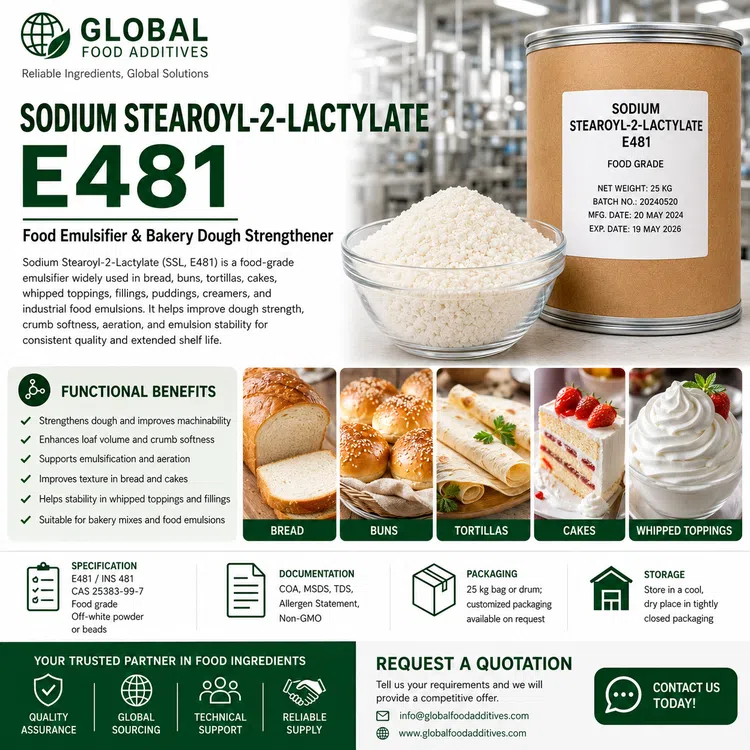
Product identity
| Product | Sodium Stearoyl-2-Lactylate |
|---|---|
| Category | Emulsifiers & Surface Active Ingredients |
| Function | Emulsifier / dough strengthener / crumb softener / surface-active food ingredient |
| E / INS number | E481 / INS 481 |
| CAS / identity | 25383-99-7 |
| Common abbreviation | SSL |
| Chemical family | Sodium salt of stearoyl lactylic acids; lactylate emulsifier derived from fatty acid and lactic acid chemistry |
| Typical form | Cream to white powder, bead, flake, brittle solid or supplier-specific granular grade |
| Technical character | Anionic emulsifier with strong bakery functionality, starch complexing and protein-interaction behaviour |
Application fit
Potential use areas may include:
- Bread, buns, rolls, sandwich bread and yeast-raised bakery products
- Tortillas, flatbreads, wraps, pizza bases and laminated bakery systems
- Cakes, muffins, sponge systems, pancakes, waffles and bakery premixes
- Whipped toppings, dessert creams, icings, fillings and puddings
- Beverage creamers, powder drink systems and fat-containing powders
- Margarine, shortenings and selected fat emulsions
- Frozen desserts and aerated dessert systems
- Snack dips, sauces, gravies and selected processed food emulsions
Industrial functionality
Sodium Stearoyl-2-Lactylate is selected when a formulation needs controlled interaction between flour proteins, starch, water, fat, air and process energy. In bakery, SSL is valued for strengthening dough, improving gas retention, increasing process tolerance and supporting loaf volume. It can also form complexes with starch components, helping improve crumb softness and reduce firming during storage. In non-bakery systems, SSL may support fat dispersion, emulsion stability, aeration and texture control when it is compatible with the product’s pH, fat phase, proteins and other emulsifiers.
Functional contribution
- Dough strengthening: helps improve dough tolerance to mixing, fermentation, proofing and mechanical handling.
- Gas retention: supports stronger dough films and more stable gas cells in yeast-raised bakery systems.
- Loaf volume: may improve volume and shape in bread, buns, rolls and other fermented bakery products.
- Crumb softness: can support softer crumb and delayed firming through starch interaction and formula balance.
- Aeration support: assists air incorporation and foam stability in suitable cake, topping and dessert systems.
- Emulsion stability: helps manage fat-water interfaces in selected toppings, creamers, fillings and processed foods.
- Process tolerance: supports repeatability across flour variation, mixing energy, proofing conditions, line speed and bake profile.
Application engineering notes
- Bread and buns: evaluate volume, symmetry, crumb grain, oven spring, slicing quality, softness and shelf-life firmness.
- Tortillas and flatbreads: review rollability, flexibility, tearing, surface cracking, moisture retention and anti-staling performance.
- Cakes and muffins: test batter specific gravity, aeration, volume, crumb texture, uniformity and emulsifier interaction.
- Whipped toppings and icings: check overrun, foam stability, fat crystallization, spreadability, gloss and storage stability.
- Creamers and powders: validate fat dispersion, reconstitution, emulsion stability, powder flow and separation resistance.
- Frozen desserts: assess overrun, meltdown, fat destabilization, mouthfeel and interaction with stabilizers and proteins.
Bakery performance factors
SSL performance should be validated in the actual flour, formula and production process. The same addition level can behave differently depending on flour protein quality, damaged starch, water absorption, yeast level, sugar level, fat level, enzymes, oxidizing agents, mixing intensity, dough temperature, fermentation time, proofing humidity and oven profile. For industrial bakeries, the best evaluation combines lab baking, pilot production and line trials.
| Factor | Why it matters industrially |
|---|---|
| Flour protein quality | Influences dough strength, gas retention and the need for SSL or other dough improvers. |
| Water absorption | Changes dough handling, hydration, crumb structure, softness and machinability. |
| Mixing energy | SSL may improve tolerance, but overmixing or undermixing can still create quality defects. |
| Dough temperature | Affects yeast activity, emulsifier dispersion, fermentation rate and final volume. |
| Fat and emulsifier system | Interaction with mono- and diglycerides, DATEM, lecithin, enzymes or shortenings affects final performance. |
| Fermentation and proofing | Changes dough structure, gas retention, oven spring and crumb uniformity. |
| Baking profile | Heat transfer, gelatinization and oven spring influence the final benefit of SSL. |
| Storage conditions | Packaging, moisture migration and shelf temperature affect crumb softness and staling rate. |
Typical specification points to compare
Exact limits vary by manufacturer, grade and applicable food-additive standard. The following parameters are practical checkpoints for procurement, R&D and QA teams when comparing suppliers or approving a new Sodium Stearoyl-2-Lactylate grade.
| Parameter | Why it matters industrially |
|---|---|
| Acid value | Helps assess free acid level and batch-to-batch consistency. |
| Ester value | Supports confirmation of esterified lactylate composition and functional consistency. |
| Lactic acid content | Useful for identity, functionality and supplier comparison. |
| Sodium content | Important for identity, label review, sodium contribution and quality consistency. |
| Fatty acid profile | Stearic and related fatty acids influence melting behaviour, dispersion and bakery performance. |
| Moisture / loss on drying | Important for caking, storage stability, flowability and shelf life. |
| Particle size | Affects dry blending, dispersion, dusting, dosing accuracy and premix uniformity. |
| Dispersibility | Critical for dry blends, dough incorporation, liquid premixes and process repeatability. |
| Melting behaviour | Influences incorporation, fat-phase interaction and process performance. |
| Colour and odour | Indicates grade consistency and helps identify oxidation, overheating or contamination risk. |
| Heavy metals, lead and arsenic | Required for food safety, customer approval and destination-market compliance. |
| Microbiological limits | Relevant for dry mixes, direct addition, ready-to-eat products and supplier approval. |
| Food-grade declarations | Confirm suitability for food use and support regulatory and customer documentation review. |
Formulation and processing considerations
Sodium Stearoyl-2-Lactylate may be added through flour blends, dry premixes, fat systems, hydrated dispersions or direct addition depending on the grade and process. Bakery manufacturers should confirm whether the SSL grade is designed for direct flour blending, premix production, high-speed bread lines, tortillas, cake systems or non-bakery emulsions. Incorrect dispersion can reduce performance, create local concentration differences or cause inconsistent dough handling.
Production checkpoints
- Confirm whether the grade is optimized for bread, buns, tortillas, cake mixes, whipped systems or general emulsification.
- Validate addition point: flour premix, dry blend, fat phase, water phase or emulsifier premix.
- Check dispersibility in the actual process temperature, mixing time and hydration conditions.
- Review interaction with flour improvers, enzymes, oxidants, reducing agents, gums, mono- and diglycerides, DATEM and lecithin.
- Monitor dough rheology, proof tolerance, volume, crumb texture, slice quality and shelf-life softness during pilot trials.
- Confirm that final dosage, label declaration and permitted use match the food category and destination market.
Quality-control checkpoints
- Compare each COA against the approved internal specification before release to production.
- Inspect packaging integrity, colour, odour, foreign matter, caking, moisture exposure and signs of overheating.
- Keep lot traceability from goods receipt through finished product batches.
- Run internal checks where critical, such as particle size, dispersibility, pH of dispersion or bakery trial performance.
- Use retention samples for supplier-change investigations and shelf-life troubleshooting.
- Request trend data if SSL is critical to bread volume, tortilla flexibility, crumb softness or high-speed line tolerance.
Application-specific value
The value of Sodium Stearoyl-2-Lactylate depends on the product matrix and process. In yeast-raised bread, it is mainly evaluated for dough strength, gas retention, loaf volume and crumb softness. In tortillas and flatbreads, it may help flexibility and rollability. In cakes and batters, it can support aeration and crumb uniformity. In toppings, fillings, creamers and desserts, it may contribute to emulsion stability, fat dispersion and texture when used with compatible stabilizers and emulsifiers.
| Application | Technical objective | Trial focus |
|---|---|---|
| Bread, buns and rolls | Improve dough strength, gas retention, loaf volume and softness. | Mix tolerance, proof stability, oven spring, loaf symmetry, crumb grain, sliceability and staling rate. |
| Tortillas and flatbreads | Support flexibility, rollability and delayed cracking. | Diameter, rollability, tear resistance, softness, surface cracking, moisture retention and shelf-life texture. |
| Cakes and muffins | Assist aeration, batter stability and crumb uniformity. | Batter specific gravity, volume, crumb grain, tenderness, symmetry and interaction with cake emulsifiers. |
| Bakery mixes | Provide consistent emulsifier distribution and performance. | Premix homogeneity, dusting, flowability, shelf life, dispersion and finished bake results. |
| Whipped toppings and icings | Support aeration, fat dispersion and foam stability. | Overrun, foam stability, spreadability, gloss, syneresis and storage stability. |
| Beverage creamers and powders | Improve fat dispersion and reconstitution. | Emulsion stability, oiling-off, reconstitution, powder flow, sediment and heat stability. |
| Frozen desserts | Assist aeration and fat destabilization where suitable. | Overrun, meltdown, texture, mouthfeel, stabilizer compatibility and freeze-thaw behaviour. |
| Sauces, gravies and dips | Support emulsion stability and process tolerance. | Viscosity, oil separation, heat stability, pH compatibility, flavour and storage performance. |
Regulatory and label review
Sodium Stearoyl-2-Lactylate is associated with E481 / INS 481, but approval and permitted use are not identical in every country, every food category or every formulation. Before commercial production, buyers should verify destination-market legislation, food category permissions, maximum use levels, carry-over rules, ingredient declaration, sodium contribution, allergen or origin statements and customer restricted-ingredient policies.
- Destination-market approval: check the final country of sale, not only the country of manufacture.
- Food category: confirm that SSL or the relevant lactylate group is permitted in the specific product category.
- Use-level responsibility: ensure final dosage complies with applicable additive rules and customer specification.
- Label declaration: verify whether the ingredient must be declared as Sodium Stearoyl-2-Lactylate, Sodium Stearoyl Lactylate, E481, emulsifier or according to local naming rules.
- Source and claims: confirm fatty acid origin, vegan status, halal, kosher, GMO, allergen and sustainability declarations where required.
- Nutrition impact: review sodium contribution when high-use formulas or sodium-sensitive products are involved.
- Food safety system: request available certificates such as FSSC 22000, ISO 22000, BRCGS, IFS, HACCP, GMP or equivalent where required.
Documents to request
For industrial procurement, the best supplier approval process combines product identity documents, batch documents, regulatory declarations and logistics information. Document availability can vary by manufacturer and market, so buyers should list mandatory documents at the inquiry stage.
- Product specification or technical data sheet
- Certificate of analysis for the offered batch or a recent representative lot
- Safety data sheet where applicable
- Food-grade statement and intended-use declaration
- Origin statement and manufacturing-site information where available
- Allergen statement, GMO statement, vegan statement, halal certificate and kosher certificate when required
- Fatty acid origin statement and palm-origin or RSPO-related statement where required by the buyer
- Acid value, ester value, lactic acid, sodium, moisture, particle size and colour specification
- Heavy metals, lead, arsenic, microbiology and contaminant declarations
- Residual solvent, pesticide, PAH, mineral oil or other market-specific declarations where required
- Shelf-life, storage and handling information
- Packaging specification, label draft, net weight, gross weight and pallet configuration
- Export documents, customs documents and legalization requirements for the destination country
Packaging, storage and logistics
Sodium Stearoyl-2-Lactylate is commonly supplied in multiwall bags, cartons, drums, fiber drums or other manufacturer-specific packaging depending on grade, particle size and order volume. Because it is a functional emulsifier, buyers should consider moisture protection, heat exposure, dust control, pallet condition, warehouse hygiene, odour pickup, caking risk and suitability for manual or automated dosing systems.
Packaging questions
- What is the standard net weight per bag, carton, drum, fiber drum or pallet?
- Is the inner liner food-grade and moisture-protective?
- Can the supplier provide batch coding on each unit and pallet?
- Is the product supplied as powder, beads, flakes, granules or customer-specific particle size?
- Is the grade designed for low-dust handling, instant dispersion or premix production?
- What are the recommended loading quantity and container conditions?
- Are sample, partial pallet, mixed container or full-container options available?
Storage guidance
- Store in closed original packaging in a clean, dry, food-grade warehouse.
- Protect from moisture, direct sunlight, excessive heat and strong odours.
- Keep away from non-food chemicals and materials that may create taint or contamination risk.
- Apply FIFO or FEFO stock rotation according to the declared shelf life.
- Seal opened packaging carefully and avoid foreign matter or water contamination.
- Review dust-control and operator-protection procedures according to the safety data sheet and site rules.
Commercial sourcing checklist
When requesting Sodium Stearoyl-2-Lactylate, provide enough technical and commercial detail to avoid unsuitable offers. The same product name can correspond to different particle sizes, dispersibility profiles, fatty acid origins, document sets, food-grade standards and application performance.
| Quotation item | Recommended buyer input |
|---|---|
| Target grade | Food grade Sodium Stearoyl-2-Lactylate, E481 / INS 481, SSL, supplier reference grade or buyer specification. |
| Application | Bread, buns, tortillas, flatbread, cake, bakery mix, topping, icing, filling, creamer, dessert or other use. |
| Required specification | Acid value, ester value, lactic acid, sodium, fatty acid profile, moisture, particle size, colour and microbiology. |
| Functional target | Dough strength, loaf volume, crumb softness, tortilla flexibility, aeration, emulsion stability or process tolerance. |
| Quantity | Sample, trial order, bag quantity, pallet quantity, container quantity, annual demand or call-off schedule. |
| Packaging | Bag, carton, drum, fiber drum, pallet format or site-specific handling preference. |
| Destination | Country, port, city, warehouse address and import-document requirements. |
| Delivery term | EXW, FCA, FOB, CFR, CIF, DAP or another requested Incoterms basis. |
| Documentation | COA, TDS, SDS, origin, fatty acid source, halal, kosher, allergen, GMO, food-grade and regulatory declarations. |
| Timing | Required shipment date, target lead time, validity period and expected repeat demand. |
Supplier comparison checklist
When approving a new source, compare technical performance and documentation reliability, not only price per kilogram. Sodium Stearoyl-2-Lactylate can strongly affect dough tolerance, loaf volume, crumb softness, tortilla flexibility, aeration, emulsion stability, label declaration and customer acceptance.
- Does the offered grade match your approved E481 / INS 481 requirement?
- Are CAS identity, acid value, ester value, lactic acid content and food-grade status clearly documented?
- Do fatty acid profile, sodium content, moisture, particle size, colour and contaminant limits match your specification?
- Is the physical form suitable for your dosing, dry blending, flour premixing, dispersion or emulsifier premix process?
- Does the material perform correctly in your flour system, process temperature, mixing sequence and packaging system?
- Does the supplier provide batch-specific COA data and traceable lot numbers?
- Are allergen, GMO, halal, kosher, vegan, origin and fatty acid source declarations available when required?
- Can packaging, palletization, lead time and freight terms support your production schedule?
- Has the ingredient been tested in pilot production, shelf-life studies or customer approval trials before commercial supplier change?
How to request this product
Send the product name, target grade or reference specification, application, required quantity, destination country, packaging preference, expected shipment date, delivery term and required documents. If you already purchase Sodium Stearoyl-2-Lactylate, attach or describe your current specification, supplier grade, COA, label declaration, functional target or customer document checklist so available sourcing options can be compared more accurately.
Useful answers
What is Sodium Stearoyl-2-Lactylate used for in food manufacturing?
Sodium Stearoyl-2-Lactylate is typically used as a food emulsifier, dough strengthener and surface-active ingredient. It is evaluated for emulsion stability, aeration, crumb softness, dough tolerance, fat dispersion, starch interaction and processing tolerance. Exact suitability depends on grade, application, process, regulations and supplier documents.
Why is SSL widely used in bakery systems?
SSL can support dough strength, gas retention, loaf volume, crumb grain, softness retention and line tolerance. It is especially useful when bakery manufacturers need more consistent performance across flour variation, mixing, fermentation, proofing and baking conditions.
Which specification parameters should buyers compare?
Buyers commonly compare acid value, ester value, lactic acid content, sodium content, fatty acid profile, moisture, colour, odour, particle size, dispersibility, melting behaviour, heavy metals, lead, arsenic, microbiology, shelf life, storage conditions and food-grade declarations.
Can Global Food Additives source Sodium Stearoyl-2-Lactylate?
Global Food Additives can review sourcing options for Sodium Stearoyl-2-Lactylate according to target specification, application, quantity, destination, packaging preference, delivery term and required documentation.
Which documents should be requested?
Buyers commonly request a technical data sheet, product specification, certificate of analysis, safety data sheet where applicable, food-grade statement, origin statement, shelf-life information, storage guidance, allergen declaration, GMO statement, fatty acid source statement, halal or kosher certificate where required, packaging details and market-specific regulatory declarations.
Is this product permitted in every country?
No. Food additive use depends on destination-market rules, food category, use level, label requirements and buyer responsibility. Buyers should verify regulatory status and final suitability for the intended application before commercial production.
Tell us which food additive or ingredient you need.
Send product names, target specifications, quantity, destination country, packaging preference, delivery term, and document requirements. Our team will review your inquiry and respond from orders@foodgradeadditives.com.
Your message has been received. You will be redirected to the home page.