
Riboflavin Fortification Grade
Riboflavin Fortification Grade is a food-grade vitamin B2 ingredient used in industrial enrichment programs, fortified foods, nutritional premixes and functional nutrition systems where manufacturers require controlled vitamin potency, consistent dosing, label-supporting nutrient contribution and stable premix performance. It is relevant for flour, cereals, dairy products, beverages, nutrition powders, bakery systems, meal replacements and special-nutrition applications where permitted. This page is prepared for purchasing teams, R&D formulators, QA departments, premix manufacturers, nutrition developers and import coordinators who need a structured starting point for grade selection, specification review, document collection and quotation requests.
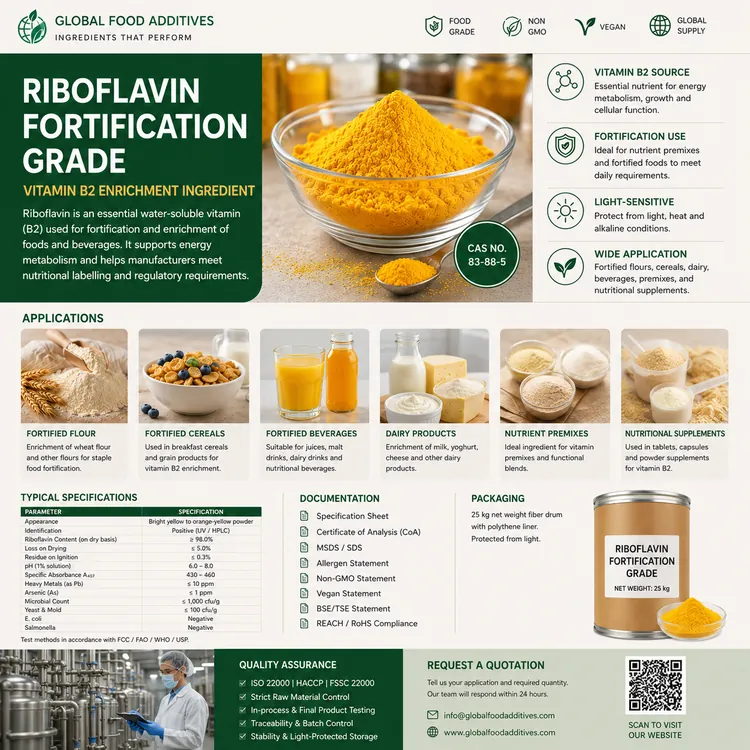
Product identity
| Product | Riboflavin Fortification Grade |
|---|---|
| Common commercial references | Vitamin B2, riboflavin, riboflavin E101, food-grade riboflavin, riboflavin premix grade, riboflavin enrichment ingredient |
| Category | Fortification Nutrients |
| Primary function | Vitamin B2 enrichment ingredient, nutritional premix component, fortification nutrient and label-controlled micronutrient |
| Secondary function | Yellow colour contribution where applicable and technically relevant |
| E / INS number | E101 / INS 101 where applicable; confirm whether the intended use is as nutrient, colour or dual-function ingredient |
| CAS / identity | 83-88-5 |
| Chemical identity | Riboflavin / vitamin B2 |
| Typical appearance | Yellow to orange-yellow crystalline powder, fine powder, beadlet or carrier-based premix depending on grade |
| Typical form | Fine powder, granule, beadlet, premix-ready grade, carrier-diluted grade, water-dispersible preparation or custom vitamin blend |
| Typical use concept | Vitamin B2 restoration, fortification, nutritional claim support, premix standardisation and controlled nutrient delivery in finished foods |
Application fit
Potential use areas may include:
- Fortified flour, enriched wheat flour and bakery premixes
- Breakfast cereals, cereal bars, extruded cereals and granola systems
- Dairy, dairy alternatives, yoghurts, desserts and drinkable dairy products
- Beverages, drink powders, fortified drinks and nutrition beverages
- Infant and medical foods where permitted and specifically approved
- Meal replacements, sports nutrition, wellness powders and protein blends
- Vitamin premixes, mineral-vitamin blends and micronutrient concentrates
- Tablets, capsules, gummies and supplement-style products where applicable
Technical purchasing notes
When reviewing Riboflavin Fortification Grade, compare the supplier specification against the intended fortification target, nutrient claim requirement, processing conditions, target food category, label expectations and local regulations. For industrial purchasing, the most useful inquiry normally includes target assay, chemical form, active content basis, physical form, particle size, premix compatibility, solubility or dispersibility requirement, packaging size, quantity, destination country and required documentation.
Industrial role and fortification performance
Riboflavin Fortification Grade is selected when manufacturers need controlled vitamin B2 contribution in finished products. In industrial enrichment programs, the target is not simply to add riboflavin, but to deliver a verified amount of vitamin B2 at the end of processing and shelf life. This requires accurate assay data, uniform distribution, defined overage, compatibility with other vitamins and minerals, controlled storage, correct packaging and analytical verification. Riboflavin may also influence finished-product colour because of its yellow to orange-yellow appearance.
Nutrient enrichment
Riboflavin is used to enrich foods with vitamin B2 and support nutrition declarations where permitted. Final contribution should be calculated on the finished product basis, considering serving size, process loss, shelf-life degradation and label tolerance.
Premix compatibility
Fortification-grade riboflavin is often used in vitamin premixes with thiamine, niacin, folic acid, vitamin B6, vitamin B12, minerals or carriers. Compatibility should be validated because minerals, humidity and pH can affect nutrient stability.
Assay and overage control
Manufacturers may include overage to ensure the declared vitamin level remains compliant at the end of shelf life. Overage should be justified by stability data, legal limits, customer tolerance and analytical method variability.
Colour contribution
Riboflavin can contribute yellow colour. In some products this is beneficial; in white powders, clear beverages or light dairy systems it may require shade evaluation and careful dosage design.
Grade selection guide
Different Riboflavin Fortification Grade products can behave differently in production. The correct grade should be selected according to assay, nutrient form, particle size, premix dilution, handling equipment, product matrix, light exposure, solubility need and regulatory market.
| Grade or format | Industrial relevance | Purchasing note |
|---|---|---|
| Pure riboflavin powder | High-potency grade used when the buyer can manage micro-dosing, premixing and uniform distribution. | Request assay, particle size, light-protection guidance, bulk density and dust-control information. |
| Premix-ready riboflavin | Designed for vitamin premix manufacturers or food plants requiring better blendability and controlled dilution. | Confirm carrier system, potency, blend uniformity, label declaration and allergen/GMO status. |
| Carrier-diluted grade | Lower-potency blend useful for easier dosing in large dry batches, flour enrichment and cereal premixes. | Request full composition, potency per kilogram, carrier identity and stability data. |
| Fine powder grade | Useful for dry premixes and powders, but may create dusting or electrostatic handling challenges. | Review mesh size, D10/D50/D90, flowability, anti-caking status and operator exposure controls. |
| Granule or agglomerated grade | May improve flowability, reduce dust and support automated dosing or dry-blend handling. | Check granule strength, segregation risk, dissolution behaviour and bulk density. |
| Beadlet or protected grade | Useful for reducing dust, improving handling or protecting potency in selected dry systems. | Request coating composition, release behaviour, heat stability and label implications. |
| Water-dispersible preparation | Relevant for beverages, dairy, sauces or liquid nutrition products where dispersion is more important than powder blending. | Confirm carrier system, pH range, sedimentation behaviour, heat stability and microbial limits. |
| Riboflavin 5 phosphate preparation | May be considered where improved water compatibility is required, depending on supplier grade and market acceptance. | Confirm exact chemical identity, CAS, assay basis, sodium contribution, regulatory status and label declaration. |
Key specification parameters to compare
A professional Riboflavin Fortification Grade offer should include nutrient potency, chemical identity, physical handling data, stability guidance and contaminant controls. Buyers should compare assay, purity, particle size, carrier system, solubility, light stability, microbiology, heavy metals and documentation completeness before approving a commercial grade.
| Parameter | Why it matters | Recommended buyer action |
|---|---|---|
| Assay / potency | Determines vitamin B2 contribution, dosage calculation and finished-product label compliance. | Request assay method, potency basis, specification limits and batch COA value. |
| Chemical form | Riboflavin, phosphate forms, premixes and carrier-diluted grades can have different solubility and label implications. | Confirm exact identity, CAS reference, E/INS reference where relevant and market-specific declaration. |
| Particle size | Influences blend uniformity, segregation, colour specking, dusting and wetting. | Request mesh size, particle-size distribution or supplier range according to the application. |
| Bulk density and flowability | Important for automated dosing, premix production and filling accuracy. | Request tapped and loose bulk density and run line trials where needed. |
| Solubility / dispersibility | Critical for beverages, dairy systems, liquid premixes and products where visible sediment is unacceptable. | Test in the actual pH, process water, mineral system, stabilisers and heat conditions. |
| Light stability | Riboflavin can degrade under ultraviolet and visible light exposure. | Request storage guidance and validate finished product in final packaging under realistic light exposure. |
| Moisture / loss on drying | High moisture can affect caking, flow, potency and premix stability. | Confirm moisture limits, water activity where available and packaging barrier performance. |
| Microbiological quality | Relevant for nutrition powders, infant-style products, medical foods and sensitive customer standards. | Request total plate count, yeast and mould, coliforms, pathogens and customer-specific limits. |
| Heavy metals | Important for food safety, export approval, infant applications and customer compliance. | Request batch values and limits for lead, arsenic, cadmium, mercury and other required elements. |
| Carrier and processing aids | Premix-ready grades may contain carriers, coating agents or processing aids affecting label declaration. | Request full composition, allergen status, GMO status, gluten status and market-specific label wording. |
Application guidance by industry
Flour and bakery enrichment
Riboflavin Fortification Grade can be used in flour enrichment, bakery premixes, bread improver blends and flour-based products where vitamin restoration or enrichment is required. The key technical challenges are micro-dosing accuracy, blend uniformity, flour colour impact, storage stability and regulatory claim compliance.
- Useful target: controlled vitamin B2 contribution in flour and bakery systems.
- Watch point: low dosage can create uniformity challenges in large flour batches.
- RFQ note: provide target vitamin level, flour type, premix dilution and batch size.
Cereals and extruded products
In breakfast cereals, extruded cereals, cereal bars and granola systems, Riboflavin is commonly used through a dry premix or post-process application system. Heat exposure, extrusion conditions, coating syrup, light exposure and packaging should be evaluated for retention.
- Useful target: vitamin enrichment and nutrient-label support.
- Watch point: extrusion heat and retail light exposure can affect retention.
- RFQ note: specify pre-extrusion, post-coating or dry-blend addition.
Dairy and dairy alternatives
Riboflavin may be used in milk drinks, yoghurts, dairy desserts, plant-based beverages and nutrition-style dairy alternatives. Because Riboflavin has yellow colour and light sensitivity, formulators should evaluate package opacity, heat treatment, pH, protein system and shelf-life retention.
- Useful target: vitamin B2 enrichment in dairy or non-dairy products.
- Watch point: transparent packaging can increase light-driven nutrient loss.
- RFQ note: provide pH, heat process, packaging type and target serving-level declaration.
Beverages and drink powders
In fortified drinks, powdered beverages, sports drinks, wellness shots and nutrition beverages, Riboflavin grade selection should focus on dispersibility, sediment, colour impact, pH stability, light protection and flavour compatibility. Clear beverages may require special consideration because standard Riboflavin powder may not dissolve fully.
- Useful target: vitamin B2 declaration and yellow colour contribution where desired.
- Watch point: sediment or colour intensity may be unacceptable in clear products.
- RFQ note: specify ready-to-drink, concentrate or powder application.
Infant and medical foods where permitted
Special-nutrition applications require strict regulatory review, tight specification control, high documentation quality and contaminant verification. Riboflavin use in these categories should only proceed with destination-market approval and customer-specific specification acceptance.
- Useful target: controlled micronutrient delivery in regulated nutrition products.
- Watch point: permitted forms, nutrient ranges and contaminant limits are highly specific.
- RFQ note: provide category, age group, regulatory market and customer specification.
Nutrition powders and premixes
Riboflavin Fortification Grade is widely used in vitamin premixes, protein powders, meal replacements and wellness blends. Premix manufacturers should evaluate carrier compatibility, segregation risk, assay uniformity, humidity sensitivity, packaging barrier and retest schedule.
- Useful target: stable vitamin B2 delivery in dry nutrition systems.
- Watch point: minerals and humidity can affect stability in complex premixes.
- RFQ note: share premix composition, carrier system and target shelf life.
Fortification design and processing notes
Successful riboflavin fortification requires a complete nutrient-delivery plan. The buyer should define the target finished-product level, minimum label level at end of shelf life, analytical tolerance, process loss, expected storage condition and final packaging. For dry systems, blend uniformity and segregation control are critical. For liquid systems, solubility, sedimentation and light exposure are critical. For premixes, compatibility with minerals, other vitamins, carriers, humidity and packaging must be checked.
Dosage calculation
Calculate Riboflavin addition using assay, potency basis, finished-product serving size, expected process loss and desired end-of-shelf-life level. Include overage only when justified and legally acceptable.
Premix dilution
Because Riboflavin may be used at low levels, carrier dilution can improve dosing accuracy and distribution. Common approaches include stepwise premixing, masterbatch blending and verified premix homogeneity.
Light control
Protect raw material, premixes and finished goods from direct sunlight and strong warehouse lighting. Transparent packaging should be evaluated under realistic retail exposure.
Assay verification
Use validated analytical methods to confirm incoming potency and finished-product vitamin levels. Retention testing should include post-process and end-of-shelf-life samples.
Stability and finished-product considerations
| Condition | Potential impact | Factory recommendation |
|---|---|---|
| UV and visible light | Can reduce Riboflavin potency and affect colour contribution over shelf life. | Use light-protective packaging and perform light-exposure shelf-life tests. |
| Humidity | May cause caking, reduced flowability and premix instability. | Use moisture-barrier packaging and control warehouse humidity. |
| Heat processing | Extrusion, baking, pasteurisation or drying can affect retention depending on matrix and exposure. | Measure assay after the complete process rather than relying only on raw-material input. |
| Mineral interaction | Complex vitamin-mineral premixes may show faster degradation due to minerals, pH or moisture. | Run compatibility testing with the full premix composition. |
| pH and formulation matrix | pH, proteins, sugars, stabilisers and salts can affect dispersion and colour visibility. | Test in the actual formula and at the intended use level. |
| Packaging oxygen and headspace | Oxygen, light and moisture together can accelerate quality loss in some systems. | Evaluate barrier packaging, opaque packs, nitrogen flushing or desiccants where relevant. |
Quality, safety and compliance review
For import, customer approval and factory quality management, Riboflavin Fortification Grade should be reviewed as a regulated micronutrient ingredient. Buyers should confirm food-grade status, nutrient identity, assay, purity, permitted form, intended use, E101 or local colour identity where relevant, microbiological quality, heavy metals, residual solvents where applicable, allergen status, GMO status, gluten status, origin, production method, carrier composition and market-specific fortification rules.
Fortification status
Confirm whether vitamin B2 addition is permitted, required or restricted in the destination market and target food category. Some markets define allowed nutrient forms, minimum levels, maximum levels and labelling rules.
Colour versus nutrient use
Riboflavin may be treated differently when used primarily as a colour versus a vitamin. The buyer should define the technical purpose and label declaration before commercial use.
Claim review
Claims such as fortified, enriched, source of vitamin B2, high in vitamin B2, supports energy metabolism or natural colour must be checked against local regulations and substantiated with finished-product data.
Special-nutrition controls
Infant foods, medical foods and regulated nutrition products may require tighter specifications, validated methods, stricter contaminant limits, supplier audits and market-specific approval.
Documents to request
- Product specification or technical data sheet with grade name, chemical form, assay, potency basis and intended use.
- Certificate of analysis for the offered batch or representative lot.
- Safety data sheet with handling, dust-control and storage information.
- Food-grade statement and fortification nutrient declaration.
- E101 / INS 101 or market-specific declaration where relevant to colour or dual-function use.
- Assay method, potency basis, purity, moisture and impurity information.
- Particle size, bulk density, flowability, solubility or dispersibility data where relevant.
- Blend uniformity or premix compatibility data where available.
- Light-stability, storage and shelf-life guidance.
- Heavy metal declaration covering lead, arsenic, cadmium, mercury and other required elements.
- Microbiological specification for nutrition products, infant-style applications and sensitive customer standards.
- Residual solvent or processing aid statement where relevant to the production method.
- Allergen, GMO, gluten, vegan, vegetarian, halal and kosher statements where required.
- Origin statement, manufacturer information, lot traceability and shelf-life information.
- Full composition and carrier declaration if supplied as a premix, beadlet, dispersion or custom preparation.
- Packaging details, pallet configuration, storage conditions and container loading information.
- Market-specific declarations required by the destination country or final customer.
Packaging, storage and logistics
Riboflavin Fortification Grade is typically supplied in sealed food-grade bags, cartons, drums, fibre drums or light-protective containers depending on grade and order size. Packaging should protect the ingredient from direct sunlight, strong warehouse lighting, moisture, odours and contamination. Fine powders require careful dust handling and accurate weighing procedures. Premix-ready or carrier-diluted grades should be stored according to supplier instructions to protect potency and blend uniformity. For export shipments, buyers should confirm shelf-life remaining, palletisation, batch coding, customs documents and whether the product will be repacked, blended or used directly in production.
| Packaging question | Why it matters |
|---|---|
| Is the product pure Riboflavin, premix-ready grade, beadlet, carrier-diluted blend or water-dispersible preparation? | Determines dosage calculation, label declaration, handling method and quality specification. |
| Is the packaging light-protective? | Helps protect assay, colour and shelf-life stability. |
| What is the net weight per bag, drum, carton or container? | Supports batch-size planning, warehouse handling and purchasing comparison. |
| Is the product fine powder, granule or agglomerated grade? | Influences dusting, flowability, blend uniformity and dosing equipment compatibility. |
| What is the shelf life and recommended storage condition? | Important for potency control, stock rotation and customer audit files. |
| Are export and customs documents available before shipment? | Reduces clearance delay and speeds up customer approval. |
Commercial evaluation and cost-in-use
Riboflavin Fortification Grade should be evaluated by cost per delivered nutrient unit, not only by price per kilogram. A higher-purity, better-flowing or premix-ready grade may be more economical if it reduces dosage error, improves uniformity, supports label compliance, reduces dust loss or prevents customer rejection. Buyers should compare assay, potency basis, blendability, stability, documentation speed, regulatory fit, packaging quality, MOQ, lead time and supplier consistency before commercial approval.
Sample approval
Request a representative sample from the same grade and production origin proposed for commercial supply. Test it in the actual formula, process and packaging format.
Premix validation
Evaluate blend uniformity, segregation risk, flowability, assay recovery, dusting and compatibility with carriers, minerals and other vitamins.
Retention testing
For fortification use, verify assay after processing and at the end of shelf life to support label declarations and overage decisions.
Supplier consistency
Review lot-to-lot assay, particle size, colour, documentation speed, minimum order quantity, shelf-life remaining and long-term availability.
How to request this product
Send the product name, intended application, target vitamin B2 level, required grade, assay requirement, potency basis, particle size, premix format, solubility or dispersibility target, processing conditions, packaging exposure, regulatory market, required documentation, annual and first-order quantity, destination country, packaging preference, Incoterms and expected shipment date. If you already purchase Riboflavin Fortification Grade, attach your current specification, certificate of analysis, SDS, dosage level, premix formula, assay target or finished-product benchmark so supplier options can be compared more accurately.
Recommended RFQ checklist
- Product: Riboflavin Fortification Grade / Vitamin B2 / Riboflavin E101 / CAS 83-88-5
- Intended use: vitamin B2 fortification, enrichment, restoration, premix, supplement blend or dual colour-nutrient function
- Application: flour, dairy, beverage, infant food where permitted, medical food where permitted, cereal, bakery, nutrition powder or vitamin premix
- Required form: pure powder, fine powder, granule, beadlet, premix-ready grade, carrier-diluted blend, water-dispersible preparation or custom premix
- Target assay, potency basis and required specification standard
- Required final vitamin level per serving and expected overage strategy
- Processing conditions: pH, heat treatment, extrusion, baking, drying, light exposure, storage temperature and packaging format
- Required documents: TDS, specification, COA, SDS, food-grade statement, assay method, allergen, GMO, halal, kosher, heavy metals and microbiology
- Destination country and target regulatory market
- Quantity for sample, pilot trial and commercial order
- Preferred packaging and pallet configuration
- Delivery term, port, airport or warehouse destination
- Existing approved reference sample, competitor specification or finished-product benchmark if available
Useful answers
What is Riboflavin Fortification Grade used for in food manufacturing?
Riboflavin Fortification Grade is used as a vitamin B2 enrichment ingredient in selected food, beverage and nutrition systems. It is commonly evaluated for fortified flour, cereals, dairy products, beverages, nutrition powders, meal replacements, vitamin premixes, infant foods where permitted and medical foods where permitted.
Is Riboflavin Fortification Grade the same as E101 colour grade?
Riboflavin is associated with E101 when used as a colour, but fortification grade is normally selected for vitamin potency, assay control, premix compatibility, nutrient retention and label-controlled vitamin contribution. The buyer should define whether the intended purpose is nutrient fortification, colour or dual function.
Why is light protection important?
Riboflavin is sensitive to ultraviolet and visible light. Raw material, premixes and finished products should be protected from strong light exposure, especially in transparent packaging or illuminated retail conditions.
Which grade should a manufacturer request?
The buyer should specify whether the project requires pure Riboflavin powder, premix-ready Riboflavin, carrier-diluted grade, beadlet, granule, water-dispersible grade, riboflavin 5 phosphate preparation or custom vitamin premix. Assay, particle size, solubility, light stability, packaging and documentation should be defined.
Can Riboflavin be used in clear beverages?
Standard Riboflavin powder may have practical dispersion or solubility limits in clear beverages. A water-dispersible or alternative preparation may be needed, and clarity, sediment, pH stability, colour impact and light stability should be tested in the final formula.
How should overage be determined?
Overage should be based on processing loss, storage loss, analytical variation, shelf-life target, legal limits and label declaration requirements. Finished-product assay testing is recommended to justify the selected overage.
Can Global Food Additives source Riboflavin Fortification Grade?
Global Food Additives can review sourcing options for Riboflavin Fortification Grade according to target assay, grade, application, required documents, quantity, destination, packaging preference and shipment schedule.
Which documents should be requested?
Buyers commonly request a technical data sheet, specification, certificate of analysis, safety data sheet, food-grade statement, assay method, allergen statement, GMO statement, origin statement, heavy metal declaration, microbiological specification, shelf-life information and packing details.
Is this product permitted in every country?
No. Vitamin fortification, nutrient addition, colour use, maximum levels, label declarations, nutrition claims and use in special-nutrition categories depend on destination-market rules, food category and buyer responsibility. Local regulations should be verified before commercial use.
Tell us which Riboflavin Fortification Grade or vitamin premix ingredient you need.
Send product name, target assay, required grade, application, vitamin target, quantity, destination country, packaging preference, delivery term and document requirements. Our team will review your inquiry and respond from orders@foodgradeadditives.com.
Your message has been received. You will be redirected to the home page.