
Lactic Acid Esters of Mono- and Diglycerides
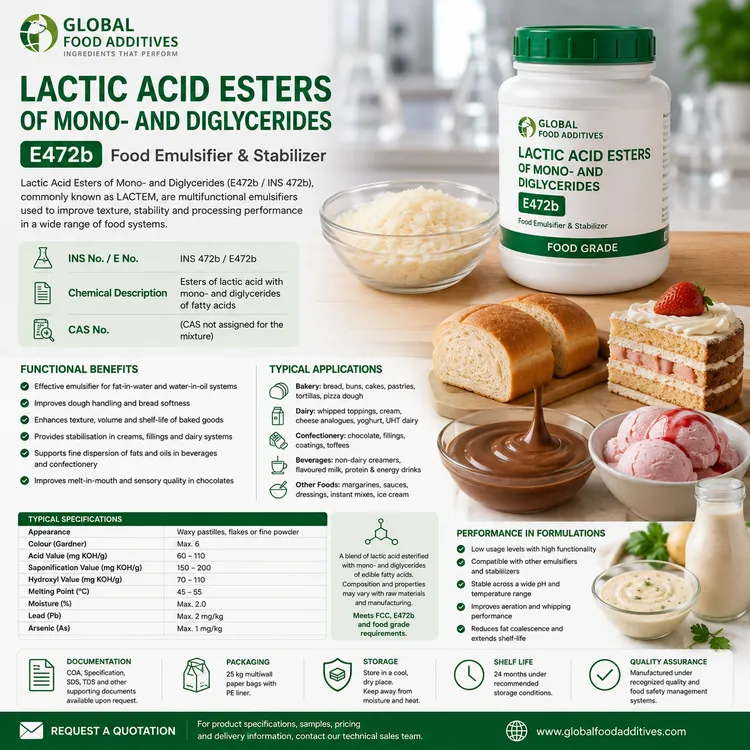
Lactic Acid Esters of Mono- and Diglycerides, commonly known as LACTEM, Lactoglycerides or E472b / INS 472b, is a food-grade surface-active ingredient used by industrial food manufacturers to improve emulsion behaviour, fat dispersion, aeration, texture consistency, processing tolerance and finished-product stability. It is typically evaluated in bakery systems, cake batters, whipped products, edible fat emulsions, dairy and non-dairy formulations, confectionery, beverage preparations, sauces and selected processed foods.
This page is designed for technical buyers, R&D teams, QA departments, regulatory teams and procurement managers who need a more complete basis for sourcing review, supplier comparison, document collection, trial planning and quotation requests.
Product identity
| Product | Lactic Acid Esters of Mono- and Diglycerides |
|---|---|
| Common abbreviation | LACTEM |
| Other names | Lactic and fatty acid esters of glycerol; Lactoglycerides |
| Category | Emulsifiers & Surface Active Ingredients |
| Primary function | Emulsifier / surface-active food ingredient |
| Additional functional roles | Stabilizer, fat-dispersion aid, aeration support and process-tolerance aid depending on formulation |
| E / INS number | E472b / INS 472b |
| CAS / identity | Variable mixture; confirm exact CAS or identity statement on supplier specification |
| Typical form | Powder, bead, flake, paste or liquid grade depending on raw material, fatty acid profile and manufacturing process |
| Solubility / dispersion | Usually oil-dispersible and dispersible in warm aqueous or fat-containing systems; practical incorporation depends on grade and process temperature |
Application fit
Potential use areas may include:
- Industrial bakery, cake mixes, sponge cakes, sweet goods and laminated products
- Margarine, spreads, shortenings, fat blends and water-in-oil or oil-in-water fat emulsions
- Ice cream, frozen desserts, whipped toppings, cream analogues and non-dairy systems
- Beverage systems, instant powders, coffee mixes, emulsified flavour systems and nutritional preparations
- Chocolate, compound coatings, fat-based fillings and confectionery systems where grade suitability is confirmed
- Sauces, dressings, processed foods, batters, coatings and other formulated food matrices
Technical overview
Lactic Acid Esters of Mono- and Diglycerides are produced as a variable mixture of esterified glycerides in which lactic acid groups and fatty acid chains create an amphiphilic structure. This structure gives the ingredient both hydrophilic and lipophilic behaviour, allowing it to locate at oil-water, air-water or fat-solid interfaces. In practical food manufacturing, this can support finer fat dispersion, improved emulsion formation, better processing stability, more uniform texture and controlled interaction with other emulsifiers, proteins, starches, fats and hydrocolloids.
Because E472b is not a single molecule, supplier-to-supplier performance may vary. Important differences may come from the fatty acid source, degree of esterification, mono- and diglyceride composition, free fatty acid level, physical form, melting range, particle size, carrier system and storage history. For this reason, industrial approval should normally include a specification comparison, bench trial, pilot trial and final confirmation under the buyer's actual process conditions.
Functional benefits in food systems
Emulsification and dispersion
Supports the distribution of fat or oil droplets in water-containing systems and helps reduce phase separation when used with the correct process, shear, temperature and stabilizer package.
Aeration and foam structure
Can improve air incorporation and air-cell distribution in selected cake batters, whipped toppings, cream analogues and aerated food systems, especially when combined with proteins or hydrocolloids.
Texture and mouthfeel
Helps control perceived creaminess, crumb uniformity, softness, spreadability, body and finished-product smoothness depending on formulation and dosage.
Process tolerance
May support stability through mixing, homogenisation, heating, cooling, freezing, whipping or reconstitution when the grade is matched to the process conditions.
Application engineering guidance
| Application | Typical technical objective | Review points before approval |
|---|---|---|
| Bakery and cakes | Improved batter aeration, crumb regularity, softness, volume support, fat distribution and eating quality. | Compare with mono- and diglycerides, DATEM, SSL, CSL or lecithin systems. Validate impact on batter specific gravity, oven spring, crumb grain, moisture retention, collapse risk and shelf life. |
| Margarine, spreads and shortenings | Improved emulsion stability, water-phase distribution, spreadability, fat network behaviour and processing consistency. | Check compatibility with fat blend, crystallisation profile, salt level, water phase, preservatives, pH, cooling rate, tempering and packaging conditions. |
| Ice cream and frozen desserts | Support for fat destabilisation, overrun, body, meltdown behaviour, dryness control and creamy mouthfeel. | Validate with stabilizer blend, homogenisation pressure, aging time, freezing conditions, protein system, fat level, total solids and heat treatment. |
| Whipped toppings and cream analogues | Whipping performance, foam stability, fat-protein interface control and consistent texture after storage. | Review melting profile, fat type, protein source, hydrocolloid system, UHT or pasteurisation process and storage temperature. |
| Beverages and instant systems | Emulsion support, cloud stability, oil-soluble flavour dispersion, powder wetting or reconstitution assistance. | Confirm grade suitability for low-viscosity systems. Evaluate pH, ionic strength, heat treatment, homogenisation, sedimentation, creaming, turbidity and flavour release. |
| Confectionery and fat-based fillings | Fat dispersion, viscosity management, smoother texture and processing consistency in selected systems. | Compare with lecithin, PGPR or polyglycerol esters where applicable. Verify compatibility with cocoa solids, sugar particle size, fat phase and tempering conditions. |
| Sauces, dressings and processed foods | Oil dispersion, emulsion body, mouthfeel, heat stability and reduced separation during distribution. | Evaluate acid phase, salt, starch, gums, proteins, shear, pasteurisation, filling temperature and shelf-life conditions. |
Specification and quality-control parameters
For industrial purchasing, the most valuable comparison is not only price per kilogram but also functional strength, batch consistency and documentation quality. Buyers should request supplier specifications that clearly define measurable parameters and accepted limits.
Identity and composition
- Product name, E number and INS number
- Manufacturing route and identity statement
- Fatty acid source and vegetable or animal origin statement where required
- Mono-, di- and triglyceride profile where available
- Degree of esterification or active emulsifier content where specified
- Free glycerol, free fatty acids and residual lactic acid where relevant
Physical properties
- Appearance, colour and odour
- Powder, bead, flake, paste or liquid form
- Particle size or sieve profile for dry grades
- Melting range, softening point or dropping point
- Dispersibility in fat, water or warm processing systems
- Bulk density, flowability and caking behaviour for powders
Chemical limits
- Acid value
- Iodine value where relevant to fatty acid unsaturation
- Saponification value where specified
- Moisture or loss on drying
- Peroxide value where oxidation risk is relevant
- Heavy metals and elemental impurities according to applicable standards
Food safety and microbiology
- Total plate count, yeast and mould where applicable
- Pathogen absence statements according to product form and supplier scope
- Allergen declaration and cross-contact information
- GMO status, irradiation status and nanomaterial statement when required
- Halal, kosher, vegetarian or vegan suitability where commercially relevant
- Food contact packaging compliance and tamper-evident packaging information
Processing and incorporation notes
Processing method strongly affects performance. Depending on the grade, E472b may be pre-blended into a fat phase, dispersed into a warm aqueous phase, dry-blended with powders or incorporated during high-shear mixing. For fat-rich systems, adding the emulsifier to the molten fat phase often improves distribution. For powder blends, particle size, carrier compatibility and anti-caking behaviour should be checked. For beverage or low-viscosity systems, homogenisation conditions and long-term stability testing are especially important.
Recommended trial work often includes hydration or melting behaviour, dispersion time, mixing order, shear sensitivity, heat tolerance, pH stability, freeze-thaw stability, aeration response, viscosity development, phase separation, sensory impact and finished-product shelf life. The optimum use level should be established by the buyer's R&D team because dosage depends on the formulation, local regulation, process conditions and performance target.
Regulatory and labeling review
Lactic Acid Esters of Mono- and Diglycerides is generally discussed under E472b / INS 472b, but market acceptance depends on local food additive regulations, product category, permitted function, maximum level, labeling language and customer-specific standards. Codex, EU, UK, GCC, Turkish, US, Canadian, Latin American, African and Asian market requirements may differ. Buyers should confirm the final regulatory position in the destination country before placing the ingredient into commercial production.
Label declarations may require wording such as the additive class name and additive name or number, depending on jurisdiction. Examples can include “emulsifier: E472b” or a local equivalent. These examples are not a legal labeling recommendation; the final label should be approved by the buyer's regulatory team or local advisor.
Industrial purchasing notes
When reviewing Lactic Acid Esters of Mono- and Diglycerides, compare the supplier specification against the intended food application, process conditions, target function, label expectations, regulatory limits and customer standards. For industrial purchasing, the most useful inquiry normally includes target grade, physical form, application, dosage range if known, packaging size, quantity, destination, delivery term and required documentation.
| Purchasing factor | Why it matters |
|---|---|
| Grade and physical form | Powder, bead, flake, paste and liquid grades may differ in handling, melting, dispersion and process fit. |
| Fatty acid source | Vegetable, palm-based, rapeseed-based, sunflower-based or other feedstock options may affect compliance, customer acceptance and sustainability declarations. |
| Functional strength | A lower-priced grade may require a higher dosage or may underperform in aeration, emulsion stability or texture. |
| Documentation package | Complete technical, safety, regulatory, allergen and origin documents reduce approval delays and customs risk. |
| Packaging and logistics | Bag, carton, drum, pail, pallet type, net weight, storage temperature and shelf life affect warehouse handling and landed cost. |
| Batch consistency | Industrial users should review COA history, manufacturing site consistency and change-control procedures. |
Documents to request
- Product specification or technical data sheet with E / INS number and identity statement
- Certificate of analysis for the offered batch, representative batch or current production lot
- Safety data sheet where applicable
- Food-grade statement and regulatory compliance statement for the destination market
- Origin, manufacturer, production site and change-control information where available
- Shelf-life, recommended storage conditions and transport temperature guidance
- Allergen, GMO, irradiation, nanomaterial and residual solvent statements where required
- Halal, kosher, vegetarian, vegan or religious suitability certificates where commercially required
- Heavy metals, microbiological limits and contaminant statements according to buyer standards
- Label draft, packaging details, pallet configuration and net weight information
- Market-specific declarations requested by the destination country, importer or end customer
- Sample COA, pre-shipment COA and batch traceability documents for approval and repeat orders
How to request this product
Send the product name, E number, target grade or reference specification, application, quantity, destination country, delivery term, packaging preference, expected shipment date and required documents. If you already purchase Lactic Acid Esters of Mono- and Diglycerides, attach or describe your existing specification, label, certificate of analysis or approved supplier grade so alternative supplier options can be compared more accurately.
For faster review, include the following technical details: finished product type, target function, processing temperature, pH, fat level, water activity if relevant, whether the product is dry-blended or added to a liquid/fat phase, required certifications, preferred origin, annual consumption estimate and whether a laboratory sample or commercial batch is needed first.
Useful answers
What is Lactic Acid Esters of Mono- and Diglycerides used for in food manufacturing?
Lactic Acid Esters of Mono- and Diglycerides is typically used as an emulsifier and stabilizing surface-active ingredient. It may support emulsion stability, fat dispersion, aeration, crumb softness, texture uniformity, whipping performance, mouthfeel, chocolate or compound coating flow and processing tolerance. Exact suitability depends on grade, application, process, regulations and supplier documents.
Is E472b the same as LACTEM?
Yes, E472b is commonly associated with Lactic Acid Esters of Mono- and Diglycerides and is also referred to as LACTEM, Lactoglycerides or Lactic and fatty acid esters of glycerol. However, commercial grades may differ in physical form, fatty acid profile, functional strength and documentation package.
Can Global Food Additives source Lactic Acid Esters of Mono- and Diglycerides?
Global Food Additives can review sourcing options for Lactic Acid Esters of Mono- and Diglycerides according to target specification, application, quantity, destination, packaging and required documentation. For accurate comparison, provide your current TDS, COA, grade name or performance target if available.
Which documents should be requested?
Buyers commonly request a technical data sheet, product specification, certificate of analysis, safety data sheet where applicable, food-grade statement, regulatory declaration, origin statement, shelf-life information, allergen statement, GMO statement, halal or kosher certificate where required, label details and packing information.
Is this product permitted in every country?
No. Food additive use depends on destination-market rules, food category, use level, function, label requirements and buyer responsibility. Always verify local regulations and final product compliance before use.
What makes one E472b grade different from another?
Differences may include fatty acid source, ester composition, acid value, iodine value, melting profile, active content, particle size, physical form, carrier system, certifications, origin, packaging and supplier quality system. These differences can affect handling and performance in real production.
Tell us which food additive or ingredient you need.
Send product names, target specifications, quantity, destination country, packaging preference, delivery term and document requirements. For Lactic Acid Esters of Mono- and Diglycerides, please also include the application, desired physical form, current grade if available and required certificates. Our team will review your inquiry and respond from orders@foodgradeadditives.com.
Your message has been received. You will be redirected to the home page.