
Egg Albumen Powder
Egg Albumen Powder, also known as egg white powder or dried egg white, is a food-grade functional protein ingredient used for foaming, whipping, aeration, gelation, water binding, film formation, protein enrichment and clean-label texture design. Industrial grade selection should consider protein content, solubility, whipping performance, foam stability, gel strength, heat treatment, desugaring status, microbiology, Salmonella control, allergen declaration, origin, packaging integrity and destination-market documentation.
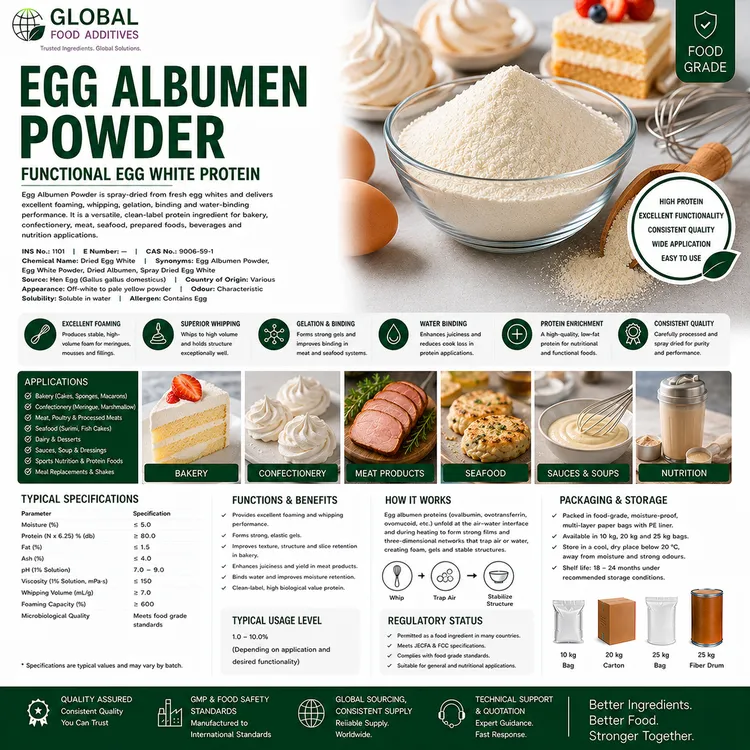
Product identity
| Product | Egg Albumen Powder |
|---|---|
| Common names | Egg white powder, dried egg white, spray-dried egg albumen, albumen powder, functional egg protein |
| Category | Proteins, Texturizers & Functional Ingredients |
| Function | Functional protein, foaming agent, whipping protein, gelling protein, binder, texture-building ingredient and protein enrichment ingredient |
| E / INS number | Not typically managed by E-number as a commodity protein ingredient; confirm by destination market and supplier documentation |
| CAS / identity | Egg protein / dried egg white / egg albumen |
| Allergen status | Contains egg protein; egg allergen declaration is required in many markets |
| Typical composition focus | High protein, low fat, low carbohydrate, controlled moisture and functional egg white protein profile |
| Typical form | Spray-dried powder, instantised powder, granulated powder, high-whip grade, high-gel grade or application-specific functional blend |
| Industrial purchasing basis | Protein, moisture, pH, solubility, foaming capacity, foam stability, gel strength, viscosity, microbiology, Salmonella status, heat treatment, origin and documentation |
Application fit
Egg Albumen Powder is evaluated where manufacturers need a functional protein with strong aeration, heat-set gelation and clean label texture-building performance.
- Bakery products, sponge cakes, angel food cakes, macarons and meringue systems
- Confectionery foams, nougat, marshmallows, aerated fillings and whipped centres
- Meat products, poultry products and seafood systems where permitted
- Surimi, fish cakes, restructured seafood and protein binding systems
- Protein-enriched powders, meal replacements and sports nutrition products
- Glazes, coatings, batters, breadings and surface adhesion systems
- Prepared meals, sauces, soups and texture-standardised industrial foods
- Vegetarian products where egg is acceptable, but not vegan or plant-based formulations
- Clean-label reformulation projects requiring egg-derived protein functionality
Technical overview for food manufacturers
Egg Albumen Powder is produced from egg whites that are separated, filtered, often desugared, pasteurised or heat treated according to supplier process, then dried into a stable powder. It offers many of the functional properties of liquid egg white while improving storage stability, transport efficiency, dosing consistency and plant hygiene. In industrial formulations, egg albumen proteins unfold during whipping, heating or mixing and help create foam structure, elastic gels, water binding, surface films and improved product texture.
Functional value in food systems
Foaming and aeration
Builds foam volume and supports air-cell structure in meringues, sponge cakes, nougat, marshmallows, whipped fillings and aerated desserts.
Heat-set gelation
Forms thermally set protein networks that contribute firmness, sliceability, bite, water retention and structural stability in many processed foods.
Water binding
Improves moisture retention, viscosity and texture consistency in bakery, meat, seafood, prepared foods and protein systems.
Protein enrichment
Provides a high-quality animal protein source for nutrition powders, bakery, bars, meal replacements and high-protein formulations where egg is acceptable.
Grade selection guidance
| Manufacturing need | Grade point to confirm | Why it matters |
|---|---|---|
| Meringue, macarons and sponge cakes | Foaming capacity, foam stability, whipping time, solubility and sugar tolerance | Controls batter aeration, volume, cell structure, cracking, collapse and finished texture. |
| Nougat, marshmallow and aerated confectionery | Whipping performance, foam stability, syrup tolerance, viscosity and heat process compatibility | Supports stable aeration, density control, bite, chew and storage stability. |
| Meat and seafood systems | Gel strength, water binding, salt compatibility, heat-set behaviour and microbial specification | Improves binding, sliceability, cook yield, texture and purge control. |
| Nutrition powders | Protein content, dispersibility, flavour, odour, microbiology and instantisation | Supports protein declaration, consumer mixing, sensory quality and low-clump reconstitution. |
| Glazes and coatings | Film formation, adhesion, browning response, viscosity and surface drying behaviour | Improves coating retention, shine, colour and surface appearance. |
| Export production | Veterinary documents, health certificate, egg-origin statement, allergen label and destination-market approval | Prevents customs delays, relabelling, customer rejection and shipment hold. |
Egg Albumen Powder compared with related proteins
| Ingredient | Typical value | How Egg Albumen Powder differs |
|---|---|---|
| Liquid egg white | Direct egg white functionality with high water content and cold-chain requirements | Powder improves shelf life, storage efficiency, shipping cost, dosing accuracy and dry-blend compatibility. |
| Whole egg powder | Egg flavour, colour, emulsification and fat contribution from yolk | Albumen powder is lower in fat and selected mainly for foam, gel and protein functionality rather than yolk emulsification. |
| Whey protein | Protein enrichment, gelation and nutrition positioning | Egg albumen offers distinctive foaming and heat-set gel properties but carries egg allergen rather than milk allergen. |
| Plant proteins | Vegan or plant-based protein structure and nutrition contribution | Egg albumen is not plant-based; it usually delivers stronger classic foaming and gelation in many bakery and confectionery systems. |
| Hydrocolloids | Water binding, viscosity, gelation and stabilisation | Egg albumen contributes true protein structure, heat-set gel networks and aeration, often working with hydrocolloids rather than replacing them. |
Processing and formulation considerations
- Hydration: allow sufficient hydration time before whipping or heating. Poor hydration can reduce foam volume, gel strength and uniformity.
- Water quality: hard water, minerals, pH and salt level can influence solubility, foam structure and gel formation.
- Whipping conditions: mixer speed, bowl geometry, solids level, sugar addition, temperature and whipping time all affect foam volume and stability.
- Fat contamination: even small amounts of fat or egg yolk residue can reduce foaming performance in sensitive applications.
- Heat treatment: controlled heating can improve microbial safety but may reduce solubility or alter whipping and gel properties if not matched to the application.
- pH and acids: acidity affects protein charge, foam stability, gel strength and coagulation behaviour.
- Salt and sugar: salt can change protein hydration and gel strength; sugar can stabilise foams but also changes viscosity and drying behaviour.
- Microbiological control: finished-product safety depends on supplier heat treatment, water activity, handling, storage and the customer’s process.
- Allergen management: egg is a major allergen in many jurisdictions; cross-contact controls and accurate label declaration are essential.
- Reconstitution ratio: confirm the supplier’s recommended water-to-powder ratio because solids and protein concentration affect performance.
Application-specific technical notes
| Application | Technical value | Trial focus |
|---|---|---|
| Meringue and macarons | Foam formation, air retention, sugar tolerance and stable drying structure | Measure foam volume, density, shell texture, cracking, drying time, collapse and storage humidity sensitivity. |
| Sponge cakes and angel food cakes | Aeration, batter stability, volume and fine crumb structure | Check whipping curve, batter specific gravity, cake height, crumb cell structure, shrinkage and softness. |
| Nougat and marshmallow | Stable aeration, chew, density control and syrup compatibility | Validate foam stability, syrup temperature, final density, water activity, texture and shelf-life chew. |
| Meat and poultry products | Protein binding, water retention, heat-set texture and improved sliceability | Test cook yield, purge, texture, salt level, pH, allergen label and processing temperature. |
| Seafood and surimi systems | Gel support, binding and improved bite in protein matrices | Evaluate gel strength, whiteness, water release, freeze-thaw stability and flavour impact. |
| Protein powders and meal replacements | High-protein declaration, amino acid quality and clean protein positioning | Check dispersibility, foaming during shaking, flavour, odour, microbiology and allergen statement. |
| Glazes and coatings | Film formation, adhesion, browning and surface finish | Test viscosity, sprayability, coating pickup, shine, drying rate, cracking and bakery process tolerance. |
Functional testing plan
Egg Albumen Powder should be evaluated under real plant conditions because foam, gel and texture performance depend on hydration, solids, pH, temperature, sugar, salt, fat, shear, heat process and storage. A useful approval plan compares the current approved material, the new sample and a control formula without egg albumen.
| Test area | Useful measurements | Why it matters |
|---|---|---|
| Foaming performance | Whipping time, foam volume, overrun, foam density and foam stability after standing | Critical for meringues, confectionery foams, sponge cakes and aerated fillings. |
| Gel performance | Gel strength, water release, heat-set temperature, texture profile and sliceability | Important for meat, seafood, prepared foods and protein gels. |
| Hydration and solubility | Dissolution time, lumping, insoluble matter, viscosity and sediment after reconstitution | Determines plant handling, smoothness and consistency in liquid or mixed systems. |
| Heat process tolerance | Coagulation behaviour, viscosity development, moisture loss and texture after heating | Prevents unexpected thickening, curdling or weak structure during baking, cooking or pasteurisation. |
| Sensory quality | Egg odour, sulphur notes, aftertaste, colour, texture and mouthfeel | Especially important in neutral-flavoured nutrition products, desserts and bakery fillings. |
| Shelf-life performance | Foam collapse, syneresis, hardening, staling, moisture migration and flavour change | Confirms that initial plant performance remains acceptable during distribution. |
Quality parameters to compare
Industrial purchasing should compare Egg Albumen Powder by functional performance, microbiological quality and document reliability rather than price per kilogram alone. A lower-cost grade may create higher cost if it whips slowly, has weak gel strength, carries higher microbiological risk, has poor solubility or lacks export documentation.
| Parameter | What to request from supplier |
|---|---|
| Protein content | Specification range, COA result, dry-basis calculation and test method. |
| Moisture | Water content, water activity where available, caking tendency and storage guidance. |
| pH | pH of reconstituted solution and impact on whipping, gelation and finished-product texture. |
| Solubility | Solubility index, hydration time, insoluble matter and recommended reconstitution procedure. |
| Foaming performance | Whip test, foam volume, foam stability, overrun, whipping time and supplier method. |
| Gel strength | Heat-set gel performance, texture data or application guidance for meat, seafood or prepared foods. |
| Microbiology | Total plate count, yeast and mould, coliforms, Enterobacteriaceae, E. coli, Staphylococcus aureus and Salmonella status. |
| Heat treatment | Pasteurisation, dry-heat treatment, desugaring process, process validation or supplier food-safety statement where available. |
| Allergen control | Egg allergen declaration, cross-contact information and cleaning/control statements for other allergens. |
| Residues and contaminants | Heavy metals, veterinary drug residue statement, dioxins/PCBs where required, pesticide statement and destination-specific contaminant data. |
| Certification | Halal, kosher, ISO, FSSC 22000, BRCGS, HACCP, GMP, non-GMO, cage-free or other customer-required certificates where applicable. |
| Packaging | Bag size, inner liner, moisture barrier, oxygen protection, pallet configuration, batch coding, shelf life and storage conditions. |
Regulatory, allergen and labelling review points
Egg Albumen Powder should be reviewed as an egg-derived food ingredient and major allergen source in many markets. It is not normally positioned as a food additive with an E-number, but its use, import documentation, allergen declaration, microbiological limits, veterinary documents and customer claims still require review. Buyers should confirm whether finished-product labels must declare “egg,” “egg white,” “egg albumen,” “dried egg white,” “contains egg” or another market-specific wording.
Allergen declaration
Egg protein must be declared according to the rules of the destination market and customer label policy.
Vegetarian and vegan status
Egg Albumen Powder is not vegan or plant-based. It may fit some vegetarian products if the customer and market accept egg-derived ingredients.
Import documents
Many markets require health certificates, veterinary certificates, origin documents or establishment approval for egg-derived products.
Claims control
Protein, clean-label, cage-free, free-range, non-GMO, halal, kosher or animal-welfare claims must be supported by supplier documents.
Formulation development checklist
- Define the target function: foam, gel, water binding, protein enrichment, coating adhesion, film formation or texture improvement.
- Choose the correct grade: standard, high-whip, high-gel, instantised, granulated, desugared or application-specific.
- Confirm reconstitution ratio, hydration time, water temperature and mixing speed before bench testing.
- Test the powder in the real formula with actual sugar, salt, fat, acids, flavours, fibres, starches and hydrocolloids.
- Measure foaming, gelation, viscosity, texture, water release, sensory quality and processing tolerance.
- Validate microbiological quality, Salmonella status and heat-process compatibility with the plant food-safety plan.
- Check allergen declaration, cleaning controls and cross-contact risk before plant trials.
- Confirm label declaration, import documents, certification and customer policy before commercial approval.
- Approve the supplier only after the specification, COA, functional test results, packaging, price, lead time and logistics meet the project requirement.
Documents to request
- Product specification or technical data sheet with identity, protein content and functional performance guidance
- Certificate of analysis for available batch or representative lot
- Microbiological specification and recent microbiological results, including Salmonella status
- Pasteurisation, dry-heat treatment, desugaring or process statement where available
- Food-grade declaration and intended-use statement for the destination market
- Egg allergen declaration and cross-contact statement
- Origin statement, manufacturer information and egg source statement
- Veterinary certificate, health certificate or sanitary certificate where required for import
- Allergen statement for other allergens, GMO statement, gluten statement and irradiation statement
- Halal and kosher certificates when required by customer or destination market
- Residue, contaminant, heavy metal or dioxin/PCB information where required
- Foaming, whipping, gel strength, solubility or application test data where available
- Shelf-life, storage temperature, humidity control and opened-pack handling guidance
- Packaging details, inner liner, net weight, gross weight, pallet configuration and batch traceability information
- Market-specific regulatory statements, label guidance and customs documents when available
Packaging, storage and logistics
Egg Albumen Powder is normally supplied in food-grade bags, lined paper sacks, polyethylene-lined cartons, fibre drums or other moisture-protective formats. Packaging should protect the powder from moisture, oxygen, odour pickup, caking, contamination and physical damage. Because egg proteins are functional and allergenic, traceability and segregation are important throughout storage and transport.
Moisture protection
Confirm inner liner, water activity, humidity tolerance, pallet wrapping and storage guidance because moisture pickup can cause caking and functional loss.
Allergen segregation
Store and handle as an egg allergen ingredient with clear identification, dedicated controls and cleaning procedures according to the plant allergen plan.
Plant handling
Review bag weight, dusting, flowability, bulk density, manual dosing, pneumatic transfer, hydration step and rework policy before approval.
Export readiness
Request COA, health certificate, origin documents, packing list, batch list, allergen statement and country-specific import documents before shipment.
Commercial sourcing notes
Commercial evaluation should include technical performance, microbial reliability, export documentation and supply continuity. Buyers should compare supplier capacity, egg origin, heat treatment, functional grade, protein specification, microbiological history, packaging options, certification, minimum order quantity, lead time, price validity, Incoterms and document availability. For recurring production, request retained samples, batch-to-batch COA history and a change-notification commitment.
| Purchasing question | Why it matters |
|---|---|
| Is the product high-whip, high-gel, standard or instantised? | Functional grade determines performance in bakery, confectionery, meat, seafood and nutrition systems. |
| What heat treatment was used? | Heat treatment affects microbiology, solubility, whipping, gel strength and customer food-safety approval. |
| Is the product desugared? | Desugaring can affect browning, flavour, shelf life and Maillard reactions in some applications. |
| What microbiological limits apply? | Egg-derived powders require strong microbiological control, especially for ready-to-eat or low-heat applications. |
| What allergen statements are available? | Egg allergen declaration, cross-contact controls and label wording must be approved before commercial use. |
| Which import documents are needed? | Health certificates, veterinary documents, origin statements and establishment approvals can be critical for export shipments. |
How Global Food Additives supports sourcing
Global Food Additives, Inc. supports food manufacturers with practical sourcing coordination for Egg Albumen Powder and other functional proteins, texturizers and clean-label ingredients. Our team can help compare grade options by foaming performance, gel strength, solubility, protein content, microbiology, allergen documentation, packaging, lead time, certification and destination-market requirements. We can also coordinate sample discussions, supplier document review and quotation comparison against your current approved egg white powder or target formulation.
How to request this product
Send the product name, target grade, intended application, required function, current specification if available, microbiological limits, quantity, destination country, packaging preference, expected shipment date and required documents. If you already purchase Egg Albumen Powder, attach your existing specification, certificate of analysis, functional test method, label declaration or benchmark sample details so supplier options can be compared more accurately.
| Best inquiry information | Example details to include |
|---|---|
| Application | Meringue, macarons, sponge cake, nougat, marshmallow, meat product, seafood gel, protein powder, glaze, coating or prepared food. |
| Technical target | Foaming, whipping, foam stability, gel strength, water binding, protein enrichment, solubility, instant dispersibility or texture improvement. |
| Grade preference | Standard, high-whip, high-gel, instantised, granulated, desugared, low microbiology, halal, kosher or supplier-recommended grade. |
| Compliance need | Destination country, egg allergen declaration, health certificate, veterinary certificate, origin statement, halal, kosher or customer-specific policy. |
| Commercial details | Sample quantity, first order quantity, annual volume, Incoterm, delivery date, destination port or country and payment preference. |
| Documentation | Specification, COA, microbiology, Salmonella status, SDS, origin, allergen, GMO, halal, kosher, shelf-life and packaging documents. |
Useful answers
What is Egg Albumen Powder used for in food manufacturing?
Egg Albumen Powder is used for foaming, whipping, aeration, gelation, water binding, film formation, protein enrichment and texture design in bakery, confectionery, meat, seafood, prepared food and nutrition applications.
Is Egg Albumen Powder the same as egg white powder?
Yes. Egg Albumen Powder is commonly called egg white powder or dried egg white. Buyers should still confirm whether the grade is high-whip, high-gel, standard, instantised, granulated or application-specific.
Is Egg Albumen Powder vegan or plant-based?
No. Egg Albumen Powder is derived from egg white and is not vegan or plant-based. It may fit some vegetarian products if egg-derived ingredients are accepted by the customer and destination market.
Does Egg Albumen Powder require allergen declaration?
Yes. Egg is a major allergen in many markets, and finished-product labels normally need clear egg declaration according to local rules.
Which grade should be selected for meringue or confectionery?
High-whip or high-foam-stability grades are usually evaluated first. The final selection should be confirmed through trials with the actual sugar system, syrup solids, pH, mixing equipment and drying or cooking process.
Which documents should be requested?
Buyers commonly request a technical data sheet, certificate of analysis, microbiological results, Salmonella statement, heat-treatment statement, allergen declaration, origin statement, GMO statement, veterinary or health certificate where required, shelf-life, storage and packaging details.
Can Global Food Additives source Egg Albumen Powder?
Global Food Additives can review sourcing options according to target specification, functional grade, application, quantity, destination country, packaging preference and required documentation.
Is this product permitted in every country?
No. Use, import requirements, veterinary documents, allergen declaration, labelling, religious certification and microbiological standards depend on destination-market rules, supplier documentation and buyer responsibility.
Tell us which Egg Albumen Powder grade or functional protein solution you need.
Send product name, target grade, application, required function, quantity, destination country, packaging preference, delivery term and required documents. Our team will review your inquiry and respond from orders@foodgradeadditives.com.
Your message has been received. You will be redirected to the home page.