
Distarch Phosphate
Distarch Phosphate, commonly identified as E1412 / INS 1412, is a crosslinked modified starch used by food manufacturers when native starch does not provide enough resistance to heat, acidity, mechanical shear, pumping, sterilization, retorting, freezing, thawing or long holding times. It is selected for stable viscosity, clean texture, process tolerance, moisture control and consistent finished-product body.
This page is prepared for industrial buyers, R&D teams, QA departments and procurement managers who need a practical starting point for grade comparison, specification review, document collection, supplier qualification and quotation requests.
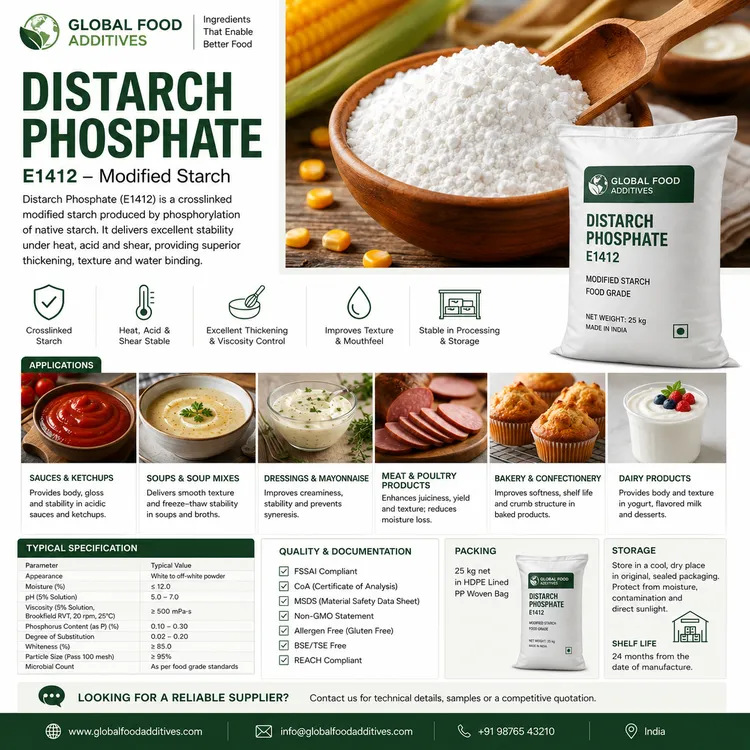
Product identity
| Product | Distarch Phosphate |
|---|---|
| Common identification | E1412 / INS 1412 |
| Category | Modified Starches, Fibres & Bulking Agents |
| Function | Texture, thickening, viscosity, bulking, stabilization and process-tolerance ingredient |
| CAS / identity | Varies by starch source and modification route |
| Typical starch sources | Maize, waxy maize, potato, tapioca, wheat or rice; source must be verified by supplier documents |
| Typical form | Fine powder, granule, agglomerated instant grade, cook-up grade or pregelatinized grade |
| Process role | Improves resistance to breakdown under heat, acid, shear and extended processing conditions |
| Use status | Food additive use depends on destination-market rules, food category and maximum permitted use level |
Application fit
Potential industrial use areas may include:
- Soups, sauces, gravies and culinary bases
- Dressings, mayonnaise-style products and emulsified sauces
- Bakery fillings, fruit preparations and cream fillings
- Meat products, marinades, brines and formed products
- Dairy desserts, puddings, creams and fermented dairy systems
- Frozen foods, ready meals and retorted products
- Powder blends, instant mixes and dry premix systems
Industrial function and technical value
Distarch Phosphate is designed to improve the performance of starch in demanding food systems. Through crosslinking, starch granules become more resistant to excessive swelling and rupture. This helps the product maintain viscosity and texture during heating, mixing, pumping, homogenization, filling, freezing, thawing or sterilization. For manufacturers, the main value is more predictable texture and lower risk of viscosity loss during production.
Key functional benefits
- Heat stability: helps maintain viscosity during pasteurization, cooking, hot filling or retorting.
- Shear resistance: supports texture retention during high-speed mixing, pumping and industrial transfer.
- Acid tolerance: useful in tomato sauces, fruit fillings, dressings and acidic culinary systems.
- Freeze-thaw stability: reduces texture breakdown, water separation and syneresis in frozen foods.
- Moisture control: improves water binding, body and eating quality in processed food matrices.
- Texture consistency: helps standardize viscosity, mouthfeel and product appearance between batches.
Common purchasing objectives
- Replace native starch with a more process-stable option
- Improve viscosity stability in hot-filled or retorted products
- Reduce syneresis in chilled or frozen systems
- Improve texture in sauces, fillings, soups and ready meals
- Support industrial line consistency and reduce batch variation
- Source export-ready documents for customer approval
Application guidance by industry
The best grade depends on the starch source, granule behavior, cooking profile, final viscosity target, process temperature, pH, shear level, solids content, salt level and storage conditions. A cook-up grade may be preferred where full starch gelatinization is available during processing, while a pregelatinized or instant grade may be selected for cold preparation, dry blends or products with limited heating.
Soups, sauces and gravies
Distarch Phosphate is commonly evaluated in culinary systems where the product must remain smooth, stable and viscous after heating, pumping, holding or hot filling. It can support body, cling, mouthfeel and suspension of particulates such as herbs, spices, vegetables or meat pieces.
- Improved viscosity stability under cooking conditions
- Reduced breakdown during shear and pumping
- Better suspension of solids and particulates
- Cleaner texture and more consistent product body
Dressings and acidic systems
In salad dressings, tomato-based sauces, fruit preparations and acidic fillings, crosslinked starch can help maintain viscosity where native starch may thin out. Compatibility with acid, salt, sugar, oil phase, emulsifiers, gums and preservatives should be confirmed by application testing.
- Acid-resistant thickening performance
- Improved emulsion body and texture
- Reduced water separation during storage
- Support for stable spoonable or pourable texture
Bakery fillings and fruit preparations
Bakery fillings often require stability during baking, cooling, freezing, thawing and shelf-life storage. Distarch Phosphate may help control viscosity, reduce boil-out, manage water migration and maintain a smooth filling texture in fruit, cream, custard and savory filling systems.
- Improved bake stability and reduced leakage
- Better freeze-thaw performance in frozen bakery
- Controlled viscosity in fruit and cream fillings
- Reduced syneresis and water migration
Meat products and prepared foods
In processed meat, poultry, seafood and ready-meal systems, modified starch may support water binding, sliceability, juiciness, sauce adhesion and reheating stability. Performance depends on salt level, protein extraction, thermal treatment, mechanical action and final product format.
- Water binding and cooking yield support
- Improved texture and bite in formed products
- Reduced purge in chilled or frozen products
- Better sauce consistency after reheating
Dairy desserts and cream systems
In puddings, creams, dairy desserts and fermented products, selected grades can provide smoothness, viscosity and spoonable texture. Buyers should confirm compatibility with milk proteins, minerals, stabilizers, cultures, pH and heat treatment.
- Smooth body and creamy mouthfeel
- Controlled viscosity after heat treatment
- Reduced syneresis during chilled storage
- Compatibility testing with dairy proteins and stabilizer blends
Frozen foods and ready meals
Frozen meals, sauces and fillings require starch systems that tolerate freeze-thaw cycles without excessive water release or texture collapse. Distarch Phosphate may help maintain sauce body and reduce syneresis after thawing, reheating and consumer preparation.
- Freeze-thaw stability support
- Reduced water separation after thawing
- Stable viscosity after microwave or oven reheating
- Improved texture during distribution and storage
Specification parameters to compare
Distarch Phosphate should not be purchased only by product name. The same additive identity can cover different starch sources, viscosity profiles, particle sizes, cooking behavior and application performance. Industrial buyers should compare the supplier specification with the target process and finished-product requirements.
| Parameter | Why it matters |
|---|---|
| Starch source | Maize, waxy maize, potato, tapioca, wheat and rice starches can produce different clarity, texture, viscosity, flavor neutrality and gelatinization behavior. |
| Moisture content | Affects storage stability, flowability, microbiological risk and dry matter contribution in formulations. |
| pH | Important for compatibility with acidic systems, dairy systems and final product taste profile. |
| Viscosity profile | Critical for matching process requirements, filling behavior, spoonability, pourability and mouthfeel. |
| Gelatinization temperature | Determines when the starch develops viscosity during heating and whether the process provides sufficient activation. |
| Cold-water swelling behavior | Important for instant mixes, dry blends, cold-prepared sauces and products with limited heat treatment. |
| Particle size | Influences dusting, mixing, hydration speed, dispersibility, lump formation and dosing accuracy. |
| Ash and phosphate-related limits | Relevant for regulatory compliance, purity assessment and supplier specification comparison. |
| SO₂ / sulfite status | Important for labeling, allergen-style declarations in some markets and customer acceptance. |
| Microbiological limits | Required for food-grade approval and especially relevant for sensitive applications or low-heat processes. |
| Heavy metals and contaminants | Supports food safety, destination-market compliance and customer quality approval. |
| GMO, allergen and origin status | Important for labeling, regulatory, religious, customer and export requirements. |
Cook-up versus pregelatinized grades
Food manufacturers should confirm whether the required grade is a cook-up starch or a pregelatinized starch. Cook-up grades develop viscosity after heating and are suitable for processes with sufficient temperature and holding time. Pregelatinized or instant grades are designed to hydrate and build viscosity in cold or low-heat systems, but may require specific mixing conditions to prevent lumping or incomplete hydration.
Cook-up grade
- Requires heating to develop viscosity
- Often used in soups, sauces, gravies, fillings and retorted foods
- Can provide strong process stability when properly cooked
- Best for systems with controlled thermal processing
Pregelatinized / instant grade
- Develops viscosity in cold or low-heat systems
- Useful in dry mixes, instant sauces, fillings and convenience foods
- Requires good dispersion to avoid lumping
- May need agglomerated particles for improved handling
Processing and formulation notes
Performance depends strongly on processing sequence. Starch should be dispersed properly before full hydration or gelatinization. Poor dispersion can cause lumping, fisheyes, uneven viscosity and inconsistent finished texture. Salt, sugar, acid, fat, proteins, gums and emulsifiers can all influence hydration and final viscosity, so pilot trials should reflect real production conditions.
Practical handling points
- Disperse starch before viscosity development to reduce lump formation.
- Confirm the correct addition point in the production sequence.
- Match the grade to pH, heat treatment, shear level and final texture target.
- Evaluate interaction with gums, proteins, emulsifiers, salts, sugars and acids.
- Check viscosity immediately after production and again during shelf-life storage.
- Test freeze-thaw, retort, pasteurization or reheating performance when relevant.
Scale-up considerations
- Mixing speed and hydration time
- Heating rate, peak temperature and holding time
- Shear intensity during pumping, homogenization or filling
- pH, salt level, sugar solids and water activity
- Cooling rate and final packaging format
- Frozen, chilled or ambient distribution conditions
Quality, compliance and documentation review
For industrial purchasing, technical approval should be completed before commercial order confirmation. The buyer should compare the technical data sheet, certificate of analysis and regulatory declarations against the intended food category, destination market and customer specification. For export shipments, documentation should also match customs clearance, customer audits and label-review expectations.
Documents to request
- Product specification or technical data sheet
- Certificate of analysis for available batch or lot
- Safety data sheet where applicable
- Food-grade declaration and regulatory status statement
- Origin declaration and manufacturing-country information
- Botanical source declaration, such as maize, potato, tapioca, wheat or rice
- Allergen statement and cross-contact information
- GMO / non-GMO statement where required
- Halal and kosher certificates where required
- Vegan or vegetarian suitability statement where required
- Sulfite / SO₂ statement where required
- Microbiological, heavy metal and contaminant limits
- Shelf-life, storage and transport information
- Label draft, packaging details and pallet configuration
- Market-specific declarations required by the destination country or end customer
Packaging, storage and logistics
Distarch Phosphate is commonly supplied as a dry powder, granule or agglomerated grade. Packaging should protect the product from moisture, contamination, odor transfer and warehouse humidity. Buyers should confirm bag weight, pallet configuration, container loading, shelf life, storage temperature and whether the product requires food-contact inner liners or additional moisture protection.
Storage guidance to confirm
- Store in a cool, dry and clean food-grade warehouse
- Protect from humidity, water ingress and direct sunlight
- Keep bags sealed when not in use
- Prevent odor absorption from strong-smelling materials
- Use first-expired, first-out inventory rotation
Logistics data to request
- Net weight and gross weight per bag or carton
- Bag type, inner liner and pallet dimensions
- Pallet configuration and container loading plan
- HS code suggestion and export document list
- Moisture protection requirements during shipment
Supplier qualification questions
Before approving a new source, purchasing, R&D and QA teams should compare the proposed grade with the existing product specification and run application trials under real process conditions. The best supplier option is not only the lowest price; it is the grade that delivers stable texture, consistent documentation, reliable logistics and repeatable batch quality.
- What is the starch source and country of origin?
- Is the grade cook-up, pregelatinized, instant or agglomerated?
- Which application is the grade designed for?
- What viscosity method is used in the specification?
- What are the moisture, pH, ash, SO₂ and microbiological limits?
- Is the product suitable for acidic, frozen, retorted or high-shear processes?
- Can the supplier provide current COA, TDS, SDS and food-grade declarations?
- Are allergen, GMO, halal, kosher, vegan or sulfite statements available?
- Is the same grade available consistently for repeat orders?
- What is the minimum order quantity, lead time and available packaging?
How to request this product
Send the product name, target grade or reference specification, intended application, process conditions, quantity, destination country, packaging preference, expected shipment date, required certifications and document list. If you already purchase Distarch Phosphate, attach or describe your existing specification, label, certificate of analysis or application target so supplier options can be compared more accurately.
Useful answers
What is Distarch Phosphate used for in food manufacturing?
Distarch Phosphate is used for texture, viscosity control, thickening, stabilization, bulking, moisture control and process stability. It is commonly evaluated in soups, sauces, dressings, bakery fillings, meat products, dairy systems, frozen foods and ready meals.
Why use Distarch Phosphate instead of native starch?
Distarch Phosphate is crosslinked to improve stability under heat, acid and mechanical shear. This helps maintain viscosity and texture where native starch may thin, break down or release water during processing.
Can Global Food Additives source Distarch Phosphate?
Global Food Additives can review sourcing options for Distarch Phosphate according to target specification, application, quantity, destination, packaging and required documentation.
Which applications commonly evaluate this product?
Common applications include soups, sauces, gravies, dressings, bakery fillings, fruit preparations, meat products, dairy desserts, frozen meals, ready meals, instant mixes and dry premix systems.
Which documents should be requested?
Buyers commonly request a technical data sheet, product specification, certificate of analysis, safety data sheet where applicable, origin statement, botanical source declaration, allergen statement, GMO statement, halal or kosher certificate if required, shelf-life information, label details and packaging configuration.
Is this product permitted in every country?
No. Food additive use depends on destination-market rules, food category, use level, label requirements and buyer responsibility. Always verify regulatory status before commercial use.
What information helps prepare a faster quotation?
Share the application, starch source preference, cook-up or instant requirement, target viscosity, process conditions, quantity, destination country, packaging preference, target shipment date, certification requirements and any reference specification or COA currently used.
Tell us which food additive or ingredient you need.
Send product names, target specifications, quantity, destination country, packaging preference, delivery term, and document requirements. Our team will review your inquiry and respond from orders@foodgradeadditives.com.
Your message has been received. You will be redirected to the home page.