
Carmine
Carmine, commonly referenced as E120 / INS 120, is a cochineal-derived red food colour used for pink, red, crimson and purple-red shade development in selected food and beverage systems. For industrial manufacturers, the real purchasing value depends on colour form, carminic acid content, shade strength, pH behaviour, solubility, heat and light stability, label declaration, animal-origin status, regulatory fit, documentation quality and batch-to-batch colour consistency.
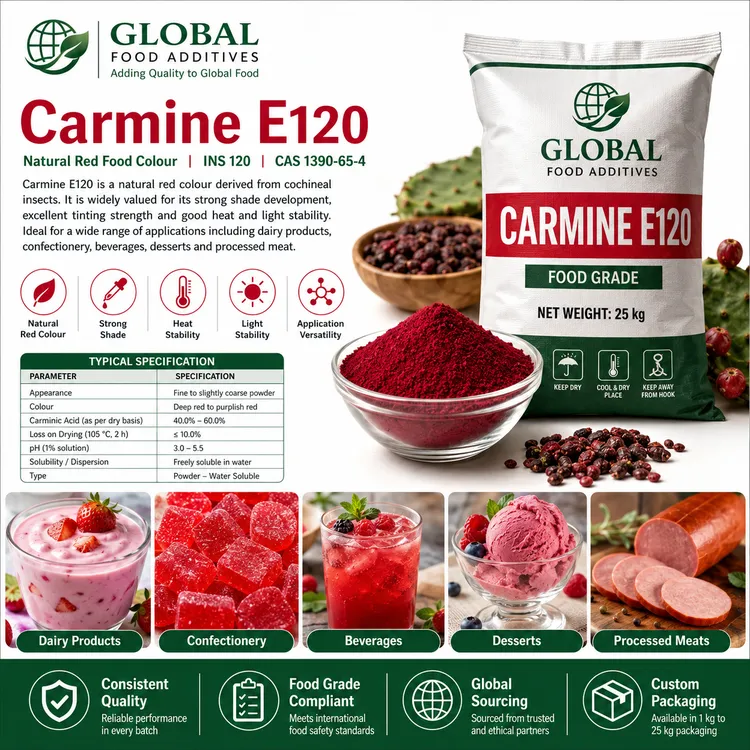
Carmine performance depends on colour form, carminic acid content, pH, protein system, heat process, light exposure, solubility, aluminium/calcium lake chemistry and destination-market colour rules.
Product identity
| Product | Carmine |
|---|---|
| Alternative names | Carmine E120; INS 120; C.I. Natural Red 4; CI 75470; carmine lake; cochineal carmine; carminic acid lake |
| Category | Colours & Colouring Foods |
| Function | Food colour / colouring food / colour standardisation ingredient |
| E / INS number | E120 / INS 120 |
| CAS / identity | 1390-65-4; confirm exact carmine form, carminic acid content and market compliance on supplier COA/SDS |
| Colour principle | Chiefly carminic acid and related cochineal-derived colouring principles depending on grade |
| Origin | Cochineal-derived animal/insect-origin colour; vegan, vegetarian, halal, kosher and allergen-positioning requirements must be verified |
| Typical shade range | Pink, strawberry red, raspberry red, crimson, burgundy, purple-red or blue-red depending on pH, dosage, colour form and matrix |
| Typical form | Powder, carmine lake, liquid solution, dispersion, paste, water-soluble grade, oil-dispersible preparation or colour blend |
| Main technical value | Provides strong red shade, good heat stability in many systems and premium natural-colour positioning where acceptable |
| Key buying point | Compare by carminic acid content, colour strength, shade, solubility, regulatory documentation and cost-in-use, not only by price per kilogram |
Industrial buying value
Carmine is normally evaluated when a manufacturer needs a strong red colour with good stability and a shade that can remain attractive in dairy, confectionery, fruit, meat, beverage or dessert systems. It is often selected where anthocyanins are not stable enough, where synthetic colours are not preferred, or where a specific pink-to-red tone is required. However, because Carmine is cochineal-derived, animal-origin, allergen-related, religious-certification and consumer-labelling issues must be reviewed early in the project.
- Supports vivid pink, red, crimson and purple-red colour standardisation
- Can deliver high tinctorial strength and low dosage in suitable systems
- Often provides better heat and light performance than many plant anthocyanin colours in selected matrices
- Available as water-soluble, lake, dispersion, liquid, powder or customized colour preparation depending on supplier
- Requires careful review of animal origin, allergen declaration, pH behaviour, carminic acid content and local colour regulations
Technical overview
Carmine is a red pigment obtained from cochineal-derived colouring principles, chiefly carminic acid, usually converted into an aluminum or calcium-aluminum lake form. Commercial E120 colour products may be supplied as carmine, cochineal extract, carminic acid preparations, water-soluble solutions, lake powders, oil-dispersible systems or application-specific blends. These forms do not behave identically, so buyers should confirm the exact identity before replacing one grade with another.
For procurement and R&D teams, Carmine should be evaluated as a colour system rather than only a commodity pigment. Shade, solubility, pH response, protein interaction, heat stability, light stability, colour strength and label declaration can change by supplier grade. A grade that performs well in a dairy dessert may not be optimal for a beverage, processed meat system, confectionery coating, fruit preparation or dry mix.
Shade and pH behaviour
Carmine shade is influenced by pH, metal-complex form, matrix composition and dosage. It can deliver pink, red, crimson, burgundy or purple-red tones depending on the system. Shade matching should be performed in the actual finished product, not only in water.
- Low pH systems: evaluate shade shift, solubility, precipitation and clarity before use
- Neutral dairy systems: check protein interaction, heat stability and sediment control
- High-protein systems: verify colour uniformity and interaction with casein, whey, gelatin or plant proteins
- Dry mixes: test reconstitution, shade development, powder uniformity and storage stability
- Lake systems: evaluate particle dispersion, opacity, staining strength and colour release
Stability variables
Carmine can be highly valuable where stable red colour is needed, but performance must be validated under real processing and shelf-life conditions. pH, heat, oxygen, light, water activity and packaging can all influence the final colour.
- Heat exposure during pasteurisation, UHT, cooking, baking or hot-fill
- Light exposure in clear packaging or retail display
- Oxygen exposure, headspace, emulsions and surface area
- Acids, salts, proteins, gums, minerals, preservatives and flavours
- Storage temperature, water activity, fat content and packaging barrier
Application fit
Potential use areas may include the applications below, subject to destination-market rules, approved food categories, use level, animal-origin acceptance, final label declaration and customer policy. These examples are technical formulation contexts, not a universal approval list.
| Application area | Technical reason to evaluate | Buyer / R&D checks |
|---|---|---|
| Dairy desserts and yogurts | Pink, strawberry, raspberry or red-fruit shade with good visual stability in milk-protein systems | pH, protein level, heat treatment, culture process, fruit preparation, light exposure, carmine declaration and animal-origin policy |
| Confectionery | Strong red shade in gummies, jellies, coatings, hard candies, fillings and sugar-based systems | pH, Brix, gel system, cook temperature, drying, colour bleed, carmine lake or soluble form and label requirements |
| Beverages and syrups | Red or pink shade in selected beverage systems where solubility and pH compatibility are suitable | pH, clarity, sediment, light exposure, preservative system, heat process, filtration, bottle type and permitted use |
| Fruit preparations and toppings | Red-fruit colour correction, shade standardisation and visual consistency across fruit batches | Fruit acid, pectin, Brix, heat process, anthocyanin interaction, colour bleed, shelf-life shade drift and declaration |
| Processed meat and seafood analogues | Pink-red or cured-style shade support in selected systems where legally permitted | pH, salt, nitrite/nitrate status where relevant, protein interaction, heat process, light exposure, oxygen, fat content and local rules |
| Sauces, dressings and condiments | Red shade adjustment in tomato-style, spicy, fruit-based or emulsion systems | pH, oil phase, vinegar, salt, gums, starch, preservatives, heat process, emulsion stability and colour migration |
| Bakery decorations and fillings | Red/pink colour in icings, glazes, fillings, toppings and cream systems | Fat system, sugar solids, bake exposure, pH, light, water activity, colour bleed and customer label policy |
| Ice cream and frozen desserts | Stable pink or red-fruit shade through freezing and frozen storage | Fat, protein, overrun, stabilizer blend, freezing profile, light exposure, fruit system, colour fade and animal-origin declaration |
| Dry mixes and powdered products | Powder colour standardisation and red shade development after reconstitution | Particle size, carrier, dry-blend uniformity, reconstitution pH, solubility, sediment and moisture-barrier packaging |
Quality and specification parameters
For industrial purchasing, Carmine should be compared by measurable colour strength, carminic acid content, shade behaviour, purity, safety documentation and regulatory status. A technically suitable grade should deliver the target shade without unacceptable precipitation, sediment, colour drift, off-odour, heavy-metal concerns, microbial risk, allergen-labelling uncertainty or animal-origin documentation gaps.
| Specification area | What to request | Why it matters |
|---|---|---|
| Regulatory identity | E120 / INS 120 confirmation, colour form, CAS number and destination-market compliance note | Prevents confusion between carmine, cochineal extract, carminic acid, synthetic red colours or non-food pigment grades |
| Carminic acid content | Declared carminic acid percentage, assay method and acceptance range | Primary driver of colour strength, cost-in-use and regulatory specification comparison |
| Colour strength | Absorbance method, dilution, wavelength, colour units or application shade panel | Allows accurate dosage comparison between suppliers and batches |
| Shade profile | Colour coordinates, hue information, visual standard or application reference sample | Supports matching of strawberry, raspberry, cherry, meat, confectionery or beverage shades |
| Colour form | Water-soluble, lake, powder, liquid, paste, dispersion, oil-dispersible or custom blend | Determines application route, clarity, opacity, sediment, dispersion and process compatibility |
| pH behaviour | Shade and stability guidance across acidic, neutral and alkaline systems | Critical for beverages, yogurts, sauces, confectionery, fruit preparations and meat systems |
| Solubility / dispersibility | Water solubility, oil dispersibility, particle size, sediment and filtration data where relevant | Important for beverages, syrups, powder blends, coatings and emulsions |
| Heat and light stability | Application data under pasteurisation, UHT, cooking, baking, freezing and retail light exposure | Reduces launch risk and supports process and packaging decisions |
| Aluminium / calcium status | Aluminum, calcium-aluminum lake or mineral information where relevant | Important for carmine lake identity, label review and market-specific aluminium considerations |
| Residual solvents | Ethanol, methanol or other extraction-related solvent data where applicable | Supports food-grade compliance, customer audits and export documentation |
| Animal origin and allergen status | Cochineal origin statement, allergen statement, vegan/vegetarian status and religious certification position | Critical for label review, consumer transparency, halal/kosher review and customer policy |
| Contaminants | Heavy metals, lead, arsenic, cadmium, mercury, pesticide residues and impurity statements | Supports food-grade approval, export compliance and customer audit requirements |
| Microbiology | Total plate count, yeast and mould, coliforms, E. coli, Salmonella and other limits where required | Important for colour preparations, dairy, beverages, desserts and high-care applications |
| Compliance | Food-grade declaration, GMO statement, gluten statement, halal/kosher if required, BSE/TSE and irradiation statements | Reduces regulatory, customer and label-approval delays |
| Traceability | Manufacturer, processor, country of origin, batch number, production date, retest date and shelf life | Enables supplier qualification, recall readiness and audit-trail control |
Formulation and plant-trial checklist
- Target shade: define whether the product needs pink, strawberry red, cherry red, raspberry red, crimson, burgundy or purple-red colour.
- Colour form: confirm whether the application requires cochineal extract, carmine lake, water-soluble carmine, dispersion, powder or custom blend.
- Dosage basis: calculate dosage by carminic acid content, colour strength and finished-product shade target.
- pH testing: evaluate shade and stability at the actual finished-product pH and after expected pH drift during shelf life.
- Heat exposure: test pasteurisation, UHT, cooking, baking, hot-fill or candy cooking conditions where applicable.
- Light exposure: run light-stability tests for clear packaging, refrigerated displays and retail shelf conditions.
- Protein interaction: validate colour uniformity and sediment in dairy, plant-protein, gelatin, meat or seafood systems.
- Dispersion method: test pre-slurry, dry blending, high-shear mixing, filtration and addition sequence.
- Label review: confirm carmine/cochineal declaration, animal origin, allergen-related requirements and customer acceptance before launch.
- Cost-in-use: compare suppliers by finished shade per tonne, dosage, stability, rejects, documentation and landed cost.
Comparison with related red colour options
Carmine is part of a wider red-colour toolbox. The right choice depends on colour target, stability, pH, label strategy, animal-origin acceptance, cost, legal status and consumer expectations.
| Colour option | Typical reason to compare | Industrial note |
|---|---|---|
| Carmine / E120 | Strong pink-red to crimson shade, good stability and low dosage in suitable systems | Cochineal-derived; animal-origin, allergen and label declaration must be reviewed |
| Cochineal extract | Related cochineal-derived colour form with different solubility and strength profile | Not identical to carmine lake; confirm carminic acid content and label wording |
| Anthocyanins / E163 | Plant-derived red, pink or purple shades for acid systems | Often pH-sensitive and may be less heat/light stable in some applications |
| Beetroot red / E162 | Plant-derived pink-red shade for selected low-heat systems | Can be heat- and light-sensitive; earthy flavour and stability must be checked |
| Paprika extract / E160c | Orange-red shade and oil-soluble colour applications | More orange than carmine; may affect flavour and oil phase |
| Lycopene / E160d | Tomato-red shade in selected fat-containing or emulsion systems | Shade and solubility differ; oxidation and dispersion should be tested |
| Allura Red AC / FD&C Red 40 / E129 | Synthetic bright red colour with strong water solubility | Label and regulatory acceptance differ from natural-colour strategies |
| Ponceau 4R / E124 | Synthetic red colour used in some markets and applications | Permitted use and warning-label requirements vary by destination market |
Process integration guidance
Carmine should be added through a controlled colour-standardisation process. The best addition point depends on whether the grade is liquid, powder, lake, dispersion or dry blend. In many products, Carmine is pre-dispersed or pre-dissolved before addition to avoid local colour streaks, specks, sediment or over-colouring.
Liquid and soluble systems
- Pre-dilute where needed to improve metering accuracy and colour distribution
- Check pH, minerals, preservatives, proteins and heat process before final dosage approval
- Evaluate clarity, haze, sediment and bottle-wall staining in beverages and syrups
- Measure colour after final pH adjustment and after thermal processing
- Record colour lot, dosage, pH, heat process and finished-product shade for traceability
Powder, lake and dispersion systems
- Use suitable pre-slurry or high-shear dispersion to avoid specks and uneven colour
- Match particle size and carrier with the host powder where dry blending is used
- Validate colour release after cooking, hydration, freezing or storage
- Check compatibility with fats, oils, emulsifiers, starches, gums and proteins
- Control humidity and light exposure during weighing, blending and packing
Shade development and colour matching workflow
Industrial buyers should request application samples and develop a colour-matching workflow before approving bulk orders. Carmine grades can vary in carminic acid content, shade and dispersibility, so the purchasing specification should include both analytical and visual acceptance criteria.
| Step | Recommended action |
|---|---|
| 1. Define shade target | Set a visual reference, colour coordinates or approved market sample for the finished product |
| 2. Select colour form | Confirm whether carmine lake, cochineal extract, liquid carmine, water-soluble powder or dispersion is technically suitable |
| 3. Calculate dosage | Use carminic acid content and colour strength to compare cost-in-use across suppliers |
| 4. Run process trials | Apply the real heat, pH, mixing, filtration, drying, freezing or filling process used in production |
| 5. Evaluate shelf life | Check colour drift, light fade, sediment, bleeding, flavour impact and packaging interaction through storage |
| 6. Lock specification | Approve carminic acid content, shade tolerance, colour form, declaration wording, documents and batch acceptance limits |
Handling, storage and warehouse control
Carmine should be handled according to the supplier safety data sheet, food-safety plan and local workplace rules. Colour powders should be protected from moisture, light, dusting and cross-contact. Liquid preparations should be protected from contamination, unsuitable temperature, microbial growth and container damage.
| Control point | Recommended buyer action |
|---|---|
| Storage environment | Store in a clean, dry, cool and well-ventilated area according to supplier recommendations |
| Light protection | Protect colour grades from direct sunlight and strong warehouse light where supplier guidance requires |
| Moisture protection | Keep powder grades sealed and protect opened packs from humidity and condensation |
| Container hygiene | Use clean dosing tools, pumps, hoses and vessels to avoid contamination or cross-colour mixing |
| Animal-origin segregation | Segregate according to site policy where vegan, vegetarian, halal, kosher or customer restrictions apply |
| Odour and cross-contact | Store away from odorous, allergenic, volatile or incompatible materials |
| Lot traceability | Record lot number, supplier COA, internal release status and expiry/retest date before use |
| Opened packaging | Define resealing, relabelling, retest and maximum-open-time procedures for each colour grade |
Packaging and logistics options
Packaging depends on supplier standard, colour strength, format and order volume. Common industrial requests include sample bottles, laboratory trial packs, 1-5 kg foil pouches, 5-25 kg cartons, lined drums, fibre drums, HDPE drums or jerrycans for liquid colours, light-protective containers, palletised export packaging and full-container supply. For export projects, buyers should request pallet dimensions, net and gross weight, container type, liner type, batch coding system, shelf life, storage temperature, HS code guidance, document language and shipping marks before confirming the order.
Regulatory, allergen and label diligence
Carmine should be managed as a regulated food colour with special attention to declaration, animal origin and customer suitability. The buyer is responsible for verifying whether E120 / INS 120 is permitted in the destination market, whether the intended food category is covered, the maximum use level, purity criteria, carminic acid content, label wording, allergen-related requirements and customer-specific restrictions.
For international projects, regulatory review should be completed before commercial purchase. A colour grade accepted in one country may require a different declaration, certification package, animal-origin statement or allergen note in another. Buyers should also verify whether the finished product is intended for vegan, vegetarian, halal, kosher, organic, clean-label, school-food, infant-food, pharmaceutical, nutraceutical or export-only channels.
Documents to request
- Product specification or technical data sheet with E120 / INS 120 confirmation and intended applications
- Certificate of analysis for available batch or representative lot
- Safety data sheet where applicable
- Food-grade declaration and market-specific colour-use declaration
- CAS, E-number, colour-form, carminic acid content and cochineal-origin identity statement
- Carminic acid assay method, colour strength, absorbance method, shade data and application guidance
- Solubility, dispersibility, particle size, pH behaviour, heat stability and light stability data where relevant
- Aluminium, calcium-aluminum lake or mineral-content statement where relevant
- Residual solvent statement or test results where extraction solvents are relevant
- Animal-origin declaration, insect/cochineal-origin statement and customer suitability note
- Allergen statement and label declaration guidance for destination-market review
- Vegan/vegetarian, halal, kosher, BSE/TSE, irradiation and nanomaterial statements where required
- GMO statement, gluten statement and cross-contact information
- Origin statement, manufacturer information and traceability declaration
- Shelf-life, retest date and recommended storage conditions
- Heavy metals, lead, arsenic, cadmium, mercury and impurity statements aligned with buyer requirements
- Microbiological specification for liquid, powder or dispersion grades where required
- Label draft, packaging details, pallet configuration and net/gross weight
- Market-specific declarations required by the importing country
How to request this product
Send the product name, target colour form, required carminic acid content, target shade, reference sample or colour coordinates, intended application, quantity, destination country, packaging preference, expected shipment date, delivery term and required documents. If you already purchase Carmine, attach or describe your current specification, label, certificate of analysis, colour strength, carminic acid content, dosage and supplier grade so alternatives can be compared accurately.
For faster technical review, include the finished-product pH, heat process, light exposure, packaging type, protein or fat system, halal/kosher requirements, vegan/vegetarian restrictions, allergen-declaration requirements, destination-market rules, customer compliance requirements and whether trial samples are needed before bulk quotation.
Useful answers
What is Carmine used for in food manufacturing?
Carmine E120 is typically reviewed for pink, red, crimson and purple-red shade development, colour standardisation and visual identity in selected dairy, confectionery, beverage, fruit, sauce, meat, dessert and dry-mix systems. Exact suitability depends on grade, application, process, regulations and supplier documents.
Is Carmine the same as cochineal extract?
No. Carmine and cochineal extract are related cochineal-derived colour forms, but they differ in chemical form, solubility, carminic acid level, shade behaviour and application performance. The exact identity should be confirmed on supplier documentation.
Is Carmine vegan or vegetarian?
Carmine is cochineal-derived and is normally not suitable for vegan positioning. Vegetarian, halal, kosher and customer-specific suitability depends on supplier documentation, certification, destination market and customer policy.
Why does carminic acid content matter?
Carminic acid content is a key driver of colour strength and cost-in-use. Two Carmine grades with different carminic acid levels may require different dosages to reach the same shade.
Which applications commonly evaluate this colour?
Potential applications include dairy desserts, yogurts, confectionery, beverages, syrups, fruit preparations, toppings, processed meat systems, sauces, bakery decorations, ice cream, frozen desserts, dry mixes and powdered products.
Which technical parameters should be compared between suppliers?
Buyers should compare E120 identity, carminic acid content, colour strength, shade, colour form, pH behaviour, solubility, dispersibility, particle size, heat stability, light stability, aluminium/calcium status, residual solvents, microbiology, heavy metals, animal-origin declaration, allergen status, origin, shelf life, packaging and compliance documents.
Can Global Food Additives source Carmine?
Global Food Additives can review sourcing options for Carmine according to target shade, carminic acid content, specification, quantity, destination, packaging, shipment timing and required documentation.
Which documents should be requested?
Buyers commonly request a technical data sheet or specification, certificate of analysis, safety data sheet where applicable, food-grade declaration, E120 confirmation, carminic acid content, cochineal-origin statement, allergen statement, halal/kosher status if required, heavy-metal information, microbiology data, shelf-life information, label details and packing details.
Is this product permitted in every country?
No. Food colour use depends on destination-market rules, food category, approved colour form, use level, purity criteria, label requirements, allergen-related declaration and buyer responsibility. Always verify regulatory status before commercial use.
Tell us which food additive or ingredient you need.
Send product names, target specifications, quantity, destination country, packaging preference, delivery term, and document requirements. Our team will review your inquiry and respond from orders@foodgradeadditives.com.
Your message has been received. You will be redirected to the home page.