
Beta-Apo-8-Carotenal
Beta-Apo-8-Carotenal, identified in many food-colour systems as E160e, is a carotenoid colour ingredient used by industrial food and beverage manufacturers for orange, orange-red, golden-orange and warm fruit shade development. It is especially relevant where a stronger orange-red carotenoid tone is required for fruit, citrus, dairy, confectionery, snack, sauce, spread, plant-based or nutrition-positioned products.
This page is prepared as a technical sourcing reference for purchasing teams, R&D technologists, QA departments, regulatory teams and import managers who need to compare Beta-Apo-8-Carotenal assay, source route, colour strength, grade form, solubility behaviour, stability, documentation, packaging and supplier suitability before quotation or approval.
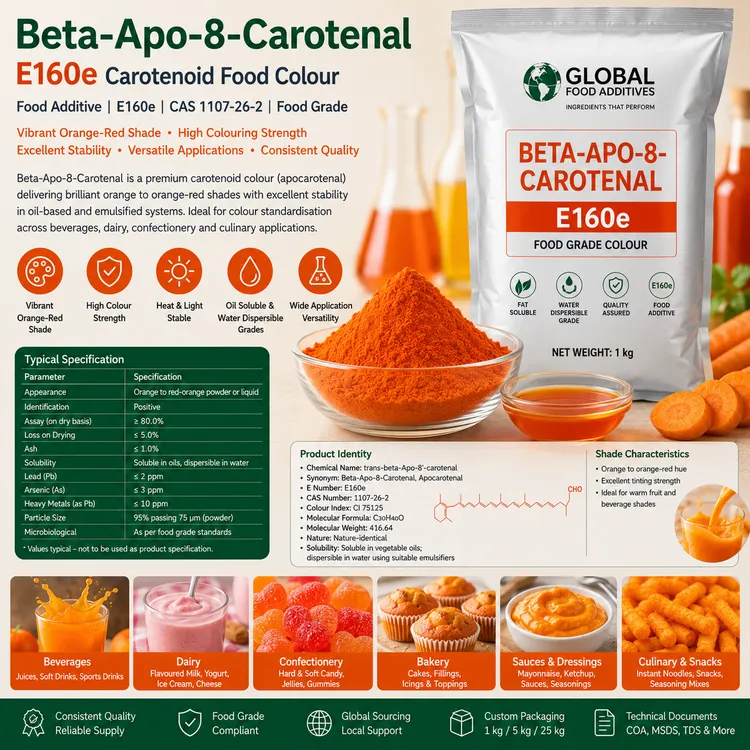
Product identity
| Product | Beta-Apo-8-Carotenal |
|---|---|
| Common names | Beta apo 8 carotenal, β-apo-8-carotenal, apocarotenal, trans-beta-apo-8'-carotenal, E160e, C.I. Food Orange 6 |
| Category | Colours & Colouring Foods |
| Function | Food colour / carotenoid colour / colour standardisation ingredient / orange-red shade development ingredient |
| E / INS number | E160e |
| CAS / identity | 1107-26-2 |
| Chemical family | Apocarotenoid / carotenoid aldehyde pigment |
| Typical colour range | Golden orange, deep orange, orange-red and warm fruit shades depending on grade, dosage and matrix |
| Typical form | Oil-soluble concentrate, water-dispersible powder, beadlet, emulsion, suspension, liquid dispersion or custom colour blend |
| Typical grade focus | Food grade, beverage grade, confectionery grade, dairy grade, oil-soluble grade, water-dispersible grade, emulsion grade or destination-market compliant grade |
Application fit
Beta-Apo-8-Carotenal is evaluated where a warm orange-red colour, carotenoid identity and strong visual standardisation are required. Suitability depends on source route, grade form, phase compatibility, carrier system, light exposure, oxygen exposure, heat process, pH, emulsification, packaging and destination-market classification.
- Beverages, beverage emulsions, syrups, drink bases and powdered drinks
- Confectionery, gummies, jellies, hard candy, coatings and fruit snacks
- Dairy desserts, yogurts, ice cream, frozen desserts and fruit preparations
- Sauces, dressings, condiments, marinades and culinary colour systems
- Snacks, seasonings, extruded products, crackers and savoury coatings
- Bakery fillings, icings, creams, toppings and decorative applications
- Margarine, spreads, fats, cheese-style products and plant-based dairy alternatives
- Nutrition products, cereals, bars, vitamin premixes and fortified foods where permitted
Technical function in food systems
Beta-Apo-8-Carotenal provides colour through its carotenoid pigment structure. In industrial food systems it can deliver orange, orange-red and warm golden shades commonly associated with citrus, apricot, peach, mango, carrot, cheese, savoury seasoning and tropical fruit profiles. It may be used as a stand-alone colour or blended with other permitted colours to adjust warmth, hue, opacity and shade intensity.
Pure carotenoid pigments are normally more compatible with oil phases than water phases. For aqueous products, suppliers typically provide water-dispersible beadlets, powders or emulsions designed to disperse in beverages, dairy desserts, sauces and dry mixes. This makes grade selection critical: an oil-soluble grade may not perform in a clear or low-fat beverage, while an emulsion or powder grade may require testing for carrier impact, turbidity, ring formation, sediment or specking.
Key functional properties
- Orange-red shade development: Provides golden orange, deep orange and orange-red shades depending on concentration and matrix.
- Carotenoid identity: Supports colour programs where formulators prefer carotenoid-based orange colour systems.
- Colour standardisation: Helps reduce visual variation in products affected by raw material, process or seasonal changes.
- Oil-phase performance: Oil-soluble grades are useful in fats, oils, spreads, flavour oils and lipid-based colour systems.
- Water-dispersible options: Emulsified or encapsulated grades can be evaluated in beverages, desserts, dry mixes and aqueous systems.
- Blend flexibility: Can be combined with beta-carotene, annatto, paprika, lutein, curcumin, caramel or other colours where permitted.
- Warm shade correction: Useful when a formula needs a deeper orange-red tone than lighter yellow carotenoid systems.
Process variables to control
- Oil-soluble, water-dispersible, beadlet, emulsion or powder grade selection
- Beta-Apo-8-Carotenal assay, colour strength and target shade
- Oxygen exposure during blending, filling, storage and distribution
- Light exposure and packaging barrier performance
- Heat process, pasteurization, hot-fill, baking, frying, UHT or retort exposure
- pH, acidity, minerals, proteins, sugars, salts and fat level
- Emulsifier system, droplet size, turbidity and sediment risk in beverages
- Interaction with antioxidants, preservatives, vitamins, flavours and other colours
Grade selection and formulation guidance
For industrial purchasing and R&D work, Beta-Apo-8-Carotenal should be selected by application phase, colour strength, source route, carrier system and stability requirement. Two products may both be labelled Beta-Apo-8-Carotenal E160e but perform very differently because one may be an oil-soluble concentrate, another a water-dispersible powder, another an emulsion and another a beadlet designed for dry premixes. Supplier comparison should therefore include both documents and real application trials.
Oil-soluble grades
- Typically selected for fats, oils, spreads, margarines, flavour oils, seasoning oils and fat-based colour systems.
- Require proper dissolution or dispersion into the lipid phase before final mixing.
- Can provide strong orange-red colour in products where the colour is carried by oil or fat.
- Should be evaluated for oxidative stability, flavour neutrality, dosage accuracy and colour carry-through.
- Packaging should protect against oxygen, light and heat where possible.
Water-dispersible grades
- Designed for beverages, desserts, sauces, confectionery, dry mixes and other aqueous systems.
- May contain carriers, emulsifiers, antioxidants or encapsulation systems that affect label and stability.
- Require testing for clarity, turbidity, ring formation, sediment, specking, foam and colour uniformity.
- Powder grades should be checked for dusting, caking, dissolution speed and dry-blend uniformity.
- Finished products should be tested after processing and during shelf-life storage.
Industrial formulation guidance
Beta-Apo-8-Carotenal should be evaluated in the real product matrix because the same dosage can create different visual results in clear beverages, cloudy drinks, dairy systems, fat spreads, bakery fillings, snacks and dry mixes. Background colour, opacity, fat content, emulsification, acidity and processing all change the final appearance. Where a precise brand shade is required, manufacturers should use colour standards, retained samples or instrumental colour measurements during development and release.
Recommended use evaluation
- Define the target shade using a physical colour standard, retained sample, L*a*b* value or approved product image.
- Confirm whether the buyer requires E160e, apocarotenal, Beta-Apo-8-Carotenal, a specific source route or a specific supplier grade.
- Test the colour in the finished product matrix, not only in oil or water dilution.
- Measure shade before and after heat treatment, filling, cooling, drying, freezing or storage.
- Evaluate colour fade, ring formation, haze, sediment, specking, flavour impact and packaging compatibility.
- Review interaction with antioxidants, emulsifiers, acidity, proteins, minerals and other colours.
- Confirm local label declaration and permitted use before commercial launch.
Common processing risks
- Wrong phase selection: Oil-soluble grades may not disperse properly in water-based systems without suitable emulsification.
- Oxidative colour loss: Oxygen, light, heat and poor packaging can reduce colour intensity over shelf life.
- Ring formation: Beverage emulsions may develop colour rings if emulsion stability is not adequate.
- Sediment or specks: Poorly dispersed powders can create particles or uneven colour distribution.
- Flavour impact: High colour dosage or certain carrier systems may affect delicate flavour profiles.
- Label mismatch: Source route, carrier, emulsifier and antioxidant components can change ingredient declaration.
- Supplier switching: Differences in assay, droplet size, carrier and colour strength can require formula adjustment.
Application-specific value
Beta-Apo-8-Carotenal is used across food categories where a stable orange-red colour and carotenoid identity are important. It may be compared with beta-carotene, annatto, paprika extract, lutein, curcumin, caramel, safflower, riboflavin, turmeric, marigold extract or custom colour blends. The best choice depends on shade target, phase compatibility, label strategy, regulatory status, process stability and cost-in-use.
Beverages and drink systems
- Water-dispersible Beta-Apo-8-Carotenal grades can support orange, orange-red and tropical-fruit shades in beverages and drink bases.
- Useful in orange, mango, peach, apricot, carrot, vitamin drink and functional beverage concepts.
- Requires testing for turbidity, sediment, ring formation, pH compatibility, heat process and package light exposure.
- Finished products should be evaluated after pasteurization, hot fill, cold fill and shelf-life storage.
Dairy desserts and plant-based alternatives
- Provides creamy orange, golden and orange-red shades in yogurts, desserts, ice cream, custards and dairy alternatives.
- Can support mango, peach, apricot, orange, carrot, cheese-style and tropical flavour positioning.
- Requires compatibility testing with proteins, minerals, stabilizers, emulsifiers, fat systems and freezing conditions.
- Finished products should be checked for colour migration, shade drift, oxidative fade and sensory impact.
Confectionery, bakery and snacks
- Supports warm orange-red colours in gummies, hard candy, icings, fillings, coatings, biscuits and snack seasonings.
- Powder or beadlet grades can be useful for dry premixes and controlled distribution.
- Heat exposure, water activity, fat content and colour bleed should be validated in the real product.
- Snack applications should be checked for light exposure, oxidation, seasoning-oil compatibility and packaging stability.
Fats, spreads and savoury systems
- Oil-soluble grades can be used in spreads, margarine, fats, oils, cheese-style products and savoury colour systems where permitted.
- Useful for cheese-like, egg-like, butter-like, spicy or golden savoury visual profiles.
- Requires proper oil-phase dissolution and protection from oxidation.
- Finished products should be evaluated for colour uniformity, oxidative stability, flavour neutrality and label compliance.
Typical specification points to review
For industrial purchasing, the most useful comparison is not only price per kilogram. Beta-Apo-8-Carotenal grades may differ in active assay, colour strength, source route, carrier, droplet size, water dispersibility, oil solubility, stability system, particle size, microbiological quality, residual solvents and documentation package. Buyers should request the supplier’s actual specification and certificate of analysis before approval.
Technical parameters
| Assay | Key purchasing parameter; confirm Beta-Apo-8-Carotenal active content, basis and test method. |
|---|---|
| Colour strength | Important for dosage, shade matching and cost-in-use comparison. |
| Identification | Confirm E160e, Beta-Apo-8-Carotenal identity and CAS 1107-26-2 alignment with specification. |
| Source route | Confirm supplier-defined manufacturing route and whether market-specific source declarations are required. |
| Isomer profile | Trans and cis profile may be relevant for selected specifications and stability comparisons. |
| Form | Oil-soluble concentrate, emulsion, beadlet, water-dispersible powder, suspension or custom blend. |
| Carrier system | Powder and emulsion grades may include carriers, emulsifiers, antioxidants or stabilizers that affect label declaration. |
| Solubility / dispersibility | Critical for oil systems, beverages, dry mixes, confectionery and uniform colour distribution. |
| Particle size / droplet size | Affects beverage turbidity, stability, specking, sedimentation and dry-blend behaviour. |
| Peroxide value | Relevant for oil-based grades and oxidation-sensitive colour preparations. |
| Moisture | Important for powder flowability, caking risk and shelf life. |
| Residual solvents | Request where applicable by manufacturing route, grade type or customer specification. |
| Heavy metals | Should comply with food-grade and destination-market limits. |
| Microbiology | Review total plate count, yeast and mold, coliforms, Salmonella and other pathogens according to buyer requirement. |
Commercial parameters
| Packaging | Liquid grades may be supplied in bottles, jerrycans, drums or IBCs; powder grades may be supplied in bags, cartons, tins or drums. |
|---|---|
| Net weight | Confirm available pack sizes according to supplier, concentration, form and destination logistics. |
| Palletization | Confirm pallet type, wrapping, stack height, container load and protection from heat, moisture, oxygen and light. |
| Shelf life | Confirm from supplier documents; depends on assay, form, carrier, antioxidants, packaging and storage conditions. |
| Storage | Store tightly closed in a clean, dry, cool and protected area away from heat, direct light, oxygen exposure and strong odours. |
| Handling | Use clean dosing tools, avoid cross-colour contamination and follow the supplier safety data sheet for dust or concentrate handling. |
| MOQ | Depends on supplier, grade, assay, packaging format, stock position and shipment route. |
| Lead time | Depends on production schedule, colour standardisation, quality release, documentation, inspection and freight route. |
| Cost-in-use | Compare active assay, delivered colour strength, stability and dosage efficiency rather than kilogram price alone. |
Quality, food safety and compliance notes
Beta-Apo-8-Carotenal for food manufacturing should be purchased only with clear food-grade documentation, source-route information, traceability and regulatory support. The buyer should verify whether the material is classified as a colour additive, food colour, colouring food or carotenoid preparation in the destination market. Where the product is used for export, private label, child-focused foods, natural-colour claims or fortification positioning, regulatory confirmation should be completed before commercial use.
QA team checklist
- Confirm product name, E/INS number, CAS number, source route and food-grade status.
- Check whether the grade is oil-soluble, water-dispersible, beadlet, emulsion, powder, suspension or blend.
- Compare supplier specification with internal purchasing and application requirements.
- Review actual batch COA before shipment or release.
- Confirm assay, colour strength, carrier system, dispersibility, moisture and microbiological limits.
- Verify allergen, GMO, halal, kosher, vegan or other buyer-required statements where applicable.
- Review residual solvents, heavy metals and contaminant declarations where required.
- Check production date, expiry date, batch number, label information and packaging integrity.
- Conduct incoming QC and application trials before changing supplier, grade, dosage or source route.
Regulatory review points
- Destination-market permission for Beta-Apo-8-Carotenal / E160e in the relevant food category
- Classification as colour, colouring food, carotenoid ingredient or colour preparation depending on grade and market
- Maximum permitted use level, quantum satis principle or customer-specific limit where applicable
- Finished-product label declaration as Beta-Apo-8-Carotenal, apocarotenal, E160e, colour or local required name
- Source-route declaration rules and natural-colour claim acceptability where relevant
- Carrier, emulsifier, antioxidant, solvent or standardising ingredient declaration rules
- Use in special nutrition, infant foods, child-focused foods or restricted categories where relevant
- Import documentation, customs description and local registration requirements
Documents to request
A complete Beta-Apo-8-Carotenal inquiry should include both technical and commercial document requirements. This helps reduce delays during supplier qualification, sample approval, customer audits, customs clearance, colour matching and first production trials.
Core documents
- Product specification or technical data sheet
- Certificate of analysis for available batch or representative lot
- Safety data sheet where applicable
- Food-grade statement or regulatory compliance declaration
- Statement confirming Beta-Apo-8-Carotenal / E160e / CAS 1107-26-2 identity where applicable
- Source route, manufacturing route and grade-form statement where available
- Assay, colour strength or active-content declaration
- Origin statement and manufacturer information where available
- Shelf-life and recommended storage conditions
- Product label, packaging details and pallet configuration
Optional buyer-specific documents
- Halal certificate, kosher certificate or other market-specific certification
- Allergen statement and cross-contamination declaration
- GMO status declaration
- Vegan or vegetarian suitability statement where required
- Natural-origin or source-route statement where relevant and supported by documentation
- Heavy metal statement or contaminant declaration
- Residual solvent or manufacturing-route statement where applicable
- Carrier, emulsifier, antioxidant or processing-aid statement where applicable
- Country-specific import, customs or registration documents
How to request this product
Send the product name, target shade, required form, assay or colour strength, application, quantity, destination country, packaging preference, delivery term, expected shipment date and required documents. If you already purchase Beta-Apo-8-Carotenal, attach or describe your existing specification, label, certificate of analysis, colour standard, target dosage, source-route requirement and finished-product process so supplier options can be compared more accurately.
Information that improves quotation accuracy
- Target application and finished-product type
- Required shade: golden orange, orange, orange-red, citrus, peach, apricot, mango, carrot, cheese-like or savoury orange
- Required classification: E160e, Beta-Apo-8-Carotenal, apocarotenal, carotenoid colour or customer-specific colour declaration
- Required form: oil-soluble concentrate, water-dispersible powder, beadlet, emulsion, liquid dispersion or custom blend
- Required assay, colour value, source-route statement, carrier restrictions or reference specification
- Product pH, fat content, heat process, packaging type and expected shelf life
- Current Beta-Apo-8-Carotenal grade, dosage or reference COA
- Required annual volume and first-order quantity
- Preferred packaging size and pallet requirement
- Destination port, warehouse or delivery city
- Required Incoterms such as EXW, FOB, CFR, CIF or DAP
- Required certificates and destination-market declarations
- Sample quantity and expected approval timeline
Supplier comparison criteria
- Food-grade documentation completeness
- Assay, colour strength and shade consistency between batches
- Source-route identity and traceability
- Application performance in the buyer’s real product matrix
- Clear regulatory classification and label support for the destination market
- Solubility, dispersibility, low specking and emulsion stability where required
- Microbiological and contaminant control
- Packaging protection against heat, oxygen, light and moisture
- Batch traceability and shelf-life remaining at shipment
- Total landed cost and performance cost-in-use
Useful answers
What is Beta-Apo-8-Carotenal used for in food manufacturing?
Beta-Apo-8-Carotenal E160e is used as a carotenoid food colour for orange, orange-red, golden-orange and warm fruit shade development in selected beverages, confectionery, dairy desserts, sauces, snacks, bakery fillings, spreads, plant-based foods and nutrition products.
Is Beta-Apo-8-Carotenal the same as apocarotenal?
Yes. In supplier and regulatory documentation, Beta-Apo-8-Carotenal may also be referred to as apocarotenal or trans-beta-apo-8'-carotenal. Buyers should confirm exact identity, E160e reference, CAS number and supplier specification.
Is Beta-Apo-8-Carotenal water soluble?
Pure carotenoid pigments are generally more compatible with oil phases, but water-dispersible powders, beadlets and emulsions are available for beverage and aqueous systems. The correct grade depends on clarity, turbidity, pH, heat process, carrier restrictions and shelf-life target.
How is Beta-Apo-8-Carotenal different from Beta-Carotene?
Both are carotenoid colour ingredients, but Beta-Apo-8-Carotenal is typically selected for deeper orange to orange-red shade development. The best choice depends on target hue, product phase, colour strength, label expectations, regulatory status and stability requirements.
Which technical parameters should be checked before purchasing?
Buyers should compare assay, colour strength, shade, identity, isomer profile where specified, source route, carrier system, solubility or dispersibility, emulsion stability, particle or droplet size, moisture, peroxide value for oil-based grades, microbiological limits, heavy metals, residual solvents where applicable, packaging type, shelf life and destination-market compliance.
Can Global Food Additives source Beta-Apo-8-Carotenal?
Global Food Additives can review sourcing options for Beta-Apo-8-Carotenal according to target specification, shade, assay, form, application, quantity, destination, packaging preference, delivery term and required documentation.
Which documents should be requested?
Buyers commonly request a technical data sheet, product specification, certificate of analysis, safety data sheet where applicable, food-grade statement, origin statement, source-route declaration, allergen or GMO declaration where required, shelf-life information, label details and packing configuration.
Is this product permitted in every country?
No. Use depends on destination-market rules, food category, use level, colour classification, source route, carrier system, label requirements and buyer responsibility. The buyer should confirm local regulations and customer standards before commercial use.
What should be tested during factory trials?
Factory trials should evaluate shade match, colour strength, dissolution or dispersion, emulsion stability, ring formation, sediment, specking, heat stability, light stability, oxygen sensitivity, flavour impact, packaging compatibility, storage colour drift and compatibility with other colours or functional ingredients.
Tell us which food additive or ingredient you need.
Send product names, target specifications, quantity, destination country, packaging preference, delivery term, and document requirements. Our team will review your inquiry and respond from orders@foodgradeadditives.com.
Your message has been received. You will be redirected to the home page.